Permanent Central-Local Fiscal Council to Launch... First Meeting Possible as Early as August
Legal Basis Established for Permanent “Central-Local Fiscal Strategy Council”
Aimed at Addressing Regional Extinction and Structural Crises
A permanent consultative body, in which the central government and all local governments join forces to address structural crises such as regional extinction and polarization as well as to improve fiscal efficiency, is set to be launched as early as August. The “Central-Local Fiscal Council,” which held its kickoff meeting in February, will be elevated to a permanent institution and begin full-scale operations.
According to the Ministry of Planning and Budget on June 16, the government has pre-announced legislation to revise parts of the Enforcement Decree of the National Fiscal Act, which will establish the “Central-Local Fiscal Strategy Council” with the Minister of Planning and Budget as its chair. This move aims to strengthen cooperation between the central and local governments in establishing mid- to long-term national development strategies and fiscal policies. The government intends to provide strong fiscal support for “local-led growth” and balanced regional development, which are key national policy objectives.
Lineup Completed after the June 3 Local Elections and Minister’s Inauguration... Push to Shorten Legislative Notice Period

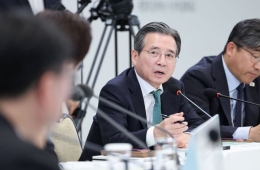
Park Hong-geun, Minister of the Office for Planning and Budget, speaking at the expanded executive meeting on the 12th. Office for Planning and Budget. Photo by Yonhap News.
View original imageThis move to make the council permanent marks the legal fruition of the blueprint that became visible after the first “kickoff (preliminary)” meeting, chaired by the Vice Minister of Planning and Budget, in February. At the time, the council functioned as a temporary forum, but since then, the government has worked to establish a stable institutional framework for regular meetings. In particular, following the June 3 local elections, the lineup of governors and mayors nationwide has been newly organized, and with Park Honggeun’s inauguration as Minister of Planning and Budget, all key decision-makers at the central and local levels have been confirmed, creating the optimal timing for launching a permanent consultative body.
To expedite implementation of the amendment, the ministry has requested the Ministry of Government Legislation to shorten the legislative notice period. Normally, the legislative notice period is 40 days under the Administrative Procedures Act (for this amendment, public opinion will be gathered until July 6), but since the issue does not require in-depth reviews such as regulatory or gender impact assessments, it is highly likely to pass quickly. The ministry expects that if the relevant procedures proceed smoothly, the first official meeting can be held as early as August.
Direct Meetings Between the Minister and Governors/Mayors... Discussion of Regional Priorities such as Semiconductor Plants

According to the legislative notice, the Minister of Planning and Budget will serve as chair of the Central-Local Fiscal Strategy Council. The council’s main discussions will be led by vice ministers of central administrative agencies and all special city mayors, metropolitan city mayors, and provincial governors nationwide. Once the council is fully operational, major regional economic growth strategies aimed at locally-led development, in addition to responses to regional extinction, are expected to be placed on the table. Hot-button issues in the industrial sector, such as the construction and attraction of advanced semiconductor plants, may also be discussed. In this way, major priority projects and various petitions that local governments request of the central government are likely to become formal agenda items.
Since the establishment of the Ministry of Planning and Budget, there has not been a formal, government-wide consultative body for exclusive discussions with local governments regarding local finance and mid- to long-term strategies. As a result, working-level staff have faced significant difficulties coordinating these matters. The creation of this permanent council reflects the necessity for a dedicated body to avoid overlapping discussions with other organizations and to facilitate in-depth deliberations focused solely on “mid- to long-term fiscal strategies” and “regional growth.”
Both fiscal authorities and local governments expect that this new council will be a win-win solution for both the central and local governments. For the ministry, it provides an official channel to directly assess the rationality of budget allocations by collecting input directly from the regions. For local governments, a ministerial-level hotline will be opened, allowing them to secure essential national funding for regional development in a timely manner.
Hot Picks Today
 Securities Firms Reverse Course as KOSPI Falls Below 7,000... More Downgrade Reports Than Upgrades in July
- Turned on the Air Conditioner All Night and Woke Up with a Sore Throat... It's Not Just a Cold [Kok! Health]
- “Senior, Are We Having the ‘Lunch Gathering’ There Today?” Even the Manager Nods... Fierce Competition Returns to Buffets After 10 Years [Why&Next]
- "Spiders Crawling Across Faces While Sleeping"... Naju Apartment Complex Plagued by Spider Infestation
- Even Without Overdue Card Payments... Everyday Habits That Lower Office Workers' Credit Ratings
A government official stated, “This will go beyond a simple forum for collecting opinions; it will become a practical mechanism for expanding local fiscal autonomy and jointly overcoming national structural crises.”
© The Asia Business Daily. All rights reserved. Unauthorized AI training and use prohibited.



![[Breaking] Coupang Apologizes for Incheon Logistics Center Fire…“Will Fully Cooperate With Authorities’ Investigation”](https://cwcontent.asiae.co.kr/asiaresize/307/2026071820375349810_1784374673.jpg)