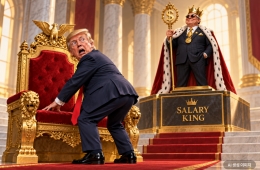
[New York Stock Exchange] Ceasefire MOU Signed Electronically... Dow Closes at Record High
SpaceX Soars for Second Consecutive Session
On June 15 (local time), the three major U.S. stock indices on the New York Stock Exchange all closed higher following news that the United States and Iran had completed electronic signatures on a memorandum of understanding (MOU) for ending the war. The Dow Jones index reached a new record high.
At the New York Stock Exchange (NYSE), the Dow Jones Industrial Average closed at 51,671.03, up 468.77 points (0.92%) from the previous session. The S&P 500 index, which focuses on large-cap stocks, rose by 122.83 points (1.65%) to 7,544.29, while the technology-heavy Nasdaq index jumped by 795.09 points (3.07%) to 26,683.94.

On this day, Vice President J.D. Vance stated in an interview that the electronic signing of the war-ending MOU between the United States and Iran, announced on June 14, had been completed. The White House also confirmed during a briefing that U.S. President Donald Trump, Vice President Vance, and Mohammad Bagher Ghalibaf, Iran’s chief negotiator for the U.S. talks, participated in the electronic signing. Separately, a signing ceremony is scheduled for June 19 in Geneva, Switzerland, with Vice President Vance and Chairman Ghalibaf in attendance.
Meanwhile, President Trump announced his approval for the reopening of the Strait of Hormuz. Vice President Vance also said in an interview with CNBC that he expects the Strait of Hormuz to "remain open for an extended period without tolls." However, Iran stated that the United States had agreed to the new navigation system for the Strait of Hormuz.
International oil prices plummeted. On the New York Mercantile Exchange, West Texas Intermediate (WTI) crude for July delivery fell 4.03% from the previous session to close at $81.48 per barrel. On the ICE Futures Exchange, Brent crude for August delivery dropped 4.10% to $83.74 per barrel.
Bryan Mulberry, chief market strategist at Jacks Investment Management, commented, "It will take a bit more time for prices of refined products like jet fuel to decline," but added, "Crude oil prices falling to $80 per barrel is a strong signal that the Federal Open Market Committee (FOMC) may not need to raise rates and that inflationary pressures are likely to ease relatively quickly."
As uncertainty in the Middle East subsides and oil prices fall, oil swap traders now believe the likelihood of a rate hike by December has decreased. The market expects the Federal Reserve to keep the benchmark interest rate within the 3.5–3.75% range while monitoring the impact of energy price shocks from the war on the broader economy.
Chris Larkin of E*Trade at Morgan Stanley stated, "The Fed will not cut rates," adding, "The June FOMC will be an opportunity to gauge how new Chair Kevin Warsh will steer monetary policy."
![[New York Stock Exchange] Ceasefire MOU Signed Electronically... Dow Closes at Record High](http://www.asiae.co.kr/news/img_view.htm?img=2026052215280074197_1779431279.png)
SpaceX also surged for the second consecutive session, boosting investor sentiment. SpaceX soared more than 19% from the previous session. Chief market strategist Mulberry noted, "The market seems to be moving much more orderly than expected," and analyzed, "This stock is not a fleeting trend but is actually held in many portfolios, and it’s not typically subject to short-term trading."
NVIDIA closed up 3.54% at $212.45 compared to the previous session. On this day, NVIDIA announced the issuance of $25 billion in corporate bonds, structured into seven tranches with maturities ranging from 2 to 30 years. It is reported that demand was more than three times higher than expected, prompting the company to increase the issuance size from the previously planned $20 billion.
Strategists led by Michael Wilson at Morgan Stanley analyzed that the U.S. stock market could gain additional upward momentum from shifts in capital toward cyclical sectors that underperformed during the war period. Mislav Matejka of JPMorgan Chase forecast that if geopolitical tensions ease and corporate earnings and inflation remain stable, investing in cyclical stocks will remain a successful strategy through the end of the year.
Hot Picks Today
 "Don't Say 'Americano' Anymore" After the Uproar... Now a Surge in 'Patriotic Spending' Sweeps Canada
- "114-Year-Old Mother Who Loves Bread Porridge; Eldest Daughter Is 94"… Japan’s Centenarian Population Surpasses 100,000
- "Weight Dropped Rapidly... Anyone Can Get It Easily": Why a Woman in Her 20s Quit Mountzaro After Losing 6kg in a Month
- [Breaking] Seoul City Buses to Strike from First Departure Tomorrow as Labor Talks Fail
- 'Pronounced Dead,' Now Boiling Again... Chinese Millennials and Gen Z Seek 'Premium Ramen'
Angelo Kourkafas of Edward Jones said, "Easing geopolitical tensions can help alleviate inflationary pressures and lower bond yields, and potentially foster a shift of capital into cyclical sectors and previously underperforming areas of the market."
© The Asia Business Daily. All rights reserved. Unauthorized AI training and use prohibited.