Yu Hongjun Proposes "Comprehensive Hospital for Cultural Heritage" and Expanded Eurasian Conservation Science Cooperation
Presentation as Northeast Asia's Representative at Mongolian Museum Directors Forum
Promoting Joint Research on Silk Road Artifacts and Cooperation in Remote Diagnosis
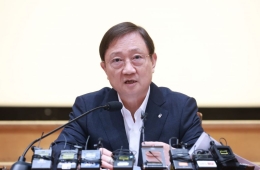
Yoo Hongjun, Director of the National Museum of Korea, attended the Eurasian Museum Directors Forum held in Mongolia, where he proposed expanding cooperation in conservation science for cultural heritage.

Yoo Hongjun, Director of the National Museum of Korea, during an interview with local media. National Museum of Korea
View original imageOn June 15, the National Museum of Korea announced that Director Yoo participated in the "1st Eurasian Museum Directors Forum," hosted by the National Chinggis Khaan Museum of Mongolia, as the representative of national museums from Northeast Asia. This forum was attended by museum directors from over 40 institutions across 20 Eurasian countries.
The forum was organized to establish a platform for exchange among Eurasian museums and to expand joint research and networks. The theme was "Eurasian Exchanges: Gateways to the Future and Multilateral Cooperation." The opening ceremony was attended by Mongolian President Khurelsukh, followed by keynote presentations, breakout sessions, and discussions.
Director Yoo gave a presentation titled "Development and Cooperation in Conservation Science for Cultural Heritage Based on the Conservation Science Center." He introduced the Conservation Science Center of the National Museum of Korea, which opened last year, describing it as a "comprehensive hospital for cultural heritage," where specialists in fields such as metal, ceramics, painting, textiles, stone, and murals use advanced equipment to restore damaged artifacts. The Conservation Science Center is a three-story facility with a total area of 9,000 square meters.
Director Yoo suggested the future direction of conservation science, including virtual digital conservation treatment, data-driven digital analysis, and smart remote diagnostic systems. He envisions that as remote diagnostic systems become more advanced, it will enable real-time, multilateral technical cooperation for conserving cultural heritage across Eurasian countries, overcoming physical distance.
The National Museum of Korea highlighted its international stature at the forum, citing its collection of 2.5 million artifacts and 6.5 million annual visitors last year. The museum expressed its intention to build a technological cooperation infrastructure for the scientific conservation and restoration of Eurasian cultural heritage, aiming to expand its role as a hub of technological diplomacy for cultural heritage.
Hot Picks Today
 "'Samsung Electronics Preferred Shares' Bought on Margin, 130 Million Won in Dividends Alone... 2 Billion Won Windfall for Teacher Couple Born in 1993"
- [Exclusive] Prostitution Near Elementary Schools for 18 Years... Police Seize Even the Beds
- Their Life Savings of 1.5 Billion Won Nearly Lost in an Instant... Police Prevent Voice Phishing Scam Targeting Elderly Couple in Their 80s
- 254 Dead but "Index Case Still Unknown" as Ebola Outbreak Reaches Record Severity
- Fully Shielded with Hat and Mask: Chinese Woman Develops Rash While Trying to Avoid UV Rays
Director Yoo stated, "With this forum presentation as a starting point, we will strengthen network foundations with major museums in Central Asia and Europe, and expand multilateral human and technological exchanges for joint research on Silk Road artifacts."
© The Asia Business Daily(www.asiae.co.kr). All rights reserved.