"We Admit Some Fault, But..."—Election Commission Voices Frustration Over Ballot Paper Shortage
Staff Cite "Crushing Workload and Lack of Manpower"
Overseas Trips and Lax Discipline Controversy Reignites
Search and Seizure Concluded...Investigation Expands to Leadership

On May 28, a day before the early voting for the June 3 local elections, election staff are conducting a mock voting session to check the equipment at the early voting station set up in the main auditorium of Nam-gu Office in Ulsan. Photo by Yonhap News Agency
View original imageWithin the National Election Commission, voices of self-criticism and frustration are erupting over the ballot paper shortage incident that occurred during the June 3 local elections. Among the staff, there are claims that "the root cause is a small workforce and a crushing workload," with some asserting that "one person was responsible for managing over 100 polling stations." As calls for a comprehensive review of the election management system and demands for institutional reform are mounting internally, criticism from the outside is intensifying over lax discipline and poor management, amplifying the fallout.
"We admit our fault, but..."—Laments From Within the Election Commission
Recently, the internal anonymous message board "Staff Communication Space" has seen a flood of posts from employees discussing the causes of the incident. One staff member, referred to as A, wrote, "Even if we acknowledge that the Election Commission made mistakes, we need to make it known that the election system is currently overloaded," arguing, "The fundamental reason is the overwhelming workload and insufficient manpower."
Another staff member, B, questioned, "When one person manages more than 100 polling stations, if there are simultaneous notifications about paper shortages, could any one person handle them all alone?"

In fact, at the Songpa District Election Commission in Seoul, where the ballot paper shortage occurred, it is reported that out of 13 staff members, only 3 to 4 were responsible for managing 146 polling stations and preparing for ballot counting at the same time. The Election Commission explained that this structure made it difficult to respond quickly to emergencies.
"Crushing Workload and Lack of Manpower Are the Causes"
Even more direct internal criticism followed. Staff member C, in a post titled "Confession," stated, "This incident in Songpa District and other commissions did not happen because staff were incompetent or irresponsible, but rather, it was an accident waiting to happen somewhere, sometime—it just happened to occur here this time by bad luck."
They continued, "Whether early voting is abolished, reduced to a single day, ballots are counted immediately at polling stations, counting is held after 9 a.m. on the day after the election, posters and publicity banners are eliminated, or election management is legally transferred as a core responsibility to local governments—whatever the reform, it should be done. We must honestly admit that we can no longer do what is beyond our capacity, and that the commission has exceeded its limits."
They also argued, "Frankly, it's strange that incidents haven't happened sooner. The workload suddenly becomes overwhelming at certain times. How long are we supposed to continue working in such a precarious, nerve-wracking way, constantly anxious and on edge?"

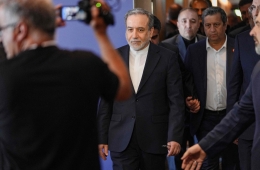
Noh Taeak, Chairman of the National Election Commission, is leaving the press room after publicly apologizing for the ballot paper shortage incident and expressing his resignation at the National Election Commission in Gwacheon, Gyeonggi Province on the 5th. Photo by Yonhap News Agency
View original imageStaff member D also said, "Even now, we need to publicly admit our lack of capacity to manage early voting and promptly communicate to the National Assembly, as an organization, the opinion that early voting should be abolished. It is clear that all of these problems stem from early voting."
They added, "The most important point is that early voting has become a pillar of election fraud conspiracy theories. Combined with the public's disappointment over poorly managed elections, the harsh criticism from radical conspiracy theorists is gaining strength like wildfire."
Controversy Over Lax Discipline...Overseas Business Trips Revisited
Despite these internal appeals, public sentiment remains cold. In addition to controversies over performance bonuses and leaves of absence, even overseas business trip cases are being revisited, fueling the spread of criticism.
According to the report released by the Election Commission on the observation trip for the Maldives presidential election, five staff members visited the country for nine days and seven nights in September 2023 to observe campaign activities, voting and ballot counting, and official banquets. The report explained, "Due to the island setting, most campaign activities took place along the coast and at sea using various facilities," and included relevant photos.

Photo from the Maldives presidential election observation report by the Central Election Commission in October 2023. Photo by the Central Election Commission
View original imageOnline, criticism poured in, with comments such as, "The total number of voters in the Maldives is smaller than Anyang City in Gyeonggi Province—what kind of exchange required a nine-day trip?" and "How can tax money be spent like that?"
It was also revealed that, ahead of the 2024 general elections, there were 33 overseas business trips conducted over the course of a year. Many of these trips, including to Switzerland and Spain, were carried out under the pretext of "enhancing election reliability." However, given that even basic management of domestic elections was lacking, criticism has only grown more intense.
End of the Search and Seizure...Key Issue Is Proving 'Intentionality'
The investigation is also in full swing. The joint investigation team of the police and prosecution looking into the June 3 local election ballot paper shortage has finished its search and seizure of the National Election Commission's servers and has begun analysis.
The investigation team has secured internal messenger records and approval logs, focusing on how the decision was made to print fewer ballot papers than the number of registered voters. Once the analysis is complete, they plan to summon district-level election commission staff as witnesses. The investigation may then expand to include former Chairperson Notaeak and former Secretary-General Heo Cheolhun.
Hot Picks Today
!["What's the Use of a Crowded Incheon Airport?" No Cash Bonanza... Suffering at '8,987 Won per Passenger' Leads to Lawsuit Worth 100 Billion Won [Why&Next]](https://cwcontent.asiae.co.kr/asiaresize/93/2026012017013498705_1768896094.jpg) "What's the Use of a Crowded Incheon Airport?" No Cash Bonanza... Suffering at '8,987 Won per Passenger' Leads to Lawsuit Worth 100 Billion Won [Why&Next]
"What's the Use of a Crowded Incheon Airport?" No Cash Bonanza... Suffering at '8,987 Won per Passenger' Leads to Lawsuit Worth 100 Billion Won [Why&Next]
- Already Expensive..."I Eat Two Eggs Every Morning—This Is Too Much": Early Heatwave Sparks Egg Price Fears
- [Breaking] 'Record High' Exports Up 60.4% by the 20th of This Month... Semiconductors Surge 188.4%
- Couple of the Same Age... Amorepacific Third Generation Daughter Seo Hojeong Holds Private Wedding at Shilla Hotel
- Foods That Make Your Face Look Worse, According to a Plastic Surgeon... What Ranked Above Ham and Ramen?
The central issue is proving "intentionality." Under the Public Official Election Act, charges such as election interference or dereliction of duty under criminal law are difficult to establish based on negligence alone. The investigation hinges on whether there was prior awareness of the problem but it was ignored, or whether any undue interference occurred. Legal experts suggest that, due to the vast amount of electronic data and the difficulty of proving intent, the investigation could be prolonged.
© The Asia Business Daily(www.asiae.co.kr). All rights reserved.