US-Iran Ceasefire MOU Imminent... Last-Minute Tussle Over Nuclear Dismantlement and Sanctions Relief
Ghalibaf Urges U.S. to Fully Implement Agreement
Permanent End to Hostilities... U.S. Troop Withdrawal from Areas Surrounding Iran
Iran to Renounce Nuclear Weapons Indefinitely
As the signing of a memorandum of understanding (MOU) to end hostilities between the United States and Iran is imminent, Mohammad Bagher Ghalibaf, Speaker of the Iranian Parliament and the chief Iranian negotiator, has pressured the United States to fully implement the provisional agreement.

On the 12th (local time), Speaker Ghalibaf stated on social media platform X (formerly Twitter), "A promise once made must be kept," stressing, "No preconditions, exceptions, or excuses can be tolerated."
He added, "There is no other way forward for an agreement on the verge of being finalized," and warned, "You will reap what you sow." This is interpreted as a warning to the United States not to introduce additional conditions at the last minute or delay the implementation of the agreement.
Previously, Shehbaz Sharif, the Prime Minister of Pakistan who served as mediator in the US-Iran negotiations, announced, "We have reached a final agreed-upon text," and added, "We are working closely with both the United States and Iran to take follow-up actions." Iranian Foreign Minister Abbas Araghchi also expressed optimism, stating, "We are closer than ever to the 'Islamabad Memorandum of Understanding.'"
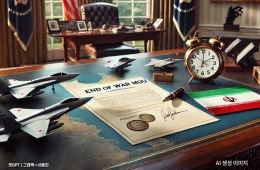
The draft ceasefire MOU, consisting of 14 articles and released by Iran's state-run Mehr News Agency, contains comprehensive provisions covering military, security, economic, and nuclear negotiations. In the military section, the draft stipulates an immediate and permanent cessation of hostilities on all fronts, including Lebanon, non-interference in Iran’s domestic affairs and respect for sovereignty, complete lifting of the U.S. maritime blockade against Iran within 30 days, and withdrawal of U.S. troops from regions surrounding Iran.
In the economic section, the draft calls for the resumption of passage through the Strait of Hormuz within 30 days in response to Iran’s actions, the suspension of sanctions on oil, petrochemical products, and derivatives, and guarantees Iran’s full access to its financial assets. It also includes a plan for the United States and its allies to propose a reconstruction plan for Iran worth at least 300 billion dollars (approximately 450 trillion won).
Regarding the nuclear issue, the parties agreed to hold technical negotiations for a final agreement within the next 60 days. The agenda includes all aspects of the Iranian nuclear issue, the first and second rounds of U.S. sanctions, UN Security Council resolutions, and International Atomic Energy Agency (IAEA) Board of Governors resolutions. Iran reaffirmed its commitment not to manufacture nuclear weapons during this period, while the United States agreed to halt additional troop deployments and the imposition of new sanctions in the Middle East during the negotiations.
U.S.: "Iran to Renounce Nuclear Weapons Indefinitely"
However, the contents of the MOU publicly released by the Donald Trump administration are far more stringent than the Iranian draft. A senior official from the Trump administration stated at a briefing that the MOU includes the complete dismantlement of Iran’s nuclear program, closure of nuclear facilities, disposal and export of nuclear materials, and a codified pledge that Iran will not develop or possess nuclear weapons indefinitely. The United States plans to provide phased economic compensation depending on the level of implementation.
According to the U.S. explanation, the dismantlement of nuclear facilities and disposal of nuclear materials will be verified through an international inspection and verification system. Each time verification is completed, economic compensation such as the release of overseas frozen assets and the easing of sanctions on crude oil exports will be provided sequentially.
The senior official described this as a "performance-based deal," emphasizing that "the structure is based on actions and verification, not on trust."
The MOU also includes the immediate reopening of the Strait of Hormuz and the lifting of the U.S. maritime blockade linked to this. Furthermore, it contains provisions for a 'comprehensive peace agreement' in the Middle East, including Israel and Hezbollah, the pro-Iranian militant group in Lebanon.
Notably, Iran has agreed to halt financial support for pro-Iranian armed groups, including Hezbollah. However, the United States warned that if Iran fails to fulfill its obligations, the possibility of an Israeli military response remains open.
Hot Picks Today
!["Is the War Finally Over?" Will KOSPI Head Straight for 10,000?... 'This' Will Decide [Weekend Money]](https://cwcontent.asiae.co.kr/asiaresize/93/2026060105231082726_1780258989.jpg) "Is the War Finally Over?" Will KOSPI Head Straight for 10,000?... 'This' Will Decide [Weekend Money]
"Is the War Finally Over?" Will KOSPI Head Straight for 10,000?... 'This' Will Decide [Weekend Money]
- "Samsung Electronics and SK hynix Have Only Risen Halfway... Sold Out Through Next Year" [Weekend Money]
- "The Largest Since 1950 Is Coming": Chilling Warning as Disruptions Have Already Begun
- "Thought It Was Just the Heat"...Why You Shouldn't Ignore Dizziness [Kok!Health]
- In Italy: "Hello, My Friend"—Who Is Chairman Jay Y. Lee’s 27-Year Friend? "Korea Is an Inspiring Place"
Ultimately, as both sides present different interpretations of the same MOU, last-minute negotiations over the extent of nuclear dismantlement and the pace of sanction relief are emerging as the biggest variables before the final signing.
© The Asia Business Daily(www.asiae.co.kr). All rights reserved.