National Participation Growth Fund to Award Extra Points to Top Managers in Policy Funds... Sub-Fund Performance Also Disclosed
Preferential Selection for Policy Funds to Top-Performing Managers
Sub-Fund Performance Disclosure in Asset Management Reports
Expanded Incentives for Responsible Management and Enhanced Returns
The Public Participation Growth Fund has decided to grant preferential benefits such as additional points to sub-fund management companies with outstanding performance when they apply to participate in future policy fund projects funded by Korea Development Bank. In addition, asset management reports must disclose investment status and returns for each sub-fund, making fund performance public to encourage competition among management companies and promote responsible management.

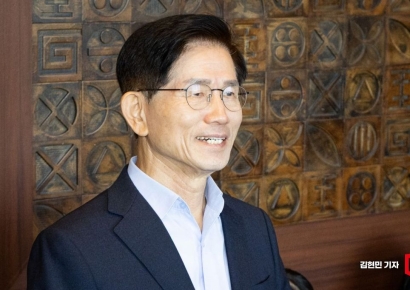
Lee Okwon, Chairman of the Financial Services Commission, is speaking at the "Public Participation National Growth Fund (hereinafter referred to as the 'Public Participation Growth Fund') Asset Management Company Meeting" held on the afternoon of the 12th at the Korea Financial Investment Association's main conference room in Yeouido, Seoul.
View original imageThe Financial Services Commission announced on June 14 that, at the "Public Participation National Growth Fund Asset Management Company Meeting" presided over by Chairman Lee Okwon on the 12th, it discussed measures to strengthen responsible management and improve returns for the Public Participation Growth Fund.
First, the Public Participation Growth Fund will provide preferential treatment to sub-fund management companies with excellent performance if they apply for future policy fund projects funded by Korea Development Bank. In particular, for projects similar to the Public Participation Growth Fund, such as those investing in the KOSDAQ sector, "experience managing the Public Participation Growth Fund" will be reflected as a separate evaluation item, and additional points will be awarded during the document review stage. Furthermore, management companies that achieve a new capital supply ratio of at least 36%—which is over 20% higher than the minimum requirement of 30%—to unlisted companies and technology-special listed companies within two years of the fund’s establishment will also receive additional preferential treatment.
In addition, asset management reports, which are prepared every three months after fund establishment, must include not only the public fund's rate of return and key investment items, but also the investment status and performance of each sub-fund.
From the sub-fund selection stage, the incentive and performance-based compensation system for key personnel will be reviewed in detail, and there are plans for continuous monitoring throughout the management process.
Previously, the Public Participation Growth Fund required sub-fund management companies to make a mandatory subordinated investment of at least 1%. This measure was introduced so that management companies participate directly as investors, rather than simply collecting management fees. If a management company invests more than 1%, additional points are awarded in the sub-fund selection evaluation.
Moreover, if the cumulative return exceeds 30% at fund maturity, a portion of the excess profit will be paid to the management company as performance-based compensation. The compensation structure is designed to encourage active management by rewarding higher returns with greater rewards. Upon fund maturity, profits are first distributed to retail investors up to the benchmark return (30% over five years), after which government finances and management companies receive distributions in sequence. However, if a management company achieves returns exceeding the benchmark, 12% of the excess profit is paid as performance-based compensation.
Additional incentives will also be provided to management companies that achieve policy objectives. If the ratio of new capital supplied to unlisted or technology-special listed companies is expanded to 40% or more, or if the regional investment ratio reaches 40% or higher, additional performance-based compensation will be provided. If both conditions are met, the management company’s share of excess profit increases from the usual 12% to between 16% and 20%.
Additionally, sub-fund management companies are allowed to autonomously invest up to 40% of total assets. Even in the main investment areas, the proportion allocated to listed stocks can be up to 30%.
Furthermore, the Public Participation Growth Fund can include KOSDAQ Venture Funds as sub-funds, allowing it to actively capitalize on opportunities in the venture and SME investment space as well as the public offering market. KOSDAQ Venture Funds are given priority allocations in initial public offering (IPO) stocks over general funds.
Hot Picks Today
 "Doesn't Know How to Sell Shares": Kim Moonsoo, Who Bought SK hynix at 20,000 Won, Draws Attention Over "100-Fold Return" Rumors
- "Called a High-Net-Worth Individual?"... YouTuber Who Lost 700 Million Won in Short-Term Trading Refutes, "Have You Ever Traded Stocks?"
- "Amputation with Scissors, Hard to Believe...But a Complicated Situation" — Practicing Doctor Weighs In on Incheon Nursing Hospital Controversy
- Was It Really Drugs? Shocking Turn as Suwon "Fentanyl Suspect" Tests Negative in Forensic Report: "I Was Just Weak"
After fund establishment, the Public Participation Growth Fund has implemented a continuous monitoring system to regularly review management performance and investment execution. Monthly and quarterly management reports for each sub-fund are used to check returns, main investment performance, and compliance with management guidelines, with Korea Growth Investment Corporation and the public fund management companies jointly overseeing this process. In particular, matters that could significantly affect management performance are subject to ad-hoc reporting to enable swift response.
© The Asia Business Daily(www.asiae.co.kr). All rights reserved.