Koo Yoon-cheol: "Youth Employment is the Top Priority... Next-Generation Semiconductor Commercialization Roadmap to Be Completed in June"
Emergency Economic Headquarters and Economic Ministers' Meeting Held on the 12th
With the number of employed people declining in May for the first time in 17 months, the government announced that it will mobilize all available policy tools to improve youth employment. In addition, as part of the ultra-innovation economy project aimed at securing a lead in the global technology market, the government plans to finalize a roadmap for the commercialization of next-generation power semiconductors within this month.

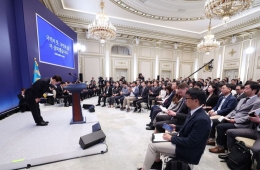
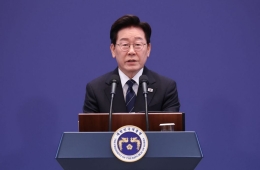
Deputy Prime Minister and Minister of Strategy and Finance Koo Yoon-cheol presides over the 'Emergency Economic Headquarters Meeting and Economic Related Ministers Meeting' held at the Government Seoul Office in Jongno-gu, Seoul on the 12th, delivering opening remarks. Ministry of Strategy and Finance
View original imageOn June 12, Deputy Prime Minister and Minister of Strategy and Finance Koo Yoon-cheol presided over the Emergency Economic Headquarters Meeting and Economic Related Ministers Meeting at the Government Seoul Office and said, "Amid mounting pressure on prices and supply chains due to the prolonged war in the Middle East, and continued volatility in exchange rates and financial markets, uncertainty in the employment situation is growing, with the number of employed people turning to a decrease in May. We will make it our top policy priority to improve youth employment and will do our utmost to achieve this," he added.
According to the Ministry of Data and Statistics, the number of people employed last month decreased by 40,000 compared to the same month last year. This marks the first decline in 17 months. The government plans to closely analyze detailed employment trends by demographic and industry group, promptly address issues that require immediate action, and implement mid- to long-term institutional improvements. Incentives related to employment will also be strengthened. Deputy Prime Minister Koo stated, "We will remain vigilant about prices and employment, minimize the impact of the Middle East conflict, and make every effort to stabilize livelihoods."
The government is also accelerating the 'ultra-innovation economy project' to secure a lead in the global technology market. Deputy Prime Minister Koo said, "We will fully pursue structural reforms and the ultra-innovation economy project to discover future growth engines, such as the second and third semiconductor industries."
In particular, the government plans to complete the next-generation power semiconductor commercialization technology roadmap by June and launch large-scale research and development (R&D) projects in collaboration with demand companies. Power semiconductors are core components for converting and controlling electricity, and are widely used in electric vehicles, renewable energy, data centers, and industrial power equipment. Since power efficiency is directly linked to industrial competitiveness, securing technology to lead the global market is considered crucial.
For small modular reactors (SMRs), the government is expediting early commercialization based on the standard design approval applied for in February and the SMR Special Act, which is scheduled to go into effect in September. The government will also actively support technology development and field demonstrations for on-sensor AI, which combines sensor and AI technologies, actuators for humanoid robots, and secondary batteries, aiming to begin producing tangible results from the ultra-innovation economy project starting next year.
Hot Picks Today
!["How Little Do Koreans Read? Who Will Acquire Munhakdongne Now on the Market [Weekend Money]"](https://cwcontent.asiae.co.kr/asiaresize/93/2026091716280432990_1789630084.jpg) "How Little Do Koreans Read? Who Will Acquire Munhakdongne Now on the Market [Weekend Money]"
"How Little Do Koreans Read? Who Will Acquire Munhakdongne Now on the Market [Weekend Money]"
- "Bank Offers 3.5%, but... Which ETF Hit a 21% Dividend Yield? [Weekend Money]"
- "I'll Pay Cash for This Home"... Cash Purchases Rise and Loan Share Falls as Sub-1 Billion Won Listings Increase in China
- "Please Be Quiet"... China to Fine Up to 210,000 Won for Disruptive Passengers Using Speakerphones
- "Raised a Stray Kitten, but..." Scientific Community Stunned: First New Wild Cat Species Discovered in 100 Years
Additionally, Deputy Prime Minister Koo remarked, "Future growth engines for economic revitalization must begin in local regions," adding, "Starting next week, I will personally visit the 'Five Regions and Three Special Zones' across the country to identify region-specific growth drivers and systematically support them."
© The Asia Business Daily. All rights reserved. Unauthorized AI training and use prohibited.