US and South Korea Hold Nuclear Consultative Group Meeting in Seoul, Reaffirm "Shared Objective of North Korea's Denuclearization"
Joint Press Statement Issued
"Continued Advancement of Nuclear-Conventional Integration"
Signing of NCG Security Guidelines
On June 11, South Korea and the United States held the 6th meeting of the Nuclear Consultative Group (NCG), the bilateral consultative body for extended deterrence, in Seoul and reaffirmed their commitment to the goal of North Korea's denuclearization.
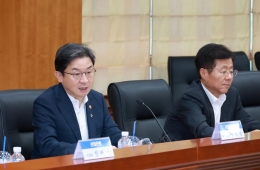
This meeting was co-chaired by Kim Hongcheol, policy chief at the Ministry of National Defense, and Robert Soofer, U.S. Deputy Assistant Secretary of Defense for Nuclear and WMD Policy. After the meeting, both sides issued a joint press statement.
According to the statement, the representatives of both countries agreed to continue and further develop the activities of the US-ROK NCG in order to strengthen the alliance and extended deterrence, especially as North Korea's nuclear and missile capabilities become more advanced and the security environment changes.

The 6th U.S.-South Korea Nuclear Consultative Group Meeting. Photo by Yonhap News Agency
View original imageThe statement specifically noted, "The United States and the Republic of Korea reaffirmed their shared objective of North Korea's denuclearization," and, "The U.S. side reaffirmed its commitment to provide extended deterrence to the Republic of Korea by utilizing the full range of U.S. capabilities, including nuclear capabilities."
The fact that South Korean and U.S. authorities have again explicitly specified North Korea's denuclearization as a joint objective draws attention. This renewed emphasis comes at a time when the international community's focus on denuclearization appears to be fading, as seen by China not mentioning North Korea's denuclearization during the recent North Korea-China summit. Notably, the joint press statement from the 5th NCG meeting held in Washington, D.C. in December of last year did not contain any mention of North Korea or its denuclearization.
Just before this latest NCG meeting, the United States and Japan held the Extended Deterrence Dialogue (EDD) on June 8-9, with their statement also confirming their commitment to the complete denuclearization of North Korea. A Ministry of National Defense official explained that, in the recent NCG, "Both sides reaffirmed their determination for the complete denuclearization of North Korea and for peace and stability on the Korean Peninsula."
According to the statement, the two countries reviewed tasks such as security and information sharing, consultation procedures during a nuclear crisis, nuclear-conventional integration (CNI), exercises and training, strategic messaging, and risk reduction. They also discussed a variety of measures to strengthen the alliance's nuclear deterrence and readiness posture.
The two sides assessed the progress made by military authorities on advancing the US-ROK CNI concept for deterring and responding to North Korea's nuclear threats and agreed to continue these efforts. The US-ROK CNI refers to the concept where South Korea provides conventional support for U.S.-led nuclear operations. The NCG delegation reportedly visited relevant South Korean units to review South Korea’s advanced conventional capabilities. There are expectations that specifying how U.S. nuclear forces and South Korean conventional forces will be integrated and operated will be necessary to maintain the effectiveness of the U.S. nuclear umbrella commitment after the transition of wartime operational control (OPCON).
The representatives of both countries also signed the "US-ROK NCG Security Guidelines," which set forth procedures for protecting information necessary for NCG activities and consultations. The NCG Security Guidelines are intended to provide an institutional foundation for deepening information sharing between the two countries. The outcomes of the NCG will also be reported at the 58th US-ROK Security Consultative Meeting (SCM), which will be held this fall with the defense ministers of both countries in attendance.
Hot Picks Today
![What Good Is Sheer Volume?... Even with 450 Trillion Won Poured In, Samsung and SK Hynix Remain Unmatched [Chip Talk]](https://cwcontent.asiae.co.kr/asiaresize/93/2026061411010198635_1781402461.jpg) What Good Is Sheer Volume?... Even with 450 Trillion Won Poured In, Samsung and SK Hynix Remain Unmatched [Chip Talk]
What Good Is Sheer Volume?... Even with 450 Trillion Won Poured In, Samsung and SK Hynix Remain Unmatched [Chip Talk]
- 'Patent Bomb' Threatens World's No. 1 TSMC...Exports at Risk in Worst-Case Scenario [Taiwan Chip Report]
- Son Heung-min Ranks 6th on AI-Selected World Cup Handsome List... Ronaldo an 'Unexpected' Result
- "They Keep Selling Off... Will I Lose Out Because of the SpaceX IPO?" [Weekend Money]
- SK Shares Soar from 160,000 to 600,000 Won...What Will Happen to the Choi Taewon–Noh Soyoung Property Division?
The next, 7th NCG meeting is scheduled to take place in Washington, D.C. in the second half of the year. The NCG is a bilateral consultative body established so that South Korea can provide input into U.S. nuclear operations as part of efforts to strengthen extended deterrence against North Korea’s nuclear threat. It was officially launched following the "Washington Declaration" by the leaders of South Korea and the United States in April 2023 and meets twice a year.
© The Asia Business Daily(www.asiae.co.kr). All rights reserved.



![[Review] "Performing in My Own Country Brings the Most Joy"... BTS Celebrates 13th Anniversary with 110,000 ARMY in Busan](https://cwcontent.asiae.co.kr/asiaresize/307/2026061402100298506_1781370602.jpg)