Kim Yongbum: "Provisional Agreement Reached on Korea-EU Duty-Free Steel Quota"...Expecting the Best Outcome
EU to Reduce Duty-Free Steel Quota by 46 Percent Starting in July
President Lee Strongly Urges “Favorable Consideration for Strategic Partner Korea”
South Korea-EU Economic Security Cooperation Expands to Semiconductors, Defense, AI, and CBA
The South Korean government has reached a provisional agreement with the European Union (EU) regarding the quota for tariff-free Korean steel exports ahead of the EU's implementation of a new steel import regime. With the EU set to drastically reduce tariff-free steel import volumes starting next month, competition among major exporting countries to secure quotas has intensified. During the Korea-EU summit on June 10 (local time), President Lee Jae-myung strongly urged the EU to give favorable consideration to Korean companies.

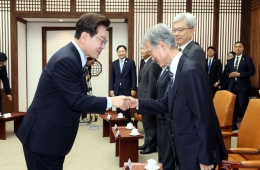
Kim Yongbum, policy chief accompanying President Lee Jae-myung on his European tour, is briefing on Korea-EU economic cooperation at the Korean Press Center set up in a hotel in Rome, Italy, on June 11, 2026 (local time). Photo by Yonhap News.
View original imageKim Yongbum, policy chief at the Office of the President, stated at a briefing held at the press center in central Rome on June 11, "South Korea and the EU have reached an internal provisional agreement." He added, "Because making the details public would not be advantageous for either Korea or the EU, both sides have determined that disclosing them would not be in the interests of the negotiating authorities, so we have decided not to announce them." He further commented, "Although it will not be possible to return to previous levels, we expect to achieve the best possible outcome under these unfavorable changes to the system."
The EU has established a new steel import regime to replace the World Trade Organization (WTO)-based global safeguards on steel, which have been in place since 2018 and will expire on June 30. Under the new system, tariffs on 30 categories of steel will be increased to 50%, but a certain volume will be allowed tariff-free through a tariff rate quota (TRQ) system.
The core issue is the reduction of tariff-free volumes. The EU's total permitted quota for tariff-free steel imports will be reduced by about 46%, from the current global safeguard quota of 33.82 million tons to 18.35 million tons. For major steel exporting countries, including South Korea, this means a smaller quota must now be divided among the same group of exporters.
Accordingly, President Lee strongly requested favorable consideration for South Korea's steel tariff-free quota at the recent EU summit, emphasizing Korea's status as an FTA partner and strategic ally. Kim explained, "During the steel quota negotiations, South Korea made the most visits to Brussels," adding, "Through intensive negotiations between Korea's chief trade negotiator and the EU's commissioner for trade, significant progress was made. Although we cannot disclose specifics yet, we expect a better outcome for Korea compared to other countries." Yeoh Han-koo, the chief trade negotiator, is reported to have worked tirelessly in Brussels, Belgium for about a month to secure the steel tariff-free quota.
The EU is South Korea's second-largest steel export market. Last year, 3.24 million tons of South Korea's total steel exports of 28.25 million tons were shipped to the EU. Currently, South Korea has been allocated a country-specific tariff-free quota of about 2.58 million tons from the EU, supplying Korean steel to key industries such as automotive, shipbuilding, machinery, and energy.
The government views these negotiations as more than just an issue for the steel industry, but as a matter of safeguarding the manufacturing base, supply chain stability, and national industrial competitiveness. Kim commented, "Our steel industry is the backbone of our national economy and a key sector that must be protected. If the steel industry falters, it could trigger a chain reaction affecting employment, partner companies, and local economies."
During the summit, President Lee explained that the EU's new measures could have a wide-ranging impact not only on the steel industry but also on industrial cooperation, supply chain stability, investment, and employment between the two sides. He stressed that results commensurate with the mutually beneficial economic cooperation and strategic partnership established through the Korea-EU Free Trade Agreement (FTA) should be achieved. In response, the EU reportedly reaffirmed that Korea is a strategically important partner sharing common values and stated its intention to take Korea's requests into maximum consideration.
In addition to steel, a wide range of economic security topics were discussed, including semiconductors, the defense industry, carbon regulations, and AI. Kim stated, "The semiconductor industries of Korea and the EU have a complementary relationship," explaining, "Korea specializes in manufacturing, while Europe has strengths in equipment and R&D; both sides agreed on the need for close joint research in semiconductors." In the defense sector, the EU is said to have highly praised Korea's production capabilities. Kim reported that the EU assessed Korea's ability to rapidly produce high-quality products as innovative and emphasized that, from the perspective of European defense industry development, Korea is an 'irreplaceable country' whose support is vital.
President Lee also requested that the EU's industrial regulations and Carbon Border Adjustment Mechanism (CBAM) be implemented in a way that eases the burden on Korean industries. He conveyed concerns from Korean industries that, despite Korea's status as an FTA partner and its entitlement to equal treatment with EU members, there are some ambiguities in certain rules, and he strongly requested that Korea be guaranteed the same treatment as EU countries. President Lee also requested that Korean institutions be included as CBAM verification bodies and additionally asked that Korea, as an FTA partner, be ensured the same treatment as EU member states under the EU's Industrial Acceleration Act.

President Lee Jae-myung (left), Antonio Costa, President of the European Council, and Ursula von der Leyen, President of the European Commission (right), are waiting for the start of the South Korea-EU expanded summit on June 10 (local time) at the EU Council headquarters in Brussels, Belgium. Photo by Yonhap News
View original imageRegarding AI cooperation, President Lee introduced the government's concept of "AI for All." He pointed out that while AI is a key driver of future growth, if its benefits are concentrated among only certain groups or companies, it could exacerbate economic and social disparities. He explained government policies aimed at improving AI accessibility and inclusiveness, such as providing free AI services to all citizens and establishing a global AI hub.
Hot Picks Today
 "Two Spend 500,000 Won in a Flash, Yet Wait Two Hours?" ... 'Dreamland' Shunned by Kids and Foreign Tourists
- The Era of Getting 200 Million Won After 30 Years Is Over... A Japanese Bank's "Perpetual Department Head" Who Just Clocked In Cries Out
- Spain Hit by Its Worst Tragedy... Lee Kangin, Moreno and Real Madrid Join Soccer World in Mourning
- They Said, “Make It Your Home for Life” - Then Suddenly Kicked 200 Passengers Off... What Happened to the Around-the-World Cruise?
- "130 Rice Bowls Sold Out in a Day"... 'Unfiltered Face' Adds 8 Million Won to Night Market Sales: China's Bungeunwoo
Meanwhile, the government plans to further develop the cooperation agenda through the Korea-EU high-level economic partnership channel, known as the "Competitiveness Partnership," and the accompanying "Korea-EU High-Level Economic Dialogue," which were agreed upon at this summit. The goal is to broaden cooperation to areas such as supply chain stability, advanced technologies, carbon neutrality, and economic security, and to establish a framework for jointly responding to the new international trade order.
© The Asia Business Daily. All rights reserved. Unauthorized AI training and use prohibited.