[Weekend Money] "Humanoid Mass Production Phase Approaching"... Spotlight on These Stocks
Humanoids Enter Mass Production Phase... "Scarcity Is Key"
Shinhan Investment Names Six Top Picks Including Robotis
This year, as mass production and commercialization of humanoid robots by companies such as Tesla and Hyundai Motor Group progress, expectations for stocks related to robot components and infrastructure are rising.

On June 13, Shinhan Investment Corp. announced that it would maintain its "overweight" investment opinion on the artificial intelligence (AI) and robotics sector. Research analysts Choi Seunghwan and Lee Byunghwa stated, "As the industry approaches the phase of mass production of humanoids, there are various stock price catalysts at play."
This Year Marks the Start of Robot Mass Production... Spotlight on Component and Infrastructure Companies
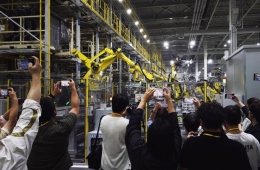
This year, the humanoid market is moving beyond the research and development (R&D) phase to enter the stage of mass production and commercialization. Tesla will begin initial mass production of "Optimus" between July and August. Hyundai Motor Group, which unveiled the mass-production model of "Atlas" at CES 2026, the world's largest electronics expo, plans to officially open its Robot Meta-Plant Application Center (RMAC) in the United States in August. Unitree, China's leading humanoid company, is also scheduled to be listed on the STAR Market of the Shanghai Stock Exchange this year.
Shinhan Investment Corp. predicted that humanoids would follow a similar trajectory to AI infrastructure, which is currently driving global stock markets. Analysts Choi Seunghwan and Lee Byunghwan commented, "Just as fear of being left behind without adopting agentic AI led to investments in data centers, fear of being left behind without preparing for labor shortages and rising personnel costs with robots could also spread." They added, "Humanoids share scarce resources with data centers and electric vehicles (EVs), which makes supply shortages even more acute. Furthermore, when it comes to crucial robot components such as actuators, high-precision sensors, and bearings, there are fewer than ten suppliers worldwide."
![[Weekend Money] "Humanoid Mass Production Phase Approaching"... Spotlight on These Stocks](http://www.asiae.co.kr/news/img_view.htm?img=2026032409035387507_1774310633.jpg)
For these reasons, they emphasized a focus on companies providing bottleneck components for humanoids, as well as robot infrastructure companies. The rationale is that these are the companies that will command scarcity premiums as demand for humanoids surges. Analysts Choi Seunghwan and Lee Byunghwan explained, "Component companies refer to those domestic firms that localize key parts currently monopolized by Japan and Germany. Regarding the expansion of robot infrastructure, China has already set a precedent by extending its electric vehicle and handset value chains to robots, so manufacturing capabilities in smartphones, semiconductors, and EVs could be converted into competitiveness in humanoids."
Six Top Picks: Including Robotis and Koh Young
Shinhan Investment Corp. named Robotis, Linksolution, and NBR Motion as its top picks among humanoid component companies. Robotis launched its general-purpose humanoid platform "AI Sapiens" in April this year. Unlike platforms in the United States and China, Robotis provides an open platform based on its own actuators, enabling it to lead the global humanoid ecosystem for research institutes and companies. NBR Motion is joining the global humanoid value chain by participating in component development and supply for major clients.
Linksolution supplied 3D printers to Hyundai Motor Company last year, which are currently being used for proof of concept (POC) in component mass production. In April, Linksolution also announced the sale of KRW 900 million worth of 3D printer equipment to Samsung Electronics. Shinhan Investment Corp. stated, "Samsung Electronics is conducting research and development to replace CMC with metal additive manufacturing (AM) and, after its own quality tests, is expected to carry out outsourcing production through Linksolution."
Hot Picks Today
![Cracks in Samsung and SK hynix’s Duopoly?... Micron’s Bet with the ‘100,000 HBM Wafers’ Bomb [ChipTalk]](https://cwcontent.asiae.co.kr/asiaresize/93/2025072814474862132_1753681669.jpg) Cracks in Samsung and SK hynix’s Duopoly?... Micron’s Bet with the ‘100,000 HBM Wafers’ Bomb [ChipTalk]
Cracks in Samsung and SK hynix’s Duopoly?... Micron’s Bet with the ‘100,000 HBM Wafers’ Bomb [ChipTalk]
- "This Is the Must-Visit Spot for Foreigners in Korea—Not Olive Young or Daiso... How Foreign Tourists Are Changing the Profit Formula [Weekend Money]"
- 44 Injured in Train Derailment in France...Police Suspect Sabotage
- "Age Is No Excuse"...Why the Elderly Person on CCTV Shocked Viewers
- "The Effects of 'Perfect Beauties' on Mental Health: Just How Harmful Are Unrealistic Standards? [Experiment Note]"
For top picks among humanoid infrastructure companies, Shinhan Investment Corp. selected Koh Young, SFA, and CMES Robotics. Koh Young is expected to benefit from its main customers, electronics manufacturing service (EMS) firms, increasing collaboration with development companies. SFA is projected to see a recovery in its standalone performance, particularly in the robot manufacturing equipment (RMH) sector. CMES Robotics announced in May this year that it had signed supply contracts worth KRW 5.3 billion and KRW 6.9 billion, respectively, with Seoheung and Coupang Fulfillment.
© The Asia Business Daily. All rights reserved. Unauthorized AI training and use prohibited.