Presidential Office: "Political Interpretation Inappropriate... PM Kim Attended Send-Off to Deliver Cabinet Instructions"
Diverse Interpretations Emerge Over Prime Minister's Attendance at Send-off and Absence of Ruling Party Leadership
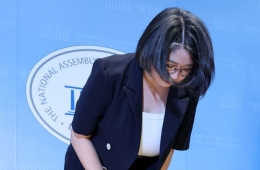
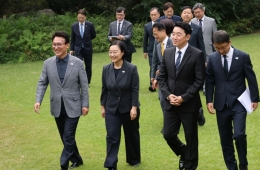
The presidential office has once again drawn a clear line regarding the political interpretations surrounding Prime Minister Kim Min-seok's attendance at the send-off for President Lee Jae-myung's European tour, especially as the ruling party leadership, including Democratic Party leader Jung Chung-rae, did not attend. As it is customary for the prime minister not to attend the president's overseas departure send-off but often to greet the president upon return, the continued analysis of Kim's attendance prompted yet another response from the presidential office.

President Lee Jae-myung, who is departing for the G7 Summit and a European tour, is greeting Prime Minister Kim Minseok, who came to see him off at Seongnam Seoul Airport on June 9, 2026. Photo by Yonhap News
View original imageOn June 10, an official from the presidential office stated regarding Prime Minister Kim's presence at the send-off, "It is not appropriate to interpret this matter politically," and explained, "Considering the prolonged Middle East conflict and the situation with the National Election Commission, as well as other domestic and international circumstances, the number of attendees was minimized." Typically, cabinet members, presidential aides, ruling party leadership, and diplomatic envoys attend the president's overseas departure, but this time, the scope of attendance was reduced in light of the domestic and international situation.
Regarding Prime Minister Kim's attendance, the official added, "It was intended to deliver work instructions and requests from the cabinet level due to the president's long overseas schedule." Since the president would be away for an extended period for the European tour, the prime minister attended to convey instructions and requests related to cabinet management and the handling of pending issues.
The core of the current controversy lies in the unusual nature of Prime Minister Kim's attendance at the send-off, combined with the absence of the ruling party leadership, who have traditionally participated in such events. As a result, interpretations have emerged both within and outside the ruling bloc that this cannot simply be viewed as a matter of protocol adjustment.
The complicated internal situation surrounding leader Jung has also fueled such interpretations. Since the June 3 local elections, there has been ongoing debate within the Democratic Party over responsibility for the loss in the Seoul mayoral race. While leader Jung has hinted at the possibility of seeking another term, some within the pro-Lee faction have openly discussed the need for Jung to "step aside," intensifying tensions over the party's future leadership.
Hot Picks Today
!["Don't Use Chinese-Made Products": One U.S. Warning Triggers a 5 Trillion Won Jackpot for Korean Batteries [Weekend Money]](https://cwcontent.asiae.co.kr/asiaresize/93/2025121709393659037_1765931975.jpg) "Don't Use Chinese-Made Products": One U.S. Warning Triggers a 5 Trillion Won Jackpot for Korean Batteries [Weekend Money]
"Don't Use Chinese-Made Products": One U.S. Warning Triggers a 5 Trillion Won Jackpot for Korean Batteries [Weekend Money]
- "Dividend Payouts of 40 Million Won Before Their First Birthday"...'Baby Shareholders' Put Ordinary Workers at a Disadvantage
- "Planning a Trip to Japan?"... Accelerating Yen Strength [Weekend Money]
- Men in Their 20s and 30s Who Struggled with Dating Are Heading to Japan: "Virtual Matchmaking First, Then Start Dating"
- Foreign Tourists Leave in Tears Praising Seoul: "Wi-Fi So Fast, My Fingers Can't Keep Up" [K-holic]
For these reasons, some have speculated that the composition of attendees at the send-off indicates the presidential office is distancing itself from leader Jung. In particular, after President Lee publicly praised Prime Minister Kim's role in state affairs during the first anniversary press conference, Kim's attendance at the send-off and the absence of the party leadership, including Jung, have drawn attention, highlighting the overlap between government-party relations and the shifting dynamics of power within the ruling bloc.
© The Asia Business Daily. All rights reserved. Unauthorized AI training and use prohibited.


![[Breaking] Party and Government Consider Renaming 'Judiciary Control Division' to 'Non-Indictment Case Review Division'](https://cwcontent.asiae.co.kr/asiaresize/307/2026091316513726167_1789285898.jpg)