[Moneyverse] Jensen Huang and Elon Musk
However, there are even more differences between them. Jensen Huang has maintained a stable marriage and enjoys a good relationship with his wife, Lori. In contrast, Musk has had at least eleven children with at least three different women.
Jensen Huang, while displaying strong charisma, can be humorous and, except when he is overcome by emotion, is warm and highly empathetic. Musk has disclosed that he is on the autism spectrum, and he indeed has difficulty picking up on social cues. Jensen Huang has never publicly endorsed any particular politician, whereas Musk has supported U.S. President Donald Trump.
Their attitudes toward layoffs are also starkly different. Musk has often fired people without warning. On one occasion, it was reported that he dismissed almost the entire Starlink engineering team on a Sunday afternoon with little notice. In contrast, Jensen Huang has rarely let anyone go. To be dismissed from Nvidia, one would have had to do something truly unacceptable. Even when there was a business need to eliminate a department, he would reassign employees to other departments rather than lay them off. This is why many employees at Nvidia have worked there for decades.
Both are entrepreneurs who execute their visions and see further ahead than anyone else. However, Jensen Huang starts from reality, secures cutting-edge technology, and then looks for long-term business opportunities on top of that. Musk, on the other hand, begins with an imaginative vision of the distant future and then works backward to make it reality. Jensen Huang created a general-purpose supercomputer by implementing what was once thought impossible—parallel computing—in the graphics processing unit (GPU). However, it took about ten years before Nvidia supplied the DGX-1 supercomputer to OpenAI. Musk started by envisioning a future in which humanity migrates en masse to Mars, then worked backward to develop the necessary technologies to reach that goal—a method known as backward planning, which involves a very long timeline.
Jensen Huang recently visited Korea, where he discussed next-generation AI data centers, including the 'AI Factory' and 'Physical AI', before departing. Meanwhile, SpaceX, the space development company Musk founded and remains the largest shareholder of, is set to go public on Nasdaq on June 12. Wall Street consensus for Jensen Huang's Nvidia is currently rated as 'Strong Buy.' Aswath Damodaran, a professor at New York University, recently stated on a Wall Street Journal podcast that the fair value of SpaceX should be $1.3 trillion—26% lower than the $1.77 trillion valuation provided by the company. Professor Damodaran argued that the value of the AI business has been excessively reflected.
A common rallying cry for both entrepreneurs could be, "Execute even what seems impossible." This is the opening sentence of the book "Nvidia Jensen Huang, Thinking Machine," which chronicles the adventures of Jensen Huang and Nvidia. The same motto, of course, applies to Musk. What set both entrepreneurs apart was their exceptional ability to execute, turning contrasting strategies into remarkable results. Execution is what ultimately brings the impossible to life.
Hot Picks Today
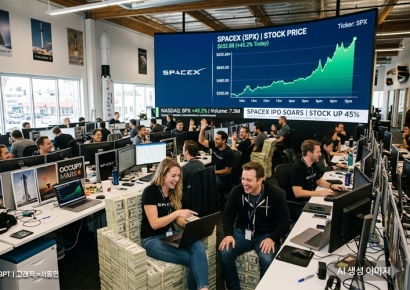 "This Is Truly Rare"... 4,400 Employees to Become Millionaires Overnight
- The Sooner You Start, the Better... "Millennials & Gen Z Should Gradually Move Stock Profits 'Here'" [Retirement Pension Investment Strategy] ⑧
- "I Tried It Because It Was Trending and Lost Weight Fast"...The Soybean Milk Craze Shaking Up the Diet Market
- 'Superbug' Emerges: "Even Last-Resort Antibiotics Useless"—Now Infecting Infants as Young as 8 Months
- "I Am an Addict"… President's Troubled Son Rises as an SNS Star
Baek Woojin, Economic Columnist
© The Asia Business Daily(www.asiae.co.kr). All rights reserved.