An Underwater Reef in the Middle of the East Sea Makes History... Completion of the "Scientific Island" Wangdolcho Ocean Science Base
Completion of the First East Sea Observation Network, Filling in the Gaps
"Real-Time Monitoring of Climate and Ecosystem Changes"
A scientific island has emerged atop an underwater reef in the middle of the East Sea. An area previously inaccessible to humans has now been transformed into a hub for marine observation.
The national ocean science base observation network, which connects the West Sea and the South Sea, has finally been completed with the addition of the East Sea. On June 9, the Korea Institute of Ocean Science and Technology (KIOST; President Lee Heeseung) held a completion ceremony for the Wangdolcho Ocean Science Base at the Uljin East Sea Research Institute and announced that it has officially begun operations.
The Wangdolcho Ocean Science Base is Korea's fourth ocean science base, following Ieodo (2003), Gageocho (2009), and Socheongcho (2014). It is the first ocean science base constructed in the East Sea. Its significance lies in establishing a long-term observation system in the East Sea, a region that had previously lacked such infrastructure.
Wangdolcho is an underwater reef located 25 kilometers east of Hupo Port in Uljin. It is an area where cold and warm currents intersect, making it a region where marine environmental changes occur rapidly. Recently, phenomena such as rising sea temperatures, subtropicalization, and barren ground have been observed here, drawing attention to Wangdolcho as a key site for climate change research.
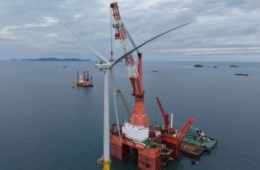
The base is anchored to the seabed at a depth of 23 meters using four piles. The steel structure covers a total floor area of 570 square meters and reaches a height of 53 meters, equivalent to a 19-story apartment building. It is designed to withstand waves up to 19.24 meters high, winds of up to 60 meters per second, and earthquakes of magnitude 6.5, with a design lifespan of 50 years.

The facility consists of five levels: a berthing facility for ships; an intermediate deck equipped with underwater observation instruments; an equipment deck housing generators and desalination facilities; a main deck with a control room, accommodations, and meeting room; and an upper deck outfitted with meteorological observation devices, a satellite antenna, and an unmanned drone operation facility.
At Wangdolcho Base, 86 pieces of advanced observation equipment spanning 37 types have been installed. These record in real time not only seawater temperature, currents, wave height, and sea level changes, but also the underwater ecological environment. Artificial intelligence (AI)-based data quality management technology has also been applied, enabling the accumulation of long-term and stable data.
The base will allow long-term tracking of subtropicalization, barren ground phenomena, and changes in the marine ecosystem of the East Sea. The accumulated data will serve as scientific evidence for detecting marine ecosystem risks, predicting fishery changes, and formulating policies to respond to the climate crisis. For fishermen along the East Coast, including Hupo and Jukbyeon, the base will also provide information for fishing operations.
The Wangdolcho Base project has been promoted since 2021 as part of the Ministry of Oceans and Fisheries' "Establishment of Advanced Ocean Science Bases and Convergent Research in Jurisdictional Waters" initiative, with a total project cost of 24.3 billion won.

Officials who attended the inauguration ceremony of Wangdolcho Marine Science Base posed in front of the camera.
View original imageLee Heeseung, President of the Korea Institute of Ocean Science and Technology, stated, "With the completion of the Wangdolcho Base, we now have the capacity to observe all of our seas, including the East Sea, without any blind spots. The high-quality data produced at the base will become a valuable asset supporting responses to the climate crisis and ensuring public safety."
Jung Jinyong, Director of the Marine Data and Infrastructure Department, emphasized, "Wangdolcho is a core observation point in the East Sea for detecting early signals of climate change. Through long-term observation, we will scientifically record and analyze changes in the East Sea."
Hot Picks Today
![[Exclusive] Building Korea's Largest Offshore Wind Farm: "Are Chinese Ships and Workers Really at the Core?"](https://cwcontent.asiae.co.kr/asiaresize/93/2026060908211092221_1780960873.jpg) [Exclusive] Building Korea's Largest Offshore Wind Farm: "Are Chinese Ships and Workers Really at the Core?"
[Exclusive] Building Korea's Largest Offshore Wind Farm: "Are Chinese Ships and Workers Really at the Core?"
- "This Is the Only Chance for Ordinary People to Become Wealthy"... Expert Recommends This Investment Method [Retirement Pension Investment Strategy] ⑥
- "If You Hire More Young People, You Get More Subsidies"... Government to Implement Job-Linked Corporate Incentive System
- "Bought Up As Soon As It Dropped"... Gold Hoarding Frenzy Ignites: 'Now Is the Time to Buy'
- "Why Is It Different From Korea?" U.S. Launch of Olive Young Faces Backlash in Its First Week
The observation data produced at Wangdolcho Base will be released to researchers and the public through a dedicated web service for ocean science base researchers in the future.
© The Asia Business Daily(www.asiae.co.kr). All rights reserved.



![Festered and Finally Burst... The Bare Face of 'Election Judgment' [Data Pick]](https://cwcontent.asiae.co.kr/asiaresize/307/2026060909144792383_1780964086.jpg)