[Exclusive] Local Election Public Sentiment by Metropolitan Proportional Vote: Progressives 55.2% vs. Conservatives 44.4%
Progressive Bloc Leads in 13 out of 17 Regions
Jeon Jaesoo Wins Busan Mayoral Race with 50.5% Despite Party Disadvantage
Oh Sehoon Secures Seoul Mayoral Victory by Rallying Conservative Bloc
Kim Bookyum in Daegu Garners 10 Percentage Points More Than the Progressive Bloc
An analysis of the 'proportional representation vote share' for metropolitan councils in the 9th Nationwide Simultaneous Local Elections showed that the broad progressive bloc and the broad conservative bloc garnered 55% and 44% of the votes, respectively. The fact that these results were produced when voters cast their ballots solely based on party name, excluding variables such as individual candidate's political abilities, indicates that the June 3 local elections concluded with a dominant position for the progressive parties. Notably, the progressive bloc held an advantage in 13 out of 17 metropolitan and provincial regions.
Based on the June 3 local election ballot counting results released by the National Election Commission on June 12, the Democratic Party of Korea received 12.6 million votes (47%) in the metropolitan proportional representative election, the People Power Party received 11.15 million votes (41.6%), the Cho Kuk Innovation Party received 1.21 million votes (4.5%), the Reform New Party received 620,000 votes (2.3%), the Progressive Party received 460,000 votes (1.7%), the Basic Income Party received 270,000 votes (1%), the Justice Party received 250,000 votes (0.9%), and the Liberty and Innovation Party received 110,000 votes (0.4%).
Based on this, an analysis dividing the parties into broad progressive (Democratic Party, Innovation Party, Progressive Party, Basic Income Party, Justice Party) and broad conservative (People Power Party, Reform New Party, Liberty and Innovation Party) blocs showed that the progressive bloc recorded 55.2% of the vote, while the conservative bloc recorded 44.4%. This highlights the current political landscape and the structure of voter support for the two blocs.

On the first day of early voting for the 9th Nationwide Local Elections on the 29th, citizens are casting their precious votes at the early voting station set up at the Administrative Complex in Sogong-dong, Jung-gu, Seoul. 2026.05.29 Photo by Dongjoo Yoon
View original imageThe conservative bloc was dominant in only four regions: North Gyeongsang Province, Daegu, Busan, and South Gyeongsang Province. In Ulsan, Seoul, and Gangwon, the support levels for the progressive and conservative blocs were similar, while in the remaining regions, the progressive bloc maintained a strong lead, albeit with varying margins.
In the closely contested Seoul mayoral race, where the victor was determined only at 7 a.m. the day after the vote count, the progressive bloc won more votes in the metropolitan proportional representation election. The progressive bloc secured 51.3% (Democratic Party 43.9%, Cho Kuk Innovation Party 4.1%, Progressive Party 1.4%, Justice Party 1.2%, Basic Income Party 0.8%), while the conservative bloc obtained 48.2% (People Power Party 44%, Reform New Party 3.7%, Liberty and Innovation Party 0.5%).
In the newly established Jeonnam-Gwangju Integrated Special City, the progressive bloc's share stood at 91.7% (Democratic Party 68.7%, Innovation Party 12.4%, Progressive Party 6%, Basic Income Party 2.9%, Justice Party 1.7%), while the conservative bloc received 8.3% (People Power Party 7.9%, Liberty and Innovation Party 0.4%).

Jeong Cheong-rae, the Chief Standing Election Countermeasure Committee Chair of the Democratic Party of Korea, is making a phone call while waiting for the exit poll results at the counting situation room for the 9th simultaneous local elections and the National Assembly by-elections, prepared at the National Assembly Members' Office Building on June 3, 2026. Photo by Kim Hyunmin
View original imageIn Busan, the progressive bloc received 47.2% and the conservative bloc 52.6%. In Daegu, the progressive bloc had 35.1% while the conservative bloc had 64.6%. In Incheon, the progressive bloc garnered 57.8% and the conservative bloc 41.7%. In Daejeon, the progressive bloc received 56.7% and the conservative bloc 43.3%. In Ulsan, the progressive bloc's share was 51.5% versus the conservative bloc's 48.5%. In Sejong, the progressive bloc secured 64.5% while the conservative bloc had 35.5%.
In Gyeonggi Province, the progressive bloc received 56.8% and the conservative bloc 42.7%. In Gangwon, the progressive bloc garnered 52.2% and the conservative bloc 47.8%. In North Chungcheong Province, the progressive bloc had 55.0% while the conservative bloc had 45.0%. In South Chungcheong Province, the progressive bloc recorded 54.4% and the conservative bloc 45.6%. In North Jeolla Province, the progressive bloc secured 89.3% and the conservative bloc 10.7%. In North Gyeongsang Province, the progressive bloc received 32.0% and the conservative bloc 67.0%. In South Gyeongsang Province, the progressive bloc had 47.4% and the conservative bloc 52.2%. In Jeju, the progressive bloc recorded 61.1% while the conservative bloc had 35.9%.
Based on these figures, it is possible to estimate the extent to which individual candidates influenced the election outcome. For example, Jeon Jae-soo, the winning candidate for Busan mayor, was elected in a region where his bloc was at a disadvantage. In the Busan metropolitan proportional representation election, the Democratic Party received 44.3% of the vote, and the broader progressive bloc only 47.2%, both lower than the People Power Party's 49.6% and the conservative bloc's 52.6%.

Jang Dong-hyuk, Standing Election Countermeasure Committee Chairman of the People Power Party, is watching the results of the exit poll for the 9th Local Elections and the June 3rd National Assembly By-elections at the vote counting situation room set up at the Yeouido Party Office in Seoul on June 3rd, receiving a report from Park Joon-tae, Chief Secretary to the Party Leader. 2026.06.03 Photo by Kim Hyun-min
View original imageHowever, Jeon managed to win the election with a 50.5% vote share in Busan. A similar case was seen with Seoul Mayor Oh Sehoon, the People Power Party candidate. In the Seoul metropolitan proportional representation election, where the progressive bloc held the advantage, the People Power Party and Reform New Party recorded 44% and 3.7% of the vote, respectively. Despite the Reform New Party fielding an independent candidate, Oh secured 49.2% of the vote and won the election. This demonstrates that Oh's personal capabilities helped boost his vote share.
Hot Picks Today
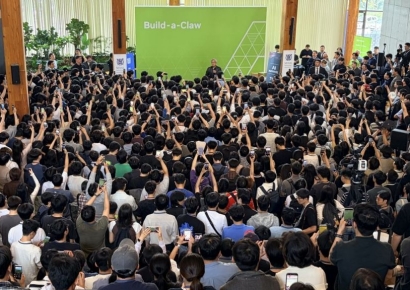 "Why Are There So Many Female Students?" Jensen Huang Surprised During First Visit to Seoul National University in 18 Years
- [Exclusive] Chinese Woman Posing as Wife of Korean Conglomerate Employee Defrauds Acquaintances Out of Billions as 'Two-Faced Investor'
- "Vests Become a 'Symbol of Success' in Korea, Drawing Attention from Foreign Media"
- "This Place Is Crazy, Four Somaek Shots as Soon as I Arrived" "I Feel Like I'm Going to Die"... KakaoTalk Messages Left by Deceased Female Firefighter in Her 20s
- [Breaking] Hwang Inbeom and Oh Hyunkyoo Score as Hong Myungbo's Squad Secures Thrilling 2-1 Come-from-Behind Victory over Czech Republic
Although he was not elected, the candidate who achieved the largest crossover vote was Kim Boo-kyum, the Democratic Party's candidate for Daegu mayor. Kim received 45.1% of the vote, surpassing not only the Democratic Party's proportional vote share in Daegu (33.3%) but also the broad progressive bloc's share (35.1%). Based on his political skills, Kim was able to achieve a result 10 percentage points higher than the progressive bloc's vote share.
© The Asia Business Daily(www.asiae.co.kr). All rights reserved.