Q1 Nominal Growth Rate Up 10.5% in Korea... Largest Increase in 50 Years (Update)
Bank of Korea Releases Preliminary Q1 Growth Rate
Real GDP Up 1.8%... GNI Surges 9.2%
The nominal growth rate, a key indicator of South Korea's economic scale, recorded 10.5% in the first quarter of this year. This is the first time in 50 years that the nominal growth rate has reached double digits since 1976. This surge appears to be driven by a super-cycle in semiconductors, which has led not only to increased production volume but also to a sharp rise in the prices of products sold by Korean companies in overseas markets.

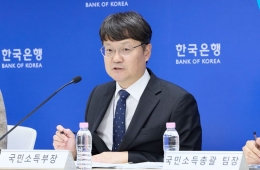
The Bank of Korea announced on June 9 that the country's nominal gross domestic product (GDP) growth rate (provisional) in the first quarter increased by 10.5% compared to the previous quarter. This is the first time in 50 years that the growth rate has reached double digits since the first quarter of 1976 (13.0%).
Compared to the same period a year earlier, the economy grew by 17.1%. This is also the highest rate since the third quarter of 1995 (19.2%).
The nominal growth rate is calculated by applying the GDP deflator, or market prices, to the real growth rate. While the real growth rate, which excludes inflation factors, shows how much the economy has actually expanded (its fundamentals), the nominal growth rate is used as an indicator to assess the overall scale of the national economy.
The main reason for the high nominal growth rate in the first quarter was a 17.0% quarter-on-quarter increase in gross operating surplus (corporate profits minus labor costs), particularly in the manufacturing and financial and insurance sectors. Compensation of employees, representing labor costs, also rose by 4.0% over the same period, driven by higher wages in manufacturing.
The rise in export prices also contributed to the higher nominal growth rate. The GDP deflator, which indicates the general price level in the domestic economy, rose by 12.9% in the first quarter compared to the same period last year. Specifically, the domestic demand deflator increased by 2.1%, while the export deflator surged by 23.5% over the same period.
The real growth rate, which excludes price factors, increased by 1.8% compared to the previous quarter. This is 0.1 percentage point higher than the advance estimate released in March.
The Bank of Korea explained, "The upward revision was due to the inclusion of some actual data for the final month of the quarter, which was not available for the advance estimate, resulting in facility investment being revised up by 1.8 percentage points and private consumption by 0.1 percentage point."
In the first quarter, real gross national income (GNI) increased by 9.2% quarter-on-quarter, significantly outpacing the growth rate. This is the highest increase since the statistics have been compiled. The rise in real GNI was due to improved terms of trade and a sharp increase in net factor income from abroad (the difference between the income earned by Koreans overseas and the income earned by foreigners in Korea), which jumped from 820 billion won to 1.16 trillion won.
Meanwhile, last year's per capita GNI increased by 154,000 won compared to the preliminary figure released in March, reaching 52.57 million won, a 4.6% increase from the previous year. In dollar terms, per capita GNI reached 36,963 dollars, up 108 dollars from the March estimate. However, due to the strong won-dollar exchange rate, the dollar-based growth was limited to just 0.3% year-on-year.
Hot Picks Today
!["This Is the Only Chance for Ordinary People to Become Wealthy"... Expert Recommends This Investment Method [Retirement Pension Investment Strategy] ⑥](https://cwcontent.asiae.co.kr/asiaresize/93/2026060816040991771_1780902249.jpg) "This Is the Only Chance for Ordinary People to Become Wealthy"... Expert Recommends This Investment Method [Retirement Pension Investment Strategy] ⑥
"This Is the Only Chance for Ordinary People to Become Wealthy"... Expert Recommends This Investment Method [Retirement Pension Investment Strategy] ⑥
- "Musk Had Every Reason to Celebrate"... Surprising Korean Record Marked with Taegeukgi
- "Only the Biggest Players First"... Why Ultra-Wealthy Investors Are Flocking to This Investment Opportunity
- "Why Spend Tens of Millions?" Surge in Popularity for 5 Million Won 'Cost-Effective' Weddings
- "Two LG Appliances in Every Upscale Taiwanese Foyer"... K-Appliances Captivate the Wealthy
South Korea's per capita GNI surpassed the 30,000 dollar mark for the first time in 2014 (30,798 dollars) and continued to rise to 37,898 dollars in 2021. However, the exchange rate spike in 2022 caused it to fall to 35,229 dollars, before recovering to 36,195 dollars in 2023. Since then, it has remained in the 36,000 dollar range for three consecutive years, showing a slight upward trend.
© The Asia Business Daily(www.asiae.co.kr). All rights reserved.