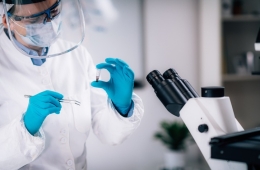
[KR-China Bio Contrast]② Korea Sells at Phase 1, While China Goes All the Way to Phase 3
Clinical Trial Phase Determines Upfront Payments
China's Patient Recruitment Up to Five Times Faster
In the first half of this year, Korean biotech companies have been successfully landing trillion-won technology export deals with global big pharma, raising expectations across the entire industry. However, a closer look at the details of these contracts reveals a reality that differs from outward appearances. Notably, Korean companies receive far less in up-front payments for their technology than Chinese firms do, even when offering similarly promising technologies. This is especially striking given that Chinese companies, leveraging their characteristic speed, have emerged as prominent players on the global stage. Bio-technology is considered a critical strategic national asset for the future, which makes it crucial to examine the root causes of the gap between Korea and China—especially as China strives not only to surpass competitors but also to become a global leader. The Asia Business Daily sheds light on this reality and explores the background as well as possible solutions.
① Despite similar promising technologies, China's up-front payments are three times higher than Korea's
② Korea sells at Phase 1, China advances to Phase 3
③ Raising funds for clinical trials can lead to delisting... Double burden suffocates K-Bio
④ To close the gap, clinical trial speed must increase and delisting regulations must be eased
Fast and Cost-Effective Clinical Trials... The Driving Force Behind China's Higher Valuations
![[KR-China Bio Contrast]② Korea Sells at Phase 1, While China Goes All the Way to Phase 3](http://www.asiae.co.kr/news/img_view.htm?img=2026060911194892859_1780971588.jpg)
China is exhibiting a clear trend of advancing to late-stage clinical trials much faster and at significantly lower costs compared to Korea. In particular, the speed at which Chinese companies recruit patients for late-stage clinical trials is two to five times faster than in the United States or Europe. According to a report released earlier this year by global market research firm McKinsey, China's early-stage process—from new drug discovery to Investigational New Drug (IND) application—is completed 50–70% faster than the global average. This is a key factor behind why, as of 2023, 39% of all clinical trials worldwide were conducted in China.
This speed advantage becomes even more significant as big pharma increasingly focuses on acquiring late-stage assets where clinical risks have been somewhat mitigated. A biotech CEO stated on June 16, "Chinese companies are able to accumulate late-stage data with their own capital and rapid clinical trials. They can afford to say, 'If you don't accept this price, we'll make a deal elsewhere.' In contrast, Korean companies, which only have early-stage assets, find it difficult to take the lead in negotiations."
This is also why many big pharma companies are prioritizing deals with Chinese firms. Zhang Fengning, a McKinsey Greater China Life Sciences Partner, said in a recent interview with an American biotech media outlet, "Big pharma's licensing contracts are based on the belief in China's speed and cost competitiveness; in other words, they believe they can enter the market faster and more cheaply." He added that China's share of global technology deals has soared from 8% to 30% in just two years.
The Negotiation Power Gap Created by Late-Stage Data
The majority of Korean biotech companies are unable to cover the costs of clinical trials and, at best, only manage to reach Phase 2 before selling off their technology. The government also sees this as a structural problem. The Ministry of Health and Welfare established a KRW 150 billion Phase 3 clinical trial fund this year because many cash-strapped companies have repeatedly opted for early technology exports rather than crossing the "valley of death" that is Phase 3. As of the end of last year, there were only 57 new drug pipelines in Korea undergoing Phase 3 trials.
Even with available capital, only a handful of companies have managed to take a drug all the way to global commercialization. The complex medical insurance systems and hospital sales networks of the United States and Europe create high barriers to entry for newcomers, making it more rational to transfer the rights to big pharma and collect royalties rather than attempt direct sales. Only a few companies—such as SK Biopharmaceuticals, which sells the epilepsy drug Cenobamate through its U.S. subsidiary, and Celltrion, which has established a U.S. sales network for its biosimilar Zymfentra—have managed to achieve direct sales. Even these cases required years of effort and massive investments to set up local subsidiaries and secure sales staff. Thus, selling technology at an early stage is less a strategic choice and more a "forced option."
![[KR-China Bio Contrast]② Korea Sells at Phase 1, While China Goes All the Way to Phase 3](http://www.asiae.co.kr/news/img_view.htm?img=2026060909363992470_1780965398.jpg)
This ongoing trend is now shaking even the traditional perception of Korea as a "clinical trials powerhouse." According to the Korea National Enterprise for Clinical Trials (KoNECT), Korea's share of global clinical trials dropped from fourth place in 2023 to sixth in 2024. Seoul, which had held the top global city ranking since 2017, has also fallen to second place, overtaken by Beijing.
As the structure of selling technology at early stages becomes more entrenched, opportunities to build capabilities for advancing late-stage clinical trials are shrinking, raising concerns that the overall capacity for technology development could deteriorate in a vicious cycle. A professor at a clinical trial center in a major Seoul university hospital commented, "Global market evaluations are becoming increasingly stringent about whether Korean companies and the industry ecosystem can take responsibility for seeing clinical trials through to the end." He added, "As China, armed with overwhelming speed, rapidly emerges as an alternative, this trend is only intensifying."
Hot Picks Today
 "Even With 400,000 Won a Day, No Takers... Here, Even Workers in Their 50s Are the 'Youngsters': The Aging Construction Site"
- "Tired of Constant Buying and Selling"... Where SamjeonNix Investors Are Turning [Click eStock]
- "Did They Add an Extra Zero by Mistake?"... The Story Behind an 18 Billion Won Apartment Sold for 172 Billion Won
- The Fruit That Disappeared from Japan Returns as "Korean" and Becomes a Hit
- "Too Cruel"... What Is the 'Natasha' Black Doll Now Banned from Schools?
© The Asia Business Daily(www.asiae.co.kr). All rights reserved.