"Painful Restructuring" Minister Park Hongkeun Considers Ending Tax Revenue Link for Education Grants (Comprehensive)
'Open Discussion on Expenditure Structural Reform' Held at Hongdae on June 8
"15% Cut in Discretionary Spending, 10% Cut in Mandatory Spending"
The government has announced a comprehensive expenditure restructuring plan targeting mandatory spending areas that have long been considered untouchable, such as local education financial grants and basic pensions.

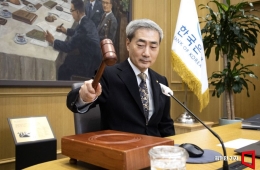
Hongkeun Park, Minister of Planning and Budget, delivers a greeting at the "Open Discussion on Expenditure Restructuring" held on the 8th at SVC Seoul in Mapo-gu, Seoul. Photo by Yonhap News
View original imageHongkeun Park, Minister of Planning and Budget, emphasized at the "Open Discussion on Expenditure Restructuring" held at SVC Seoul in Mapo-gu, Seoul on June 8: "The 2027 budget proposal will be the first budget fully coordinated by the Lee Jae-myung administration throughout the entire budget formulation process," he said. "If we do not carry out a drastic restructuring this year, we may not have another opportunity." Minister Park went on to outline concrete guidelines, stating that all government projects would be reviewed from scratch, with a goal of reducing discretionary spending by 15%, mandatory spending by 10%, and consolidating or abolishing 10% of all projects.
The government's target for next year's expenditure restructuring has been set at 50 trillion won. This is nearly double the annual amount of 23 trillion to 27 trillion won from 2023 to 2026. The Ministry of Planning and Budget, using the newly introduced integrated fiscal project performance evaluation for the first time this year, classified 901 projects—36% of the total eligible—as subject to budget cuts or elimination, achieving a reduction effect of about 7.7 trillion won. However, this amount falls far short of the 50 trillion won target, making the restructuring of mandatory spending essential.
The mandatory spending items at the forefront of restructuring are the education financial grants and basic pension, which were allocated 71.7 trillion won and 24.2 trillion won, respectively, in this year's main budget. In particular, since the education financial grant is linked to 20.79% of domestic tax revenue, if excess tax revenues of 100 trillion won are collected by next year, regional education offices would receive approximately 20 trillion won in additional allocations.
Jeonghwan Lee, Professor of Economics and Finance at Hanyang University, who delivered the keynote presentation, pointed out, "The number of children is plummeting, but the funding automatically increases. With the current formula that allocates resources as a fixed percentage, it is impossible to respond to the needs of future education." He also expressed concern that regional education offices have increased cash welfare projects by more than 3.5 trillion won, leading to a competitive race to promise populist welfare pledges.
Minister Park also stated, "We cannot ignore the declining school-age population, and the rigidity of the domestic tax linkage system must be addressed. Currently, about 74% of education finances are spent on elementary, middle, and high school education, while only 26% is allocated to early childhood, higher, and lifelong education, so it is necessary to correct this imbalance." He added, "We are discussing various scenarios in communication with the Presidential Office, the Ministry of Education, and superintendents of education."

Hongkeun Park, Minister of Planning and Budget, is giving a greeting at the 'Open Forum on Spending Structure Adjustment' held at SVC Seoul in Mapo-gu, Seoul on the 8th. Photo by Yonhap News
View original imageThere was also heated debate over the basic pension, which is expected to severely impact national finances due to the rapid aging of the population. Jaeun Seok, Professor of Sociology at Hallym University, argued, "The current system of uniformly providing benefits to the bottom 70% income group among those aged 65 and older does not fit the transitional period of the baby boomer generation's retirement." He stressed the need to gradually narrow the recipient pool while providing greater support for low-income seniors. Doheon Kim, a researcher at KDI, warned, "If the current system continues, basic pension spending alone will surge to 47 trillion won by 2050," suggesting a model linked to median income as an alternative. Budget Office Director Yongbeom Cho of the Ministry of Planning and Budget also agreed with the basic direction of gradually adjusting the benefit range.
The unemployment benefit (job-seeker's allowance) system, which has long been criticized as a chronic problem in the employment insurance sector, was also discussed. Dongyeol Yoon, Professor of Business Administration at Konkuk University, pointed out issues with the minimum benefit amount and repeated claims, proposing adjustments to the minimum benefit, stricter eligibility requirements, and restructuring the early reemployment allowance. He noted that, for some low-wage workers, unemployment benefits can exceed their previous earnings from work, creating a reverse incentive. Director Cho said, "The issue of the minimum benefit amount has been continuously raised in the National Assembly," and added, "Adjustments to the benefit period and restructuring of the early reemployment allowance will be reviewed as they have public support." Regarding the early reemployment allowance, he indicated the need for reform, stating that "the system has not proven very effective."
Hot Picks Today
 "The Transfer Failed, but 'Ding Dong' Money Came In"... 32.5 Billion Won Financial Incident at Toss Bank
- "They Wouldn't Give It a Second Look When Offered to Ancestors"... MZ Goes Wild for 80-Year-Old Ceremonial Liquor as a Household Must-Have
- Pinky swear: "I'll become a female soldier"... An elementary school student's moving letter of support from 11 years ago
- Arrest Warrant Sought for Daughter in Her 40s Over 'Mother's Murder'; She Denies the Crime in Police Questioning
- The 'Hangover Legend' That Had You Waking Up the Day After Tomorrow Returns After 11 Years... Lee Sunmin's Captain Q Sells Out
Minister Park concluded the forum by stating, "The golden time for structural reform is within the first year to year and a half after a new administration takes office. If we don't resolve these issues now, we will not be able to break the vicious cycle of tens of trillions of won in taxpayer money being wasted inefficiently each year." He added, "Regardless of the amount of excess tax revenue collected, expenditure restructuring will proceed as planned."
© The Asia Business Daily. All rights reserved. Unauthorized AI training and use prohibited.