President Lee: "Supplementary Investigative Authority Will Be Left to the National Assembly... Public Distrust Toward Prosecution Grows"
"I still believe checking the prosecution should not harm the public... but this is the prosecution's own consequence"
"In the past, the prosecution did not manipulate cases... but they have crossed too many lines"
President Lee Jae-myung stated on June 8 that he intends to leave the decision on whether to retain the prosecution's supplementary investigation authority to the National Assembly, regardless of the outcome.

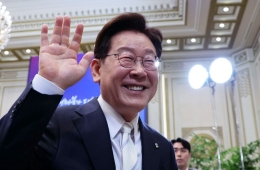
President Lee Jae-myung is speaking at the first anniversary press conference held at the Blue House Guesthouse on June 8, 2026. Photo by Yonhap News
View original imageAt the first anniversary press conference held at the Blue House Guesthouse on this day, President Lee made these remarks in response to a question regarding discussions on the revision of the Criminal Procedure Act. He said, "No system is an absolute truth; each has its pros and cons." This suggests that while he maintains his existing position that the prosecution’s supplementary investigation authority should be retained in a limited manner, he will ultimately defer the legislative direction to discussions in the National Assembly.
President Lee cited the simple verification of factual matters as an example where supplementary investigative powers are necessary. Referring to cases transferred to the prosecution after the police investigation is complete, he mentioned situations such as "if a resident registration number is missing, if there is a possibility of someone having the same name, or if fingerprint verification needs to be conducted properly." He stated, "If such matters do not infringe on human rights or pose a risk of manipulating or distorting the case, then there are supplementary tasks that should be handled efficiently."
He continued, "To take an extreme example, if the statute of limitations is about to expire and time is wasted going back and forth, my view was whether we should completely block even the simple verification of factual matters where there is absolutely no risk of human rights violations." He added, "My view on this has not changed." He explained that although the prosecution's direct investigative powers should be blocked, if even mechanical or supplementary verification procedures are prevented, it could undermine the efficiency of criminal justice proceedings and the rights of the people.
However, President Lee also acknowledged the deep public distrust toward the prosecution. He said, "There are many concerns about what would happen if the prosecution abuses its supplementary investigation authority for wrongdoing, and the distrust toward the prosecution is extremely deep." He added, "This is not an unreasonable argument either."
He further pointed out, "In the past, the prosecution did cause problems, but they did not engage in fabrication. At some point, however, they began to do so." He continued, "It's like saying you could grind a spoon into a knife or do something with wooden chopsticks, so now people are told to eat with their hands." He also commented, "We have to see this as the consequence of the prosecution crossing too many lines and causing too much damage."
Hot Picks Today
 Ballot Box Found in Trash... Peru Holds Runoff Amid 'Ballot Shortage Crisis'
- A Single Market Buy Order Sends SK hynix ETF Soaring 50%... Investors Hit with Sudden Losses
- Samsung Heavy Industries Secures New FLNG Order... Cumulative Orders Reach KRW 15 Trillion
- "I Now Doubt My Students"... Teachers Devastated by Student Deepfake Scandal
- "Click! Gotta Post on SNS"... 'Small Luxury' for 20s and 30s Cools Down Amid High Inflation
In future discussions on the revision of the Criminal Procedure Act, it is expected that the National Assembly will begin earnest coordination on whether to completely abolish the prosecution’s supplementary investigation authority or allow it within a limited or exceptional scope. Since President Lee has acknowledged the limited necessity of such powers while leaving the final decision to the National Assembly, coordination between the ruling party and the government, as well as negotiations with the opposition, are likely to become key variables in the follow-up discussions on prosecutorial reform.
© The Asia Business Daily(www.asiae.co.kr). All rights reserved.




![[Breaking] President Lee Criticizes Election Commission: "No Excuse, Extremely Serious"](https://cwcontent.asiae.co.kr/asiaresize/307/2026060817232560108A.jpg)