Higher Taxes on Non-Owner Properties, Reduced Capital Gains Deductions... Lee Administration's Real Estate Policy Moves Forward as Promised
President Lee Outlines Real Estate Policy in First Anniversary Press Conference
Property and Capital Gains Tax Reforms Expected in July
"Jeonse Loans Are Main Cause of Rising Housing Prices," Hints at Policy Overhaul
President Lee Jae-myung stated at a press conference held on June 8 to mark his first anniversary in office, "Did real estate have any impact on the recent local elections? I consider it a constant factor." By clarifying that he does not see the real estate policies introduced since his inauguration as a major variable affecting election results, he made it clear that he intends to maintain the existing policy direction. It is expected that the current real estate policies—focused on demand suppression through tighter lending regulations and encouraging both new construction and the listing of properties held by multiple homeowners to address the supply shortage accumulated over the past two to three years—will be maintained.
The market's immediate attention is now on the tax reform plan scheduled to be announced next month. Increasing the property tax burden on non-owner-occupied homes is a direction President Lee has consistently emphasized. He commented, "In our country, property taxes are generally low, so even if you accumulate many properties, the burden is minimal. In other countries, simply owning real estate becomes a burden, so at some point people end up letting go of their properties." He continued, "If you make a normal investment and earn a profit, that's fine. But if you buy up land just for speculation, thinking 'this is how you make money,' and this has been the case for decades and will continue to be so, that is the problem I want to address."

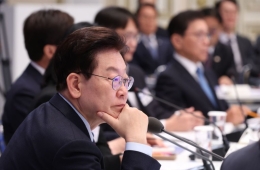
President Lee Jae-myung is speaking at a press conference held on the 8th at the Blue House Guesthouse to mark his first anniversary in office. Photo by Yonhap News
View original imageSpecifically, the plan is expected to include measures to raise the effective property tax rates, such as for property tax and the comprehensive real estate tax. Property taxes in Korea have a progressive structure, with higher rates applied based on the publicly announced price and other tax bases, but there has been ongoing criticism that generous deductions result in an effective tax rate lower than those in advanced economies. In the case of the comprehensive real estate tax imposed on high-value homes, the basic deduction is set at 900 million won (1.2 billion won for a single household with one home), and additional deductions are applied based on the taxpayer's age and length of ownership.
Regarding capital gains tax on real estate, the government has decided to reduce the number of deduction items. For a single household with one home, up to 80% can be deducted by separating ownership and residence periods, but there is a high possibility that the ownership portion will be eliminated or the deduction rate will be lowered. President Lee said, "People pay nearly half of their income in taxes earned through hard work, but for real estate, even if it's worth tens of billions of won, the tax is negligible. We have been a society that encourages speculation."
As for supply measures, President Lee drew a clear line against easing development restrictions in the Seoul metropolitan area or creating large-scale housing sites. While such measures could temporarily dispel concerns about supply shortages, there is a risk of conflict with the government’s ongoing efforts toward balanced regional development. As with his direct intervention to encourage multiple homeowners to list their properties by declaring that there would be "no further extensions" of the capital gains tax exemption, the government is expected to continue pushing for measures to bring more multi-homeowner properties to the market. This is closely linked to property tax reform.

President Lee identified jeonse (long-term rental deposit) loans as the main cause of rising housing prices and as the background of the jeonse fraud crisis, which has become a major social issue. While regular mortgage loans are secured by tangible property, jeonse rights are intangible and cannot serve as loan collateral. Thus, public institutions such as the Korea Housing and Urban Guarantee Corporation (HUG) provide guarantees. This structure has kept jeonse deposits artificially high, creating conditions for jeonse fraud to emerge. President Lee said, "By providing jeonse loans to keep things comfortable in the short term, we ended up with the jeonse fraud crisis. It caused enormous damage, and now we need to normalize the situation."
Having consistently emphasized the role of finance in moving away from a real estate speculation-driven economy, President Lee is also likely to tighten current jeonse lending policies. While there is already a loan limit based on housing prices, it is expected that this threshold will be lowered. Discussions about strengthening requirements for joining jeonse deposit return guarantee products have also been ongoing within both the government and the National Assembly.
Hot Picks Today
 He Left It in the Car and Forgot... "I Nearly Collapsed with Joy": Man Wins $1.48 Million Lottery
- "Please Pay Me at Least 3 Million Won a Month": More Than Half of Young People Today Prioritize "Working Conditions" Over Company Size
- Selling Like Crazy Every Year... 30-Year-Old Hetbahn Takes on a New Challenge: Tastes Better Than "Mom's Home Cooking" [On-Site Report]
- Ran 18 km With 9-Year-Old Tied to Him at the Waist... "Man Banned From Competing for 3 Years"
- Beachgoer Finds 'Plastic' That Turns Out to Be Perfume Ingredient Worth More Than Twice as Much as Gold
President Lee refuted the claim that the sudden rise in jeonse prices has exacerbated housing difficulties. He said, "When the capital gains tax exemption for multiple homeowners ended, many properties were sold. Since those who used to rent out their homes sold them, the supply of jeonse properties decreased." He added, "But did we really see a surge in jeonse prices? That is not the case. The people who bought those homes were mostly those without homes, so the demand for jeonse decreased by that amount. The claim that jeonse prices soared due to a shortage of supply is a narrative created by those who want such an outcome. This, too, is part of the normalization process."
© The Asia Business Daily. All rights reserved. Unauthorized AI training and use prohibited.