President Lee: "Middle East War Unlikely to End Soon...Final Resolution Difficult to Achieve"
Press Conference Marking the First Anniversary of Inauguration
President Lee Jae-myung stated on June 8, "The Middle East war does not appear likely to end easily in the near future," adding, "It is my assessment that we must fully consider the fact that (the United States and Iran) have different conditions and desired outcomes, making it difficult to reach a final conclusion easily."

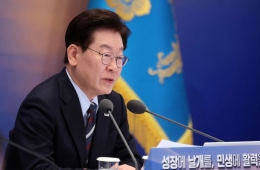
President Lee Jae-myung is speaking at the press conference held at the Blue House State Guest House on the occasion of his first anniversary in office. 2026.6.8 Yonhap News Agency.
View original imageAt the press conference commemorating the first anniversary of his inauguration, held at the Blue House Guesthouse on this day, President Lee responded to questions about the situation in the Middle East war by saying, "Although ceasefire talks are ongoing, bombings are still taking place, and both sides continue to threaten retaliation." Regarding concerns over instability in energy supply due to a prolonged war, he said, "A significant number of oil refining and extraction facilities, airports, and other infrastructure such as oil pipelines have already been destroyed, so even if a ceasefire is reached, recovery will not be easy," and added, "We are preparing countermeasures with full consideration that a considerable period of time will be needed." However, he did not specifically answer questions about whether South Korea would provide the "military contribution" that the United States has openly requested to secure freedom of navigation through the Strait of Hormuz.
Earlier, in his opening remarks, President Lee cited the following as diplomatic and security achievements over the past year through negotiations with the United States: the revision of the Korea-U.S. Nuclear Cooperation Agreement, the introduction of Korean nuclear-powered submarines, and the pursuit of an early transfer of wartime operational control. He stated, "I will do my utmost to ensure that these valuable achievements in diplomacy and security bear tangible fruit."
Just ten days after taking office last year, President Lee immediately participated in summit-level multilateral diplomacy, including the G7 Summit. Over the past year, he has visited 14 countries and held more than 50 summits. President Lee said, "Over the past year, Korea has proven that it is no longer a small nation in the East shaken by great powers, nor a latecomer passively following changes in the international order," and emphasized, "Based on a solid Korea-U.S. alliance, robust self-reliant defense, and pragmatic, national interest-oriented diplomacy, we will continue to strengthen our status and role as a 'global responsible nation.'"
He went on to say, "I will make 2026 the year when Korea embarks on the bold dream of becoming an 'irreplaceable nation' that no country in the world can substitute," adding, "By leveraging Korea's experience, capabilities, values, charm, and the national energy to overcome crises, we will usher in a new era of the 'K-Initiative.'"
Hot Picks Today
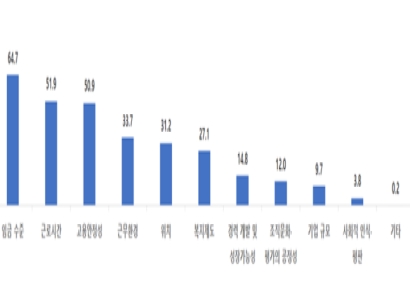 "Please Pay Me at Least 3 Million Won a Month": More Than Half of Young People Today Prioritize "Working Conditions" Over Company Size
- Selling Like Crazy Every Year... 30-Year-Old Hetbahn Takes on a New Challenge: Tastes Better Than "Mom's Home Cooking" [On-Site Report]
- I Thought Only 'Old Guys' Ate It... Young People Are Hooked on This 'Unusual Food' at Risk of Disappearing? [Delicious Stories]
- "Hey, Lady, Teach Your Kids to Behave!" ... 300,000 Won in Cash and a Bodily Injury Claim Demanded Over Child's Door Ding
- Beachgoer Finds 'Plastic' That Turns Out to Be Perfume Ingredient Worth More Than Twice as Much as Gold
Regarding North Korea policy, which has not found a breakthrough since North Korea's declaration of "two hostile states," President Lee stated the basic principle that "peace is growth, and peace is the people's livelihood," adding, "We will steadfastly pursue the path of peace and stability, coexistence, and joint prosperity on the Korean Peninsula."
© The Asia Business Daily. All rights reserved. Unauthorized AI training and use prohibited.