'Black Monday': Won-Dollar Rate Opens in 1,550 Range, Defense Wobbles... Authorities Call Emergency Meeting
The won-dollar exchange rate opened in the 1,550-won range, the highest level since the 2009 global financial crisis. Due to continued selling of domestic stocks by foreign investors for semiconductor profit-taking and the accumulation of factors such as a strong dollar, the won-dollar exchange rate continues to hit new highs. At the current pace, some even forecast that the average exchange rate for the second quarter of this year could reach levels seen during the International Monetary Fund (IMF) currency crisis. Authorities believe that, in addition to structural factors behind the won’s weakness, certain speculative activities arising in offshore markets are further fueling the won’s depreciation, prompting them to launch an emergency market inspection.

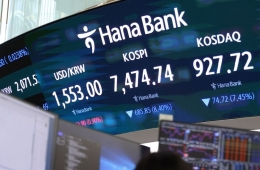
The KOSPI index plunged more than 8% immediately after the market opened on the 8th, falling to the 7400 level. The exchange rate, KOSPI, and KOSDAQ indices are displayed on the status board in the dealing room at the headquarters of Hana Bank in Jung-gu, Seoul. 2026.06.08 Photo by Dongju Yoon
View original imageAccording to relevant ministries on the 8th, the Financial Services Commission and the Financial Supervisory Service will convene an emergency foreign exchange market meeting this afternoon, summoning major domestic banks that handle foreign exchange operations. A financial industry official explained, “Authorities are convening this meeting to discuss institutional response measures, as they believe the herd behavior in the non-deliverable forward (NDF) derivatives market abroad is exacerbating market instability.”
When rumors spread last May about the Taiwanese government allowing currency appreciation in the wake of U.S. reciprocal tariffs, and during the unwinding of yen carry trades following Japan’s interest rate hike in 2024, the won-dollar exchange rate experienced severe volatility in offshore markets. To stabilize the foreign exchange market, authorities are reviewing ways to enhance transparency in the NDF market and to absorb trading into the domestic spot market. Even on the weekend of the 7th, Koo Yoon-chul, Deputy Prime Minister for Economy and Minister of Strategy and Finance, Bank of Korea Governor Shin Hyun-song, Financial Services Commission Chairman Lee Eog-weon, and Financial Supervisory Service Governor Lee Chanjin, among others, held a joint emergency market situation review meeting, stating, “We will not tolerate excessive volatility or one-sided herd behavior.”
On this day, the won-dollar exchange rate in the Seoul foreign exchange market began trading at 1,555.2 won, up 16.1 won from the previous session. This was the highest opening since March 6, 2009 (1,590 won) during the global financial crisis. Over the weekend, the rate peaked at 1,561.5 won in overnight trading, marking the highest point since March 6, 2009 (1,597.0 won). If the current trend continues, the average exchange rate for the second quarter (based on the weekly closing price as of the 5th, 1,490.98 won) is expected to soar to the level seen during the IMF currency crisis in the first quarter of 1998 (1,596.88 won). In the past month alone, the won-dollar exchange rate has shown a wide fluctuation of up to 115 won (from May 6 to June 5). Compared to previous crises—IMF bailout (+900 won), the 2008–2009 global financial crisis (+450 won), and the 2020 pandemic (+115 won)—the short-term fluctuation has been even greater.
The key variable driving the recent exchange rate surge is the heavy selling of domestic stocks by foreign investors. As the KOSPI approached 9,000 points, profit-taking from semiconductors intensified, and demand for portfolio rebalancing added to the pressure. Since the beginning of this year, foreign investors have recorded net sales of more than 118 trillion won in the KOSPI market, with net selling continuing for 20 consecutive trading days. In addition, the strong dollar was further fueled by the prospect of further U.S. interest rate hikes, as inflationary pressure and robust employment indicators persisted. The dollar index, which measures the value of the dollar against six major currencies, rose 0.66% from the previous session to 100.071.
Hot Picks Today
![[Exclusive] "Why Is Only My Stock Not Rising?" The Reason Revealed... Suspicions of 'Stock Price Suppression' Mocking Government Policy [Wealth Succession] Intops②](https://cwcontent.asiae.co.kr/asiaresize/93/2026060808161990499_1780874178.png) [Exclusive] "Why Is Only My Stock Not Rising?" The Reason Revealed... Suspicions of 'Stock Price Suppression' Mocking Government Policy [Wealth Succession] Intops②
[Exclusive] "Why Is Only My Stock Not Rising?" The Reason Revealed... Suspicions of 'Stock Price Suppression' Mocking Government Policy [Wealth Succession] Intops②
- [Breaking] Jensen Huang: "The Future of AI Is Extremely Bright... Now Is the Time to Buy Stocks Cheap"
- [Breaking] KOSPI Plummets... Sell-Sidecar Triggered
- "Making History This Year": National Museum of Korea Draws 3.25 Million Visitors in Just Five Months
- "The Cockroaches Are Coming"... Outraged Gen Z Group Holds First Street Protest

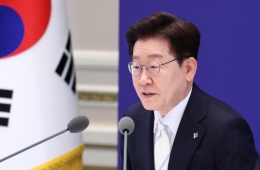
Koo Yoon-chul, Deputy Prime Minister and Minister of Finance and Economy, is presiding over the market situation review meeting held on the 7th at the Korea Federation of Banks in Jung-gu, Seoul. Ministry of Finance and Economy
View original imageAuthorities believe that certain speculative trades are further amplifying exchange rate volatility and are deliberating countermeasures. In particular, they have identified herd behavior in offshore NDF derivative trading as a factor and plan to consider ways to improve market transparency and, if necessary, absorb such trades into the domestic market. Authorities also noted that, during periods of rising exchange rates, domestic export and import companies are delaying dollar sales earned overseas (“leading”) and accelerating dollar purchases (“lagging”) as part of their FX management techniques, which is causing a sharp decline in spot market trading volume. They plan to investigate whether any illegal trades are taking place as a result.
© The Asia Business Daily(www.asiae.co.kr). All rights reserved.
!["Don't Get Excited, Crushes Are Exhausting Too: The 'Crush Recession' Among Gen Z [World is Z Gold]"](https://cwcontent.asiae.co.kr/asiaresize/307/2026060508335888548_1780616038.png)