"Exchange Rate Surge, Government Messaging Ambiguous...Must Break Market Sentiment with Strong Intervention" [Issue Interview]
Interview with Jang Min, Senior Research Fellow at the Korea Institute of Finance
"Even a Base Rate Hike Is Unlikely to Curb the Rise of the Exchange Rate"
"A US Rate Hike Could Become a Turning Point for the Stock Market"

Jang Min, Senior Research Fellow at the Korea Institute of Finance, is giving an interview to The Asia Business Daily. Photo by Dongju Yoon
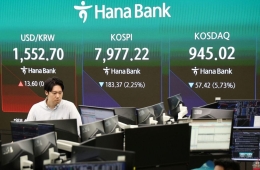
View original imageJang Min, Senior Research Fellow at the Korea Institute of Finance, recently commented on the sharp rise in the won-dollar exchange rate, stating, "The government's messaging has been ambiguous so far." He emphasized, "Since market expectations are converging, the authorities should break market sentiment with a strong willingness to intervene." He also explained, "Even if the Bank of Korea raises the base interest rate, it will be difficult to curb the rise of the exchange rate, as the main factor is not the interest rate gap between Korea and the United States."
Jang further stated, "If inflation in the United States continues to rise, the US will inevitably have to raise its base interest rate. An increase in the US base interest rate would cause a major shock to the global capital market. It tightens liquidity, and institutional investors will have to adjust their portfolios as a result."
Jang is a macroeconomics expert who has served as an economist at the Bank for International Settlements (BIS), head of international and macro-finance research at the Korea Institute of Finance, and as Director General of the Research Department at the Bank of Korea. This interview took place on June 2, 2026, and three additional questions related to the exchange rate were added on the morning of June 8, following a sharp rise in the exchange rate on June 5.
- On Friday, June 5, the exchange rate jumped 25.5 won to reach 1,559.5 won. Do you think the foreign exchange authorities have been too passive in their intervention?
▲The government's messaging has been ambiguous. There were even remarks suggesting that the high exchange rate was an unavoidable cost of success as the Korean economy makes a leap to a new level. In the market, there is also a perception that the government does not have effective tools to respond, which seems to have driven concentrated market expectations.
- Some say the current situation is due to foreign investors selling stocks, retail investors (the so-called 'Seohak ants') investing heavily overseas, and import/export companies holding on to dollars in anticipation of further appreciation, pushing the exchange rate too high. What is the main cause? If these are structural factors, is the rise in the exchange rate inevitable? Still, shouldn't the authorities intervene?
▲The biggest factor is foreign investors leaving the market to realize stock profits, but I believe there is also a strong conviction that the exchange rate will not fall. Given the large current account surplus, this is an unusual situation. The government needs to demonstrate strong policy resolve. Otherwise, the exchange rate will continue to rise. The authorities must break market sentiment decisively by showing a strong willingness to intervene.
- Some argue that since the exchange rate is a price, the focus should be on preventing excessive volatility, rather than worrying about the absolute level. But if the exchange rate is too high, doesn't that have a significant negative impact on prices and the economy overall? What's your view?
▲It's important to prevent excessive volatility, but the absolute level of the exchange rate also matters. A weak won means reduced purchasing power. When the won depreciates, the amount of money you can spend abroad decreases. This is problematic. Apart from the 1997 foreign exchange crisis and the 2008 global financial crisis, we haven't seen the exchange rate this high. The level is something we must be concerned about as well.
- Looking at last month's Monetary Policy Board decision and the governor's press briefing, it seems almost certain that the base interest rate will be raised in July.
▲At the last Monetary Policy Board meeting, there were two dissenting votes in favor of raising the rate. If it hadn't been Governor Shin Hyun-song's first meeting, the rate probably would have been raised. Since it was his first meeting right after taking office, dissenting opinions were recorded as a signal. As the governor said, all major economic indicators—growth, inflation, exchange rate, housing prices, and the stock market—are moving in one direction.
- I hadn't considered the stock market, but do you think it's overheated?
▲When the index approached the 9,000 mark recently, I found it a bit alarming. I think Governor Shin may also feel some need for adjustment.
- It seems everyone is talking about stocks wherever you go.
▲These days, even Buddhist monks are reportedly investing in stocks.
- Since May, foreigners have been net sellers, and it seems only individual investors are holding up the market.
▲Korean stock prices have risen so high that their weight in global portfolios has increased, so investors need to reduce their allocation to maintain their designated ratios. Individuals are liquidating deposits, taking out overdraft loans, and even cashing in insurance policies to invest in stocks. I hear people are even cashing out whole life insurance policies. There's the so-called 'FOMO'—fear of missing out. While whole life insurance yields about 5% a year at best, large-cap stocks like LG Electronics can hit their daily 30% upper limit in a single day.
- When everyone is rushing in like this, it brings to mind the tulip bubble.
▲That's always the case. The same happened with tulips, US railroads, and during the Great Depression. Until the bubble bursts, it's impossible to tell whether it's a bubble or not. In every past bubble, investors rushed in right until just before the crash. Once it pops, the market plunges, but until then, you can't know for sure. Some argue this time is different because of the AI boom and the semiconductor supercycle.
- Even so, shouldn't people be more aware of the risks?
▲They absolutely should. Overdraft loans and margin lending by securities companies have increased significantly. Margin loans are fine when the market rises, but if it falls, forced liquidations accelerate the downturn. Now, there are even double-leveraged single-stock ETFs being launched.
- Single-stock ETFs for Samsung Electronics and SK hynix seem odd. ETFs are supposed to diversify risk by bundling multiple stocks or sectors, but double-leveraged single-stock ETFs are simply a vehicle for leveraged bets on a single stock, which greatly increases risk.
▲That's why the market is starting to look like a speculative playground. If investor sentiment sours, it could trigger major problems. These leveraged products can amplify declines during downturns. Inflation is rising and interest rates are set to increase. The Korean bond market is already pricing in four 0.25 percentage point hikes. In the US, inflation is also rising, so contrary to earlier expectations of rate cuts, cuts now seem unlikely. If inflation continues, expectations are growing that the base interest rate will go up instead.
- If the US raises its base interest rate, what will be the impact?
▲A US rate hike would shock the global capital market. It would tighten liquidity, and institutional investors would have to adjust their portfolios. The impact would be significant.
- In any case, monetary tightening and US rate hikes would negatively affect the stock market.
▲Portfolio adjustments would be necessary, and debt positions and other assets would also need to be rebalanced. A US rate hike is the worst scenario. With inflation staying high, the possibility of US rate increases is rising.

Jang Min, Senior Research Fellow at the Korea Institute of Finance, is giving an interview to The Asia Business Daily. Photo by Dongjoo Yoon
View original image- According to a Brookings Institution report, before the reopening of the Strait of Hormuz, 15 million barrels per day passed through, but this dropped to 2.5 million barrels. The rest was made up by releases from strategic reserves, floating storage on tankers, and sanctions waivers. From March to May, daily supply was about 12 million barrels, but with these temporary buffers disappearing in July, supply could fall to 8 million barrels a day, and international oil prices could rise to as much as $150 per barrel.
▲That is possible. Moreover, with supply chains damaged, even if the Strait of Hormuz reopens, it won't recover immediately. Especially for Korea, the proportion of oil passing through the Strait of Hormuz is highest, along with Japan. Korea, Japan, and India are the top three countries in this regard.
- Consumer prices rose by 3.1% in May, presumably due to supply-side factors. But how much of a role do demand-side factors play?
▲Right now, oil prices have had a direct, primary impact, and sectors that use petroleum products are also affected. However, the oil price cap is limiting the impact for now. Without the cap, inflation would have hit the high 2% to 3% range by March. Since oil contracts are typically made 2-3 months in advance, the effects are delayed. This is the direct impact, but the knock-on effects on manufactured goods and other areas may emerge later.
- So, is the current inflation mainly driven by supply-side factors, while demand-side effects are still limited?
▲Demand is not particularly strong at the moment.
- The first quarter growth rate was high, and the stock market is booming. Is it still too early to see a 'wealth effect'?
▲It appears the wealth effect hasn't materialized yet. For it to occur, people would need to sell stocks and spend the proceeds, but right now, funds are still flowing into the stock market. With expectations of further gains, we haven't reached a stage where people are cashing out to spend. The wealth effect has yet to kick in.
- If the base interest rate is raised, could this reverse the trend of rising exchange rates and housing prices?
▲I don't think so. The current high exchange rate isn't due to the base rate or the interest rate gap between Korea and the US. In the past, the Korea-US rate differential explained much of the exchange rate, but that's not the case now. Even though US rates remained high for a while, since the second half of 2024, the US has started to lower its base rate, and the gap with Korea has narrowed—yet the exchange rate has continued to rise. The exchange rate is currently being driven by foreign investors selling stocks and perceptions of Korea's vulnerability to geopolitical risks.
- By geopolitical risks, do you mean the Middle East situation?
▲Yes. Right now, the yen and won are much weaker than other currencies. For Koreans, Japan is almost the only affordable overseas travel destination. Conversely, many Japanese are visiting Korea for similar reasons. The won's depreciation against the Thai baht is almost double that of other currencies. Korea and Japan are similar in terms of raw material reserves and export structures. A base rate hike or two by the Bank of Korea is unlikely to impact the exchange rate.
- Housing prices keep rising, but historically, rate hikes have often been cited as a factor that slows or reverses housing price increases. Isn't that the case anymore?
▲That used to be the case, but not now. For higher interest rates to lower home prices, there must be sufficient demand. However, with strict lending regulations, especially in Seoul where many homes now cost over 1.5 billion won and key areas like Gangnam exceed 2–3 billion won, a 1 percentage point interest rate increase is irrelevant for most buyers. While higher rates may dampen expectations for further gains, I don't expect an immediate impact on prices. Supply constraints are another problem.
- According to a report by the American Enterprise Institute (AEI), there are concerns that continued fiscal deficits in the US, Japan, France, Italy, and the UK could cause problems in government bond markets. Europe also needs to significantly increase defense spending.
▲Bond yields are expected to keep rising, which is why bonds are currently weak. The most important factor is inflation. High international oil prices are expected to persist for about a year. Even if oil doesn't reach $150 a barrel, supply chain damage and refinery destruction mean prices will take a long time to normalize. As oil prices remain high and inflation persists, countries are more likely to maintain or raise their policy rates. That, in turn, drives up government bond yields.
- A recent Financial Times column, "The End of Cheap," argued that the decades-long era of 'low-cost economic paradigms' driving global growth has come to an end, and that a structurally high inflation and high interest rate era is here to stay.
▲I believe the era of low inflation driven by China's low-cost production ended some time ago. Although China is still pushing exports due to oversupply, wages have risen so much that low-cost production has shifted to Southeast Asia. The structure has changed. Of course, the US-China trade war and rising geopolitical tensions have also increased costs.

Jang Min, Senior Research Fellow at the Korea Institute of Finance, is being interviewed by The Asia Business Daily. Photo by Dongjoo Yoon
View original image- The semiconductor supercycle has been a welcome boon to the Korean economy. There must be positive effects, such as a larger current account surplus, increased consumer spending and investment, and higher tax revenues.
▲Last year, the current account surplus reached a record $123 billion, and in the first quarter of this year alone, the surplus was $73.8 billion. In the first three months, we've already achieved 60% of last year's total. The Bank of Korea's forecast for this year's current account surplus is $250 billion, which is enormous—about 9–10% of GDP. The US uses a 3% of GDP threshold to monitor for currency manipulation; anything above 3% is considered too high, so 9–10% is extraordinary.
- Are there any negative side effects?
▲The semiconductor sector is performing extremely well, but it's uncertain whether this will translate into increased consumption. Samsung Electronics and SK hynix employ about 150,000 people, and the entire semiconductor industry probably employs around 200,000—just 2–3% of total employment and about 4% of manufacturing jobs. The remaining 96% receive no performance bonuses or similar benefits. The gap is widening. Semiconductors have a very small employment multiplier. Polarization is likely to become a major issue.
- According to Choi Byungchun, a specialist at the law firm Sejong, in his book "Good Inequality," Korea's export booms have historically coincided with widening inequality.
▲The result is that when exports are strong, export companies and large corporations prosper while the rest lag behind, exacerbating inequality. But when big companies perform poorly, everyone else does too, so inequality narrows, though overall conditions worsen. While this isn't inherently bad, persistent inequality can undermine the foundations for growth, foster social resentment, and become a source of instability. We must strive to address this issue.
- There are differing views on how to use the unexpected tax windfall from the semiconductor supercycle. Options include government debt repayment, establishing a sovereign wealth fund, or supplementary budgets.
▲Think of it as a bonus, not a recurring windfall. If you received an unexpected bonus, would you spend it on travel, leisure, savings, or future investments? The government faces the same choice—it can't do just one thing. The Ministry of Strategy and Finance may allocate some to a sovereign wealth fund, but not all. Some will go toward debt repayment. It's also wise to reduce deficits in boom times to prepare for future downturns. In addition, strengthening social safety nets for vulnerable groups is important, though these should avoid rigid expenditures.
- In 2025, per capita GNI was $36,855, and the year-end won-dollar exchange rate was 1,439 won. Based on the OECD's projected 2.6% growth and a 7.6% GDP deflator, nominal growth this year is about 10%. If the exchange rate stabilizes at last year's level, per capita income could surpass $40,000 by the end of this year.
▲After first surpassing $30,000 in 2014, we've failed to break through the $40,000 barrier for 11 years. In 2021, it reached around $38,000, but then fell due to unfavorable exchange rates. In most countries, the jump from $30,000 to $40,000 takes about four years; in Taiwan, it took seven. But what's important isn't just exceeding $40,000, but sustaining it. Japan exceeded $40,000 but dropped back below $30,000. If the semiconductor supercycle proves temporary, we could fall below $40,000 again.
Lowering the exchange rate is also important, but this depends largely on how the outside world perceives our economy. We need to enhance credibility through industrial restructuring, reforms in labor and medical personnel, and other structural changes.
- The "Yellow Envelope Law" is seen as being too favorable to unions and could pose a serious problem.
▲Even now, public sentiment toward unions is quite negative, and Samsung Electronics' labor strike over performance bonuses is a case in point. Just as the progressive government led by Roh Moo-hyun pushed for the Korea-US FTA, progressive administrations sometimes have a better chance to persuade unions and pursue structural reforms. In this regard, the current administration seems to be lacking.
- With the foreign exchange market becoming 24-hour starting July 6, will the influence of the offshore NDF (non-deliverable forward) market diminish and the won-dollar exchange rate become more stable?
▲Currently, the market closes at 2 a.m. and reopens at 9 a.m., so overnight developments are reflected all at once in the morning, increasing volatility. Moving to 24-hour trading will reduce this. One concern is that with low trading volume at night, volatility could rise if someone attempts to manipulate the market. Still, this is the right direction, and won internationalization is also necessary for inclusion in the MSCI Developed Market Index.
- Is it advisable to pursue internationalization of the won? Until about 2010, there were concerns that this would increase foreign exchange risks and make the currency vulnerable to speculative attacks.
▲Those concerns stemmed from the trauma of the 1997 foreign exchange crisis, which led to strict controls on foreign currency inflows and outflows. Now that Korea's net external financial assets exceed $700 billion, it is appropriate to open up. Korea is the world's 12th largest economy, and even much smaller Southeast Asian countries have internationalized their currencies. As long as the authorities are confident in managing market risks—even if speculators attempt to manipulate the won—opening up is the right approach. It's a matter of government confidence.
- When the exchange rate spiked last year, the Ministry of Economy and Finance's off-the-record briefing gave the impression that the ministry was very confident.
▲In that case, they should proceed. There is also talk of stablecoins now. Some argue that if dollar stablecoins become too widespread, they could undermine monetary sovereignty, so a won-based stablecoin is needed. If the won is not internationalized, a stablecoin cannot function. Foreigners need to be able to create won-based stablecoins. Issuing them only for domestic use would be meaningless.
- Is a won-based stablecoin really necessary? Couldn't we just use a central bank digital currency (CBDC)?
▲The question is less about necessity and more about business viability. Dollar stablecoins like Tether are massive in scale. The companies behind them earn 3–4% interest on their huge holdings of government bonds and cash, generating enough profit to sustain their operations. Would a won-based stablecoin company be able to exceed 10 billion or 100 billion won in scale? Even at 100 billion won, that's only 3 billion won in annual interest—hardly enough to cover operational and system costs. Would demand reach several hundred billion or over 1 trillion won? Dollar-based stablecoins are used globally, not just by Americans. Even in Korea, foreign workers reportedly receive their salaries in dollar stablecoins.
- Is that because remittance costs are too high?
▲In many countries where foreign workers in Korea come from, there aren't many bank branches, so remitting money through banks is difficult. With dollar stablecoins, workers can send money instantly to their families' mobile phones, and local agents drive around to convert stablecoins into local currency. Transfers take place phone-to-phone, without banks. Many import/export companies also use stablecoins to avoid currency conversion fees.
- So dollar stablecoin demand must be huge.
▲It's enormous. That's why, last year, Tether reportedly ranked fourth globally in US Treasury purchases. Including all countries, Tether ranks 17th in terms of US Treasury holdings.
Hot Picks Today
 Ballot Box Found in Trash... Peru Holds Runoff Amid 'Ballot Shortage Crisis'
- "Brothers, You've Been Waiting for News?"... Orphanage Library Built Thanks to 'Money Brag' by SK hynix Employee
- "Exactly the Same Early Voting Results in Songdo 1-dong and 2-dong?"... Uproar Over Ballot Counting
- "A Mother's Quick Reflexes Save Child from BRT Bus Rushing onto Sidewalk"
- "Click! Gotta Post on SNS"... 'Small Luxury' for 20s and 30s Cools Down Amid High Inflation
- Does this mean US sanctions and financial restrictions via SWIFT, the interbank messaging system, are ineffective?
▲Even so, the US has strong incentives to allow this, because it issues a vast amount of government bonds, and dollar stablecoins provide significant demand. The dollar's dominance is only growing online. Dollar-based stablecoins make up 99% of the total, a near monopoly. Euro-based stablecoins have been issued for some time, but account for less than 1% of the market.
© The Asia Business Daily(www.asiae.co.kr). All rights reserved.