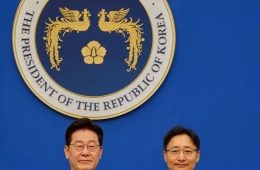
'Speaker-Elect' Jo Jung-sik Vows "Effectiveness in Addressing Livelihood Issues, Not Political Strife"
Won 267 out of 276 Votes Cast
Jo Jung-sik, a lawmaker from the Democratic Party of Korea who was elected as the Speaker for the latter half of the 22nd National Assembly, stated on June 5, "I will do my utmost to ensure that the 22nd National Assembly is remembered by the public for its tangible results, not just rhetoric, and for its effectiveness in addressing people's livelihoods rather than political strife."

Jo Jung-sik, the newly appointed Speaker of the National Assembly, is attending the '436th National Assembly (Extraordinary Session) 1st Plenary Session' held at the National Assembly main chamber in Yeouido, Seoul, on June 5, 2026, giving his acceptance speech. Photo by Kang Jin-hyung
View original imageSpeaker Jo remarked, "There is a saying that has always been engraved in my heart throughout my political life: 'Do your best and leave the rest to fate (Jininsadaecheonmyeong).'"
He continued, "A member of the National Assembly is a representative of the sovereign people, and the Speaker must be at the forefront of safeguarding popular sovereignty. I will look only to the people and follow only their mandate. I will prove myself to the people with concrete achievements."
He then outlined his main priorities: advancing livelihood legislation with speed, expanding public participation, presenting future agendas for the Republic of Korea, and systematizing parliamentary diplomacy.
Speaker Jo added, "I will ensure that the public can truly feel the effectiveness of politics." He announced plans to regularize plenary sessions and set it as a principle to process all bills that have passed standing committees and the Legislation and Judiciary Committee within the same session.
He also proposed ways to expand public participation. His plan includes institutionalizing legislative expos and social dialogues, and enhancing the effectiveness of the petition system to lower the barriers to the National Assembly.
Referring to last year's martial law crisis, he proposed designating December 3 as "National Sovereignty Day."
Speaker Jo also initiated discussions on constitutional amendment. He noted, "Next year marks the 40th anniversary of the 1987 constitutional system. It is time for the National Assembly to resolve the long-standing issues it has postponed." He emphasized, "The current constitutional system has limitations in guaranteeing fundamental rights of the people in this changing era. A constitutional amendment is needed to realize popular sovereignty and to establish effective and accountable politics."
He further stated, "The preamble of the Constitution should explicitly mention the Busan-Masan Democratic Uprising and the May 18 Gwangju Democratization Movement, and parliamentary oversight over martial law must be strengthened." He added, "We must strengthen responsible politics by restructuring the power structure and realize the principle of separation of powers by transferring the Board of Audit and Inspection to the National Assembly."
He continued, "Next year is an opportune time to properly discuss constitutional amendments, as there will be no nationwide simultaneous elections." He urged, "Let us fulfill our generational duty by enacting a constitutional amendment that embodies the aspirations of the people and the future of our nation."
Hot Picks Today
![[Breaking] North Korea's Kim Yo Jong: "Southern Border Unstable... Reviewing Resumption of Loudspeaker Broadcasts to South Korea"](https://cwcontent.asiae.co.kr/asiaresize/93/2026101512403462023_1792035635.png) [Breaking] North Korea's Kim Yo Jong: "Southern Border Unstable... Reviewing Resumption of Loudspeaker Broadcasts to South Korea"
[Breaking] North Korea's Kim Yo Jong: "Southern Border Unstable... Reviewing Resumption of Loudspeaker Broadcasts to South Korea"
- "Please Let Me Go Home"... Customers Trapped in Department Store Parking Lot for 5 Hours Vent Their Anger
- "I Should Enjoy It After Retirement": Prices Quadruple... Memberships Over 100 Million Won Popular, but Closures Mount
- Safety Concerns, Administrative Burden... Teachers Seek Solutions for School Trips
- "Come Live With Me on My Farm": Man Sells Everything and Travels 1,930 km, Trusting a Beautiful Woman
On the afternoon of the same day, Jo was elected as the Speaker of the National Assembly with 267 votes in favor out of 276 lawmakers present at the plenary session. His term will last for two years, until May 2028.
© The Asia Business Daily. All rights reserved. Unauthorized AI training and use prohibited.