[Real Asset Strategies] Semiconductor Stocks Are Attractive, but Sector Diversification Deserves Attention
Foreign Investors Shift from Semiconductors to Non-Semiconductor Sectors
Non-Semiconductor Sectors in the Spotlight: Securities, Distribution, and Energy
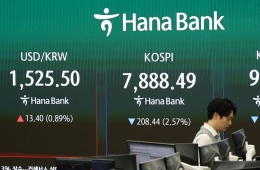
Recently, the KOSPI has shown a rollercoaster performance. On the day the KOSPI index surpassed 8,000 for the first time, a wave of profit-taking sales triggered a sharp plunge back to the 7,000 range. The index later surged again to the high 8,000s, only to decline once more, resulting in an unpredictable trajectory. As volatility continues to center around semiconductor stocks—the main growth engine—voices are emerging that stress the need to diversify portfolios by including undervalued non-semiconductor sectors.
What Does Volatility Signal? ... Semiconductors Reach Profit-Taking Zone
On May 15, the KOSPI index exceeded 8,000 during trading for the first time, reaching 8,046.78 before plunging sharply. Due to a surge in profit-taking, the KOSPI finished the day at 7,493.18, falling 553.6 points (6.88%) from its intraday peak. Since then, the KOSPI has entered a period of heightened volatility. As the index’s gains have been largely driven by concentrated investments in Samsung Electronics and SK hynix, profit-taking sales are emerging. In particular, foreign investors have been heavy sellers.
As of the 5th, the combined market capitalization of Samsung Electronics and SK hynix accounted for about 49% of the KOSPI, reflecting this concentration. While most analysts agree that this is tangible growth tied to the semiconductor cycle, there is also speculation that, as large institutional investors such as foreign funds and pension funds adjust their portfolios mechanically, this round of profit-taking could channel funds into non-semiconductor sectors.
Following Foreign Investors’ Insight ... Domestic Demand Sectors Top the List
If high semiconductor stock prices seem daunting, what about entering non-semiconductor sectors? According to iM Securities’ Research Division, the KOSPI’s earnings growth rate next year is projected to rise 25.8% from the previous year. While the main driver is expected to be semiconductor-led growth, the KOSPI’s growth rate excluding semiconductors is also forecast at 15.7%—by no means a small figure.
Sectors expected to remain at the center of rallies next year are those with strong operating profit momentum. Looking at next year’s sector-by-sector operating profit momentum: semiconductors are expected to grow by 126.4%, trading companies and capital goods by 46.2%, IT hardware by 19.6%, securities by 18.7%, and IT home appliances by 11.7%.
![[Real Asset Strategies] Semiconductor Stocks Are Attractive, but Sector Diversification Deserves Attention](http://www.asiae.co.kr/news/img_view.htm?img=2026061007421893638_1781044939.jpg)
A look at sectors where foreign investment ratios are rising makes the trend even clearer. According to iM Securities’ Research Division, from the start of the year until May 18, the leading sectors in which foreign shareholdings increased were nonferrous metals and lumber (10.8%), IT hardware (5.0%), IT home appliances (4.6%), consumer staples (3.5%), cosmetics, apparel, and toys (3.4%), retail and distribution (3.2%), and energy (2.2%)—with domestic demand-related sectors ranking high. In contrast, the semiconductor sector saw a 1.8% decrease.
Sectors in the Spotlight: "Securities, Distribution, and Energy"
In Yeouido’s financial district, the non-semiconductor sectors drawing attention—based on both earnings and market supply-demand factors—are securities, distribution, and energy.
The securities sector is expected to benefit from higher brokerage commissions amid expanded trading volumes in the Korean stock market. Thanks to robust stock performance driven by the semiconductor boom and the launch of integrated accounts for foreign investors, the domestic stock market is becoming even more attractive. Including NextTrade (NXT), average daily trading volume, which stood at around 37 trillion won in the fourth quarter of last year, expanded to about 67 trillion won in the first quarter, and has reached a cumulative 78 trillion won in the second quarter, showing an upward trend.
Securities firms’ assets are also on a growth trajectory. According to iM Securities’ Research Center, the assets of securities firms under coverage have increased by an average of 15.6% since the start of the year. This is due to rising customer deposits, improved risk asset investment sentiment driving increased sales of financial products such as ELS and RP, and greater capital-raising through note issuance and IMA sales as risk appetite improves.
Yongjin Seol, a researcher at iM Securities, said, "Given the recent policy measures to revitalize the stock market and the expansion of venture capital investment, the role of the securities sector within corporate finance is growing. In this environment, companies with high earnings sensitivity to trading volume and those aggressively leveraging will stand out."
![[Real Asset Strategies] Semiconductor Stocks Are Attractive, but Sector Diversification Deserves Attention](http://www.asiae.co.kr/news/img_view.htm?img=2026060509573388865_1780621053.png)
Signs of a domestic demand recovery amid asset market inflation are drawing attention to distribution and cosmetics/apparel sectors as well. Department stores, for instance, have posted first-quarter results exceeding market expectations, continuing their upward momentum. In addition, as the won-dollar exchange rate remains in the 1,400–1,500 won range, foreign purchasing power is increasing, and the resurgence of K-culture is driving more foreign travelers to Korea, supporting this positive trend.
Jinhyub Lee, a researcher at Hanwha Investment & Securities, said, "Foreigners contributed about 3 percentage points to department stores’ same-store sales growth in the first quarter. If the proportion of foreign sales exceeds double digits in the second half, their contribution could expand to the high single-digit percentage points." Beyond department stores, foreign inflows are expected to continue at duty-free shops, road shops, and select shops.
The energy sector is also attracting attention. This is due to soaring power demand from AI data centers and the high oil price environment caused by Middle East turmoil. According to a report by Daishin Securities last month, since November 26 of last year, the forward EPS (earnings per share) of the energy sector has risen about 160%, but stock prices have only increased about 60%, indicating the sector remains undervalued relative to earnings.
Within the energy sector, solar power is particularly promising. As the United States fosters the solar industry as a key energy asset—not just to ensure power supply but to secure dominance in the space industry—Korean solar companies that meet Non-PFE (Non-Prohibited Foreign Entity) requirements are also likely to be re-evaluated. Jaesung Yoon, a researcher at Hana Securities, noted, "Given the US-China space race, it is inevitable for the US to foster solar power and localize its supply chain. In the short term, as data center construction shifts from the Middle East back to the US, demand for solar plus energy storage system (ESS) combinations as an alternative is also rising, which is positive."
Hot Picks Today
 "Spent More in Crisis": Samsung Pours 90 Trillion Won Annually, Dominates Semiconductor Investment Rankings
- It Soared 192% in a Year... A Stock Now Targeted at 1.2 Million Won [This Week's Hot Stock]
- [Exclusive] National Growth Fund to Invest 300 Billion Won in Yahwol Offshore Wind Project... Boosting Domestic Wind Power Supply Chain
- After-Work Side Job Planners Flock in for '130,000 Won a Month' Allowance, but Side Effects Grow [Financial Microscope]
- Model Y Tops Sorento and Grandeur: "Korea is Awesome"—Musk Gives Rare 'Shout-Out' as Sales Hit No. 1
For crude oil, a traditional energy source, there is a view that Asia’s crude oil procurement has diversified since the Strait of Hormuz incident, enhancing relative bargaining power with the Middle East. Oil refiners’ profits (refining margins) are also expected to remain strong due to supply shortages from war and increased demand during the winter season in the second half of the year.
© The Asia Business Daily(www.asiae.co.kr). All rights reserved.


![Festered and Finally Burst... The Bare Face of 'Election Judgment' [Data Pick]](https://cwcontent.asiae.co.kr/asiaresize/307/2026061009353894036_1781051738.png)