Kioxia’s 50-Fold Stock Surge on Single-Minded NAND Focus... The Rise of Toshiba’s “Troubled Child” [Mwonil Issyu]
IPO Price Surges from 1,440 Yen to 80,000 Yen per Share
Fell Behind in Competition with Sole Focus on NAND Flash
AI Boom Drives Data Center Demand, Leading to Dramatic Turnaround
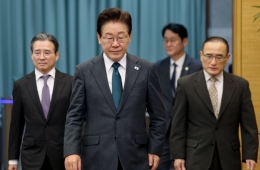
Following SoftBank last week, the company that set the Japanese stock market abuzz this week was none other than memory semiconductor manufacturer Kioxia. On June 3, Kioxia’s share price jumped over 7% during trading, even briefly surpassing Toyota Motor Corporation in terms of market capitalization.
Japanese media outlets raced to report the news. Kioxia’s market capitalization, which was around 800 billion yen (767.02 billion won) at the time of its IPO in December 2024, soared past 45 trillion yen (431 trillion won). Shares that debuted at an offering price of 1,440 yen (13,816 won) at the end of 2024 have now soared to nearly 80,000 yen (760,000 won) per share. Hiroo Ota, President of Kioxia, told Japanese media, “I was surprised myself.”

There are understandable reasons for this. Kioxia has been through numerous ups and downs. The company traces its roots to Toshiba. In 2015, Toshiba was hit by an accounting scandal and significant losses from its nuclear power business, which led to management turmoil and the eventual sale of its core business, “Toshiba Memory.” A consortium including Bain Capital from the United States and SK hynix acquired the business for 2 trillion yen (19 trillion won) in 2018, and the company was rebranded as Kioxia in 2019.
The situation didn’t get much easier after that. Kioxia had to compete in the global market against giants like Samsung Electronics, SK hynix, and Micron. Memory semiconductors are divided into DRAM, which temporarily stores data during processing, and NAND flash, which stores data for the long term.
While Samsung Electronics and SK hynix produce both DRAM and NAND flash, Kioxia focuses exclusively on NAND flash. The issue was the market environment. As DRAM used in PCs and smartphones came to dominate, the NAND flash market experienced sluggish demand and falling prices. As a result, Kioxia posted significant losses in both 2023 and 2024. This led to repeated delays in its listing, which finally took place in December last year.
The turning point was artificial intelligence (AI). The proliferation of generative AI has spurred the construction of data centers everywhere, rapidly increasing demand for NAND flash, which is essential for storing large volumes of data over long periods.
![Kioxia’s 50-Fold Stock Surge on Single-Minded NAND Focus... The Rise of Toshiba’s “Troubled Child” [Mwonil Issyu]](http://www.asiae.co.kr/news/img_view.htm?img=2026060510062688918_1780621586.jpg)
As demand for NAND flash surged, Kioxia’s performance rebounded sharply. For the fiscal year ending March 2026 (April 2025 to March 2026), sales jumped 37% year-on-year to 2.3376 trillion yen (22.4124 trillion won), while profits more than doubled to 554.4 billion yen (5.3154 trillion won), both marking all-time highs. Some industry experts now predict that Kioxia’s net profit for the fiscal year ending March 2027 (April 2026 to March 2027) could surpass that of Toyota Motor Corporation. Japanese media are praising Kioxia’s strategy of focusing solely on NAND flash as a success.
Many recent articles have compared the surges in SoftBank and Kioxia’s share prices. While SoftBank has generated returns by investing heavily in AI-related companies such as OpenAI, analysts point out that Kioxia differentiates itself by generating profits from its own core business.
Of course, there are concerns. The memory semiconductor industry is known for its boom-and-bust cycles, which typically repeat every three to four years. While the surge in NAND flash demand has improved Kioxia’s results for now, it is unclear how long this momentum can be sustained. The Asahi Shimbun pointed out that Samsung Electronics, SK hynix, and even Chinese companies are expanding their NAND flash production capacity, forecasting even fiercer competition ahead.
There are also calls for a stock split. Japanese stocks are generally traded in lots of 100 shares, but with Kioxia’s share price near 80,000 yen (760,000 won), the minimum investment amount has soared to 7.8 million yen (74.78 million won). This has led to complaints among retail investors that “it’s a stock people want to buy but simply can’t afford.” The Nihon Keizai Shimbun (Nikkei) has also pointed out that a stock split is needed to broaden the investor base.
Hot Picks Today
!["Why Securities Analysts Expect the KOSPI to Hit 9,500 Next Week [Weekend Money]"](https://cwcontent.asiae.co.kr/asiaresize/93/2026062409233021342_1782260609.jpg) "Why Securities Analysts Expect the KOSPI to Hit 9,500 Next Week [Weekend Money]"
"Why Securities Analysts Expect the KOSPI to Hit 9,500 Next Week [Weekend Money]"
- Even Record Earnings from Samsung and SK Hynix Can't Strengthen the Won... How High Will the Soaring Exchange Rate Go? [Weekend Money]
- Delisted for Outperforming Expectations? What Happened to These "High-Flying" ETFs [Weekend Money]
- NPS Moves the KOSPI: How Much Will It Need to Sell If the Index Surpasses 9,000? [Weekend Money]
- Two Typhoons Make Landfall Simultaneously, Earthquake Risk Looms... Record 250mm Per Hour Downpour Hits Japan
Thus, the memory business that was once Toshiba’s “troubled child” has now emerged as a new leader of the Japanese stock market. The key question is whether Kioxia can maintain its strong performance once the AI boom subsides. There is keen interest both inside and outside Japan as to whether Kioxia’s all-in bet on NAND flash will continue to pay off.
© The Asia Business Daily. All rights reserved. Unauthorized AI training and use prohibited.