Foreign Investors Net Sell 7 Trillion Won... Won-Dollar Exchange Rate Surpasses 1,540 in After-Hours Trading (Comprehensive)
Despite Verbal Intervention by Koo Yoon-cheol,
Highest Level Since the Global Financial Crisis

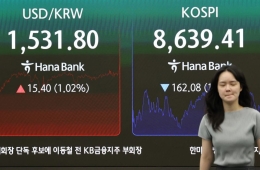
The won-dollar exchange rate surpassed 1,540 won during after-hours trading. This is the first time since March 2009 that the exchange rate has exceeded 1,540 won. It is believed that the value of the won fell due to increased risk aversion, triggered by stalled Middle East negotiations and the growing possibility of U.S. tariff impositions, as well as nearly 7 trillion won in net selling by foreign investors on the KOSPI market.
On June 4, in the Seoul foreign exchange market, the won-dollar exchange rate hit an intraday high of 1,540.3 won at around 5:06 p.m. This is the highest level in approximately 17 years and 3 months, since March 10, 2009, when the rate peaked at 1,561.0 won during the global financial crisis.
The exchange rate opened at 1,530.0 won, up 13.6 won, and briefly fell to the 1,520-won range after Deputy Prime Minister and Minister of Economy and Finance Koo Yoon-cheol made verbal interventions, but rose again before closing, finishing weekly trading at 1,529.7 won.
This marks the 13th consecutive trading day that the exchange rate has remained above 1,500 won. This is the longest stretch since the foreign exchange crisis, when the rate stayed above 1,500 won for 49 consecutive trading days from late December 1997 to early March 1998. It also surpasses the streaks of 11 trading days from February 24 to March 10, 2009, during the global financial crisis, and 9 trading days from March 26 to April 7 this year, immediately following the outbreak of the Middle East war.
While the domestic foreign exchange market was closed for the June 3 local elections, the risk aversion sentiment intensified as the Office of the United States Trade Representative (USTR) announced tariff impositions on Korean products, and the U.S.-Iran ceasefire negotiations faltered amid continued military clashes. In fact, in the offshore non-deliverable forward (NDF) market on the day before the June 3 local elections (June 3), the won-dollar exchange rate had already surged to 1,536 won.
Net selling by foreign investors in the KOSPI market, amounting to 6.988 trillion won, also contributed to the situation. Foreign investors have been net sellers for 19 consecutive trading days since May 7. International oil prices have risen for three consecutive days, reaching the high end of the 90-dollar-per-barrel range, while the dollar index stood in the mid-99 range.
Hot Picks Today
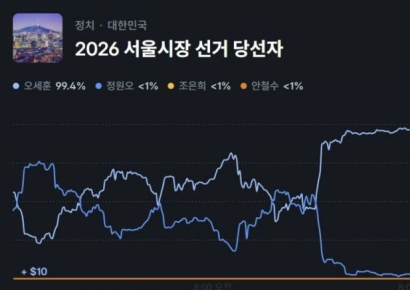 Foreign Investors Lament Huge Losses in an Instant as Oh Sehoon Overtakes Jeong Wonoh in Seoul Mayoral Election Bets
- "I Can No Longer Work With Such an Incompetent Group"... Songpa District Official Slams Election Commission
- "Ballot Boxes Must Leave to Confirm Oh Sehoon," Authorities Say, but "Re-vote Needed"—Jamsil 7-dong Blocks Vote Counting
- Coveting a Friend's 13 Million Won Gold Necklace... Gave Sleeping Pill-Laced Drink and Stole It
- "I Feel Safer on the Streets Where I Can See Everyone"... Homeless at Seoul Station Exposed to Sexual Offenses and Violence
The yield on government bonds also soared. In the Seoul bond market, the yield on three-year government bonds closed at 3.858% per annum, up 8.5 basis points (1bp=0.01 percentage point) from the previous trading day. This is the highest level since November 14, 2023, when it was 3.857%.
© The Asia Business Daily(www.asiae.co.kr). All rights reserved.