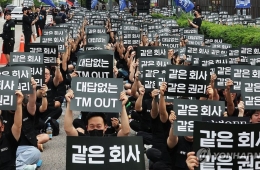
Samsung BioLogics Faces Appeal Over Strike Injunction...Will the Importance of 'Continuous Processes' Be Recognized?
Injunction Only Prohibits Strikes in Final Processes
Will Recognition of Continuous Operations Expand the Scope of Strike Bans?
An appellate hearing will be held regarding Samsung BioLogics’ request for an injunction to prohibit strike actions by its labor union. Whether the ruling that applies the “maintenance of normal operations” precedent—originally established for continuous processes in the semiconductor industry—and whether the union’s violation of the first-instance decision will lead to a prohibition of strikes in key processes are expected to be major variables in this case.
On June 5, the Incheon Division 1 Civil Chamber of the Seoul High Court will hold the first hearing of the appeal filed by Samsung BioLogics against its labor union regarding the injunction to prohibit strike actions.

This trial is the appellate review of the injunction, part of which was granted by the court on April 23. At that time, the court ruled that, considering the unique characteristics of continuous processes in biopharmaceutical manufacturing, the union must not strike over certain essential tasks during industrial action. This decision recognized the necessity for safety tasks to prevent deterioration or spoilage of raw materials or products, as stipulated in Article 38, Paragraph 2 of the Trade Union Act, as being applicable to the bioindustry. However, the court excluded some of the most critical production processes, such as cell culture, from the strike prohibition.
Because biopharmaceutical production involves living cells, processes must proceed continuously based on strict procedures and timing. An industry insider commented, “It is hard to say that the unique characteristics of the bioindustry were properly considered in the first trial, which is why the company decided to file an appeal.”
At an expert roundtable hosted last month on May 15 by the Shareholder Action Research Institute, Seunghoon Kang, professor of Biopharmaceutical Engineering at Inha University, pointed out, “If management is interrupted or proper control is not maintained during the process, low-quality biopharmaceuticals may be produced. Current quality control or analytical methods may not reveal these issues, but in the future, unforeseen quality problems could emerge.”
Legal professionals suggest that the appellate court could reach a different conclusion from the first trial. This is due to new legal standards recently established in the semiconductor sector, another industry with continuous processes. Recently, the court sided with management in an injunction case filed by Samsung Electronics to prohibit strike actions. The court emphasized that semiconductor manufacturing processes are designed for uninterrupted 24-hour operation, and even temporary suspensions could cause significant losses such as lower yields and wafer losses. In particular, the court specified that during a strike, “the same level of manpower, operating hours and scale, and duty of care as before the industrial action” must be maintained in order to meet normal operation standards.
One legal professional stated, “Since this ruling was handed down after the Samsung BioLogics injunction, the high court is likely to take it into consideration. It appears that the court is moving in the direction of better securing companies’ rights to conduct business, taking the seriousness of strikes into account.” In addition, the union’s actions since the first-instance injunction decision may prompt a stricter judgment from the court. The union has continued to stage full-scale strikes in some processes where industrial action had been prohibited, thus violating the court’s decision.
Previously, the court had ordered the union not to instruct its members to suspend work or distribute related guidelines for operations where strike actions had been prohibited. However, it was found that the union ignored this, distributing strike instructions asserting that it was legal for all workers in those processes to participate in the strike. As a result, the court has now issued an indirect compulsory order, requiring the union to pay 20 million won to the company for each violation of the injunction.
Hot Picks Today
!["Spend 200,000 Won, Get 100,000 Won Back?"... Government's Bold Move Unveiled [Essential Tips for Benefits]](https://cwcontent.asiae.co.kr/asiaresize/93/2022101316351067863_1665646511.jpg) "Spend 200,000 Won, Get 100,000 Won Back?"... Government's Bold Move Unveiled [Essential Tips for Benefits]
"Spend 200,000 Won, Get 100,000 Won Back?"... Government's Bold Move Unveiled [Essential Tips for Benefits]
- Received Suspended Prison Sentence for Stalking Unknown Teenage Girl While on Trial for Sex Crimes
- Starbucks' Sales Slump Reverses: Surprise Comeback Against Twosome Place as Card Payments Rebound
- "Surviving on One Meal a Day to Invest 3.5 Million Won Monthly... 'FIRE' Craze Sparks 'NISA Poverty' in Japan"
- "I'm Getting Married, But Please Don't Come"... Gen Z's Changing Wedding Trends [World is Z-gold]
Another legal professional commented, “Although the union promised to comply with the injunction, it blatantly ignored it, leading to the issuance of the indirect compulsory order. Now that the principle of good faith has been broken, it is expected that the court will review the case with even greater caution.”
© The Asia Business Daily. All rights reserved. Unauthorized AI training and use prohibited.




![[Report] "From AI Homes to Premium Lineups"… Chinese Electronics Dominate IFA 2026](https://cwcontent.asiae.co.kr/asiaresize/307/2026090505514216935_1788555102.jpg)