[Lee Jae-myung Administration One Year] Shortest-Ever Reciprocal South Korea-U.S. Summits, Nuclear Submarine Achievements... Clouded Inter-Korean Relations
First Diplomatic Message: "The Return of Democratic Korea" Delivered on the Global Stage After Inauguration
President Lee Visits 14 Countries and Holds Summits with Over 50 Nations in First Year
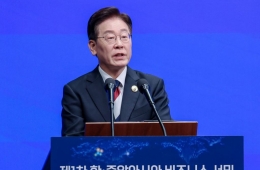
President Lee Jae-myung's first diplomatic message to the international community after taking office in June last year was "The Return of Democratic Korea." At a time when global uncertainty was at its peak due to U.S.-China tensions, quickly restoring South Korea's diplomatic standing beyond the illegal martial law crisis became the top priority.
Within just ten days of his inauguration, President Lee began a whirlwind of diplomatic activity, starting with his participation in the Group of Seven (G7) summit. Over the past year, he has visited 14 countries and held summits with more than 50 nations. This period included the shortest-ever reciprocal visits between the leaders of South Korea and the United States, as well as the first state visit to South Korea by Chinese President Xi Jinping in 11 years. Shuttle diplomacy was also revived with Japan, resulting in seven summits, effectively mending the strained relationship from the previous administration.
![President Lee Jae-myung is shaking hands with U.S. President Donald Trump after presenting him with a model of the Cheonmachong gold crown at the Gyeongju Museum in Gyeongbuk last October. 2025.10.29 [Photo by Presidential Office Press Photographers Group] Yonhap News Agency](http://www.asiae.co.kr/news/img_view.htm?img=2025102918244686599_1761729885.jpg)
President Lee Jae-myung is shaking hands with U.S. President Donald Trump after presenting him with a model of the Cheonmachong gold crown at the Gyeongju Museum in Gyeongbuk last October. 2025.10.29 [Photo by Presidential Office Press Photographers Group] Yonhap News Agency
View original imageAlthough the environment was far from easy, President Lee's "pragmatic diplomacy" delivered its first tangible results at the South Korea-U.S. summit held on the sidelines of the Asia-Pacific Economic Cooperation (APEC) summit in Gyeongju last October. In the most challenging issue—U.S. tariff negotiations—an agreement was reached at a 15% reciprocal tariff rate, lower than the initial U.S. demand of 25%. Additionally, a decision was made to invest 350 billion dollars (about 500 trillion won) in the United States.
Particularly noteworthy was breaking through to expand cooperation in the peaceful use of nuclear energy and the introduction of nuclear-powered submarines (nuclear subs), a long-standing goal of South Korea's foreign and security policy. Defense Minister An Kyu-baek formalized the "Jangbogo N Project," which calls for constructing nuclear-powered submarines of 5,000 tons or more by the mid-2030s and deploying them in the latter half of the decade. The nuclear fuel will use low-enriched uranium (LEU) with an enrichment rate below 20%, and the entire lifecycle—from design, construction, operation, to decommissioning—will be driven by domestic technology. A nuclear-powered submarine uses a reactor for propulsion. Unlike conventional diesel submarines, which must surface periodically to recharge batteries, nuclear submarines can stay submerged for several months, making them ideal for long-term underwater operations. They also surpass diesel submarines in speed and stealth, making them valuable strategic assets.
The transfer of wartime operational control (OPCON) is also being expedited. Minister An stated, "I conveyed to U.S. lawmakers in detail that even if OPCON were transferred tomorrow, there would be no difficulties," and added, "Both South Korea and the United States agreed in 2020 that 94% of the conditions for OPCON transfer had already been met, and I provided a thorough explanation of our capabilities." It is highly unusual for the government to disclose the specific percentage of OPCON transfer conditions met, underscoring the administration's strong will.
However, although broad consensus has been achieved with the United States, differences remain over the exact timing. U.S. Forces Korea Commander Xavier Brunson cautioned during a congressional hearing last month that "political expediency should not override the conditions." Pete Hegseth, the U.S. Secretary of Defense (Department of War), who attended the Shangri-La Dialogue, also emphasized the need to find "balance" where U.S. operational plans and decades-old responsibilities of American service members are respected. While there is agreement on the overall direction of OPCON transfer, it is interpreted that an appropriate timing must still be found.
Hot Picks Today
 "Additional 25% Mobile Bill Discount From Today" Causes Stir Online... The Truth Revealed
- "The Clothes My Dad Used to Wear"... Ralph Lauren, Beanpole, and Hazzys See Sales Surge as MZ Generation Embraces the Trend
- "So Many Inconsiderate People": Kicking and Struggling After Clothes Are Grabbed... Subway Line 2 Altercation Sparks Uproar
- "Please Take Off Your Shoes"—From Crawling onto the Bed to Changing Habits, Young Americans Lead the Shift
- "Famous Actress on KBS Is Perpetrator's Sister"... KBS Responds to 'Busan Fall Death' Family's Plea

President Lee Jae-myung is listening to Defense Minister An Kyu-baek's briefing on the basic plan for nuclear-powered submarine development at the 1st Future Defense Strategy Committee held on the 26th of last month in Jinhae District, Changwon City, Gyeongnam. Photo by Yonhap News Agency
View original imageOn North Korea policy, a breakthrough remains elusive. This is because North Korea has enshrined its stance of viewing South Korea and the United States as "hostile states" in its constitution and shows little willingness to engage in dialogue. Since taking office, the administration has suspended all activities such as sending leaflets to the North and loudspeaker broadcasts, emphasizing a "peaceful coexistence" policy to improve relations. President Lee issued an official expression of "regret" over the "Pyongyang drone intrusion" incident that occurred under the Yoon Suk-yeol administration, but North Korea's response has remained cold.
© The Asia Business Daily. All rights reserved. Unauthorized AI training and use prohibited.