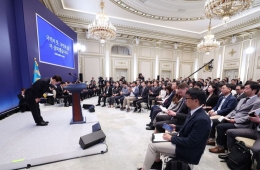
Jensen Huang Reaches Out to 'Korean Robotics'... Expanding NVIDIA-Korea Robot Value Chain
NVIDIA Expands Physical AI Supply Chain
Highlights Korean Robotics as Key Focus, Visit Signals Deepening Collaboration
Digital Twin Development Accelerates with Isaac Platform Adoption
Direct Investment in Korean Startups Also Expected
"We are always considering investments in Korea. I believe robotics is extremely important for Korea."

Jensen Huang, CEO of Nvidia, is being interviewed by global reporters including those from Korea at the 'Korea Partner Night' dinner event held on the 1st (local time) at a restaurant in Taipei, Taiwan. Photo by Yonhap News Agency Joint Press Corps
View original imageJensen Huang, CEO of Nvidia, was the first to mention robotics when asked about investment plans in Korea at the 'Korea Partner Night' event held in Taipei, Taiwan on June 1. This reflects Nvidia's view of Korea not just as a semiconductor supplier, but as a hub for collaboration in robotics and AI—a direction the company has championed for years by positioning physical AI as its next growth engine.

In fact, Nvidia has recently been rapidly expanding its collaborations with Korean companies beyond the memory supply chain. At the center of this are Nvidia’s physical AI platforms, including the humanoid AI model ‘Isaac Groot,’ the reinforcement learning framework ‘Isaac Lab,’ the robot simulator ‘Isaac Sim,’ the digital twin platform ‘Omniverse,’ and the physics-based simulation platform ‘Cosmos.’ Korean companies are leveraging these platforms to train their own robots in virtual environments and to build digital twins of actual factories, allowing them to repeatedly verify workflows. Instead of designing AI from scratch, companies can adapt Nvidia’s pre-trained, physics-based models to their own products. This approach reduces development costs and time while securing advanced AI capabilities, which is why Korean companies are quickly integrating into this ecosystem.
This trend is underpinned by the fact that, starting last year, Korean companies began to actively engage in the development of physical AI and digital twins. While Samsung Electronics and SK hynix handle the AI infrastructure supply chain through the provision of semiconductors such as high-bandwidth memory (HBM), Hyundai Motor Group—led by Boston Dynamics—along with Doosan Robotics, POSCO DX, Naver, and SK Telecom have all begun developing manufacturing AI and physical AI technologies based on Nvidia’s robotics platforms. In this way, Korea’s entire industrial structure—spanning semiconductors, robotics, and platforms—has become deeply intertwined with Nvidia’s physical AI ecosystem.
Nvidia and the Korean Robotics Value Chain: Who Has Joined?

Jensen Huang, CEO of Nvidia, gave the keynote speech at Nvidia's "GTC Taipei 2026" on the 1st (local time). Screenshot from Nvidia YouTube.
View original imageThe sectors most deeply embedded in this ecosystem are manufacturing, telecommunications, and platform companies. Hyundai Motor Group, for example, uses Isaac Sim and Groot in the development of Boston Dynamics’ humanoid ‘Atlas,’ training and validating the motion data required for workplace tasks in virtual environments. The company is also expanding cooperation to establish AI training environments for future humanoid commercialization.
LG Electronics is developing a physical AI model based on Isaac Groot, and is also building smart factory solutions and the real-time digital twin system ‘PRISM’ using Omniverse. The same platform is being applied to service robot development. In his keynote speech at GTC 2026 this March, CEO Huang specifically named LG Electronics as a physical AI partner—a testament to this collaboration.
SK Telecom is using Omniverse to build a digital twin of SK hynix’s semiconductor production facilities, and has recently developed agentic digital twin modeling technologies utilizing Nvidia’s Agent Toolkit. Naver is developing the Seoul World Model, a virtual representation of Seoul using Cosmos, and is advancing its own AI model, HyperCLOVA X, through Nvidia’s large language model (LLM) ‘Nemotron3 Ultra.’ Naver Cloud is also simultaneously building region-specific sovereign AI models.

Specialist robotics companies are also accelerating their efforts. Doosan Robotics, for example, is developing collaborative robot simulations and AI-based control software with Isaac Sim, and has laid out a plan to connect its proprietary agentic robot operating system with Nvidia’s AI infrastructure. POSCO DX is advancing its physical AI and digital twin technologies using Isaac Sim, has established a dedicated optical laboratory at its Pangyo headquarters, and has initially implemented physical AI in cranes that transport atypical products. Humanoid startup Arobot is also participating in next-generation humanoid development using Isaac Groot. Game developer NC is reportedly working with Nvidia on foundational robot models and virtual simulation technologies as well.
Hot Picks Today
 "KOSPI Surpassed 9,000, but May Fall Below 5,200 Next Year"...Expert Explains the Forecast
- In the Same Neighborhood, One Apartment Costs 2 Billion Won, Another 450 Million... What's Happening in Gangnam?
- "New Infections Sixteen Times Higher Than in 2019"... National Emergency Declared Over Spread of This Virus
- "I Thought I Lacked Willpower, But It Turns Out 'This Hormone' Is to Blame? [Experiment Note]"
- With Two Extra Days Added to Chuseok Holiday: "Pack Up, Let's Go Anywhere"... Domestic Travel Demand Surges
Nvidia is also investing in Korean robotics startups. According to the securities industry, Nvidia is pursuing a 20 billion won investment in humanoid and wearable robot startup WeRobotics, and Korean companies Didden Robotics and Realworld were featured at the Nvidia Startup Pavilion during Computex Taipei 2026.
© The Asia Business Daily. All rights reserved. Unauthorized AI training and use prohibited.