Fed Issues Successive Inflation Warnings... White House Calls It "Temporary"
Lisa Cook and Susan Collins Express Inflation Concerns
Trump Administration Faces Declining Public Opinion in Polls
Treasury Secretary Defends Policy, Citing Biden Administration
As the aftermath of the Iran war intensifies inflationary pressure in the United States, concerns about inflation are spreading within the Federal Reserve (Fed). In response, the White House has sought to calm market anxiety, stating that the rise in prices will be a temporary phenomenon.
John Williams, President of the Federal Reserve Bank of New York, said in an interview with Yahoo Finance on the 3rd (local time), "Given recent developments, the upside risks to inflation have somewhat increased and, in fact, have grown considerably." He added, "In particular, rising energy prices and other factors contributing to price increases are having an impact."

John Williams, President of the Federal Reserve Bank of New York. New York, USA – Photo by Yoonju Hwang
View original imageThese remarks were made during a response to the question of whether the policy statement's easing bias should be maintained or removed, considering the current inflation outlook. He stated, "Monetary policy is exactly where it should be right now. There is no need to raise or lower interest rates at this moment," but added that inflation remains a concern.
He continued, "I believe the balance of risks related to achieving the Fed's dual mandate of maximum employment and price stability has shifted somewhat compared to before. The risks to price stability have increased, while the risks on the employment side appear to have slightly decreased."
Fed Officials Issue Consecutive Inflation Warnings
Recently, there have been a series of statements from within the Fed emphasizing concerns about rising prices. Lisa Cook, a member of the Fed's Board of Governors, also expressed concerns about inflation at a Stanford University event last month, saying, "What I want to make clear in risk assessment is that the upside risks to inflation remain high."
Previously, Susan Collins, President of the Federal Reserve Bank of Boston, said in an interview with Bloomberg that she is focused on the persistence of inflation, pointing out that the global ripple effects of the war are ongoing and that supply chain disruptions could spread price increases beyond energy to food.
According to the minutes of the Federal Open Market Committee (FOMC) meeting in April, Fed officials evaluated that rising global energy prices and supply chain disruptions originating from the Middle East are driving up inflation. Some members pointed out that higher fuel costs are spreading to airfares, transportation expenses, and fertilizer prices.
Heightened vigilance about inflation is due to the fact that the surge in energy prices following the Iran war is spilling over into overall consumer prices. In April, the Consumer Price Index (CPI) rose 3.8% year-on-year, reaching its highest level in three years.
Secretary Bessent: "A Temporary Phenomenon"... Responding to Deteriorating Public Opinion

In contrast, the Trump administration has characterized the price increases as a temporary phenomenon. Scott Bessent, Secretary of the Treasury, stated at a Senate Finance Committee hearing on the same day, "Apart from inflation, the economic indicators are very strong," adding, "The current rise in prices is merely a short-term blip."
However, as of this day, the average gasoline price across the United States stood at $4.251, a 42.65% surge from the average price of $2.980 on February 28, the day the Iran war broke out. According to Brown University, the additional gasoline and diesel costs borne by American consumers after the outbreak of the war amount to $53 billion. The Financial Times (FT) noted that this equates to more than $400 per household.
Secretary Bessent's direct dismissal of inflation concerns appears to have been influenced by a recent decline in approval ratings in public opinion polls. In the Harvard CAPS-Harris poll, only 39% gave a positive assessment of the Trump administration's economic management. In particular, approval for cost-of-living management fell to the low 20% range.
Hot Picks Today
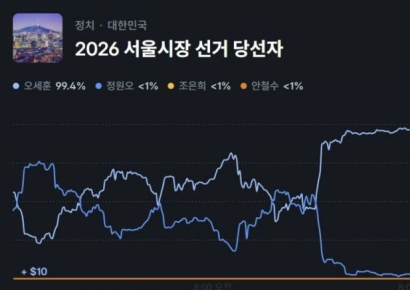 Foreign Investors Lament Huge Losses in an Instant as Oh Sehoon Overtakes Jeong Wonoh in Seoul Mayoral Election Bets
- "Ballot Boxes Must Leave to Confirm Oh Sehoon," Authorities Say, but "Re-vote Needed"—Jamsil 7-dong Blocks Vote Counting
- Lee Jaemyung Effect, Real Estate, and Changing Yeongnam: Three Key Factors That Shaped the June 3 Local Elections
- Exit Polls Miss the Mark Again: Major Errors in Broadcasters' Projections Despite Predicted 8.6% Lead
- Oh Sehoon Achieves Dramatic Comeback in Fierce Battle... June 3 Local Elections: Democratic Party Wins 12 to 4
Secretary Bessent tried to draw a distinction from the high inflation during the previous Joe Biden administration, noting that prices surged during the economic recovery after Russia's invasion of Ukraine and the COVID-19 pandemic. He claimed that after President Trump took office, the pace of food price increases has slowed.
© The Asia Business Daily(www.asiae.co.kr). All rights reserved.