[Lee Jaemyung Administration Year One] President's Bipartisan Efforts Praised... Low Public Perception Due to Democratic Party's Dominance
Positive Assessments for Bipartisan Cooperation, but Lacking Persuasive Process
Regret Over Failed Constitutional Amendment... Suggestions for "Single-Point Push Next Year"
One year has passed since the launch of the People’s Sovereignty Government, which championed the value of “integration.” Experts have given positive assessments of the government’s efforts toward integration and reform in the political and social spheres, but they have also emphasized the need for concrete actions that can gain public empathy.
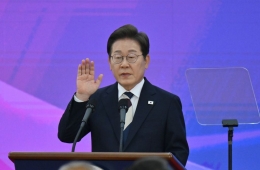
Political experts generally gave high marks to President Lee’s efforts toward bipartisan cooperation. Jaemook Lee, professor of Political Science and International Relations at Hankuk University of Foreign Studies, said, “President Lee, when delivering policy addresses, has made a point of approaching the opposition first, offering a handshake and showing gestures of goodwill. These actions suggest a genuine will for bipartisan cooperation.”
Over the past year, President Lee has continued his efforts at dialogue, proclaiming himself “everyone’s president” and meeting with both ruling and opposition leaders for a luncheon on the day of his inauguration. Shinyul Shin, professor at Myongji University’s Department of Political Science and International Relations, commented, “Compared to the previous Yoon Suk-yeol administration, the current government is better in its willingness to engage with the opposition.” He added, however, “Despite the president’s efforts, the Democratic Party’s stance has not changed, so the public does not strongly feel the impact of integration.”
![[Lee Jaemyung Administration Year One] President's Bipartisan Efforts Praised... Low Public Perception Due to Democratic Party's Dominance](http://www.asiae.co.kr/news/img_view.htm?img=2026060509243588719_1780619076.jpg)
Sangcheol Park, professor at Kyonggi University’s Graduate School of Politics, noted, “Due to the single-term presidency and single-member district system, Korean politics inevitably gravitates toward a two-party confrontation, and it is within this dynamic that the president must demonstrate leadership. The government must carefully interpret the significance of this local election.”
Political scientists pointed out issues such as the failure of constitutional amendment efforts—which had been promoted alongside the June 3 local elections—due to the opposition from the People Power Party, and called for a higher level of bipartisan cooperation. Professor Lee remarked, “A constitutional amendment changes the structure of government, but instead of persuading others and working together, the process was unilaterally pushed forward with a ‘the content is good, so why not support it—take responsibility’ attitude. Regardless of the content, it was necessary to make efforts to persuade and collaborate.”
Some viewed next year as an opportune time for constitutional amendment. Professor Shin said, “If a constitutional amendment is pursued together with an election, the side advocating the amendment inevitably benefits. Next year, with no scheduled elections, it would be appropriate to separate the amendment from the electoral process.” Professor Park agreed, adding, “Since there is public consensus on the need for constitutional change and next year is an election-free year, it is important to calmly pursue a constitutional amendment for the people, beyond just single-point or power structure reforms.”
The past year has also seen the dismantling of two longstanding sanctuaries in Korean society: the “insufficient response system for social disasters” and the “unchecked power of the prosecution.” These were chronic issues pointed out repeatedly in the past, but experts say that under the current administration, the institutional framework has been established early in the term.
On April 16, President Lee attended the Sewol Ferry Memorial Ceremony for the first time as a sitting president, bowing his head and saying, “As President of the Republic of Korea, I feel a heavy sense of responsibility.” Then, on May 7, one of the 10 major policy agendas of the Lee Jaemyung administration, the “Basic Law on Life and Safety,” passed the National Assembly’s plenary session, officially recognizing the rights of disaster victims and codifying the state’s duty to guarantee safety. Civil society and the legal community highly praised the government’s commitment. Saeyan Choi, attorney at the Public Interest Human Rights Advocacy Center of Lawyers for a Democratic Society (MINBYUN), said, “The initial enactment of the Basic Law on Life and Safety and the president’s official apologies at various memorials are extremely encouraging.”
Opinions are divided regarding the prosecution reform, a key focus of the government. Starting October 2, the government plans to abolish the existing prosecution office and split its functions between the “Prosecution Service” under the Ministry of Justice and the “Serious Crime Investigation Service” under the Ministry of the Interior and Safety. The prosecution will be limited to indictment and maintaining prosecutions, while the Serious Crime Investigation Service will handle investigations of the six major crimes: corruption, economic crimes, defense industry crimes, narcotics, insurrection and foreign exchange crimes, and cybercrimes.
Hot Picks Today
 After a Taste, the World Wonders, "Was This Only for Koreans?"... K-Sauces Captivate Global Palates
- Preferring Travel and Hobbies Over Hospitals, Still "Young at Heart"... The New Key Spenders Catching Card Companies' Attention
- "How Terrifying Was His Boss?"... The Fate of a Man Who Chose Bank Robbery Over Going to Work
- "Why Doctors Warn Against Touching This After Applying Hand Cream"
- [Exclusive] "This Is Why Samsung Stands Out"... Onnuri Gift Certificates Offered Instead of Points
Following the local elections, there is concern within the legal community over amendments to the Criminal Procedure Act, including the supplementary investigation authority, with worries about diminished investigative capacity. Youngsoo Jang, emeritus professor at Korea University Law School, said, “By pushing through the abolition of the prosecution office without addressing the core issue—the link between the president and the prosecution, which is at the heart of prosecutorial abuse—the resulting unprepared institutional changes are delaying investigations, and the public is bearing the brunt of this.” Hansanghee Han, professor at Konkuk University Law School, said, “Prosecution reform is not yet complete. We need to closely observe how the amendments to the Criminal Procedure Act are announced over time.”
© The Asia Business Daily(www.asiae.co.kr). All rights reserved.