Blue House Vows to Maintain Balance of Interests in Korea-U.S. Tariff Agreement Amid U.S. Push for Additional 'Forced Labor' Tariffs
Written Opinions Due July 6, Public Hearing Set for July 7
Blue House: "Maintaining Close Communication with U.S."
Simultaneous Section 301 Investigations on Forced Labor and Overcapacity
Government Focused on Managing Trade Risks with the U.S.
The Blue House announced that it would make every effort to ensure that the balance of interests under the existing Korea-U.S. tariff agreement is not undermined, in response to the Office of the United States Trade Representative (USTR) moving to impose an additional 12.5% tariff on Korean products due to what it describes as inadequate restrictions on imports of goods produced by forced labor.

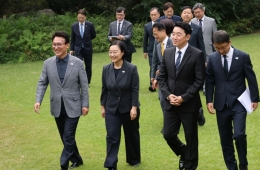
On December 29, 2025, the phoenix flag was hoisted at the Blue House in Seoul as President Lee Jae-myung arrived at the Blue House, officially marking the beginning of the Blue House era again after 3 years and 7 months. Photo by Jo Yongjun
View original imageAn official from the Blue House stated on the 3rd, "Since the USTR initiated the Section 301 investigation into restrictions on imports of goods produced by forced labor on March 12, we have maintained close communication with the U.S. side through the submission of written opinions and bilateral consultations."
On June 2, the USTR proposed imposing additional tariffs of 10 to 12.5% on 60 economic regions, including Korea, on the grounds that these regions had failed to restrict or enforce bans on the import of goods produced by forced labor. Korea is understood to be among those subject to the 12.5% tariff, along with Japan, China, and India. The USTR explained that this investigation is a measure under Section 301 of the Trade Act.
The Blue House and the government have stated their intention to respond actively in the upcoming procedures. For this proposal, the USTR will accept written opinions until July 6 and hold a public hearing on July 7. During this process, the government is expected to explain Korea's system and enforcement status, as well as supply chain management measures, and to highlight the unfairness of the proposed additional tariffs.
The government is closely monitoring not only the current Section 301 investigation related to forced labor but also the ongoing Section 301 investigation into manufacturing overcapacity. On March 11, the USTR launched a Section 301 investigation into structural manufacturing overcapacity targeting 16 economic regions, including Korea.
There are growing concerns both inside and outside the government that the successive Section 301 investigations by the U.S. may weaken the practical effectiveness of the existing Korea-U.S. tariff agreement. The Blue House's public mention of "balancing interests" appears to reflect the judgment that, if the forced labor and overcapacity investigations result in additional tariffs, the burden on Korean companies exporting to the U.S. could increase once again.
Hot Picks Today
!["Don't Use Chinese-Made Products": One U.S. Warning Triggers a 5 Trillion Won Jackpot for Korean Batteries [Weekend Money]](https://cwcontent.asiae.co.kr/asiaresize/93/2025121709393659037_1765931975.jpg) "Don't Use Chinese-Made Products": One U.S. Warning Triggers a 5 Trillion Won Jackpot for Korean Batteries [Weekend Money]
"Don't Use Chinese-Made Products": One U.S. Warning Triggers a 5 Trillion Won Jackpot for Korean Batteries [Weekend Money]
- "Dividend Payouts of 40 Million Won Before Their First Birthday"...'Baby Shareholders' Put Ordinary Workers at a Disadvantage
- "Planning a Trip to Japan?"... Accelerating Yen Strength [Weekend Money]
- Men in Their 20s and 30s Who Struggled with Dating Are Heading to Japan: "Virtual Matchmaking First, Then Start Dating"
- Foreign Tourists Leave in Tears Praising Seoul: "Wi-Fi So Fast, My Fingers Can't Keep Up" [K-holic]
The government plans to maintain bilateral consultation channels with the U.S. while simultaneously responding through the submission of written opinions and participation in the public hearing. The Blue House official stated, "We will make every effort to ensure that the balance of interests under the existing Korea-U.S. tariff agreement is not undermined, while actively responding to the submission of written opinions and the public hearing, taking into comprehensive consideration the ongoing Section 301 overcapacity investigation."
© The Asia Business Daily. All rights reserved. Unauthorized AI training and use prohibited.

![[Breaking] Party and Government Consider Renaming 'Judiciary Control Division' to 'Non-Indictment Case Review Division'](https://cwcontent.asiae.co.kr/asiaresize/307/2026091316513726167_1789285898.jpg)