Chinese College Entrance Exam Sites Now Inspect Eyeglasses... AI Glasses Prompt Gaokao Alert
Chinese Education Ministry: "Bringing Devices Alone Constitutes Cheating"
AI Companies to Lock Exam-Solving Features
Chinese university entrance exam sites have entered a stage where inspections now extend beyond smartphones to include eyeglasses. As AI-powered smart glasses become increasingly widespread, Chinese education authorities have started taking steps to prevent cheating using wearable devices ahead of the Gaokao, the national college entrance exam.

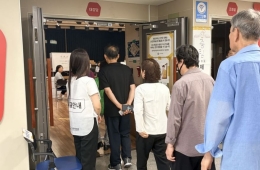
According to Chinese local media such as The Paper on June 3, Guangdong provincial education authorities announced in a notice issued the previous day that examinees must undergo a separate inspection of any eyeglasses they wear or carry during security checks at exam sites.
Hubei Province issued a similar notice, and the city of Shanghai also advised examinees wearing glasses to cooperate with supervisors for inspections before entering exam rooms. Fujian Province instructed exam supervisors to focus on checking smart glasses during their training, asking them to carefully examine the size and shape of the glasses.
The Chinese Ministry of Education also issued a warning on June 2 stating that bringing mobile phones, smartwatches, or smart glasses into exam rooms would be considered cheating. The ministry explained that bringing these devices into the exam site is problematic, regardless of whether they are used. The Ministry also stated that, with strengthened security for the Gaokao in recent years, many exam sites have adopted a “smart security checkpoint plus manual inspection” system.
In some regions, students who usually wear smart glasses have been instructed to prepare regular optical glasses in advance. Provinces such as Hebei and Guizhou announced that only standard optical glasses may be worn in the exam room. The Inner Mongolia Autonomous Region also announced that it would not accept requests to use smart glasses in place of optical glasses during the exam.
The reason education authorities have tightened inspections of eyeglasses is the rapid spread of AI smart glasses. Recently, in China, products equipped with real-time translation, voice assistant, photo and video recording, and information search functions have been released one after another. Some devices can communicate independently without a smartphone connection, raising concerns that they could be abused to take photos of exam questions or exchange information with outsiders during tests.
The Gaokao is a national exam in China, with around 13 million examinees each year. China has enforced strict controls on everything from the transport and storage of test papers to access to exam sites and supervision processes. During the exam period, police assist with transporting test papers, and equipment such as radio signal detectors, facial recognition devices, and security checkpoints are deployed at test sites. As cheating using mobile phones, wireless earphones, and miniature cameras has continued, the range of items subject to surveillance has broadened.
What has changed this year is that the scope of anti-cheating measures has expanded from "electronic devices in possession" to "AI devices worn on the body." Many smart glasses are difficult to distinguish from regular glasses by appearance alone, making it hard for supervisors to detect them with the naked eye. For this reason, some regions have even instructed examinees to remove their glasses and place them on the inspection table for supervisors to check directly.
AI companies have also launched special measures for the Gaokao period. According to China Central Television (CCTV), major AI platform operators have decided not to suspend their entire platforms during the exam period, but instead to restrict specific functions related to exams, such as question photography, image recognition, answer generation, and problem explanations, during exam hours. General conversation and daily information search functions will remain available, but features that could be abused for solving exam questions will be locked according to the exam schedule.
Hot Picks Today
 17-Year-Old Seriously Injured While Trying to Save "Gwangju High School Girl" Nominated for Righteous Person Status
- "At Least 400,000 Won a Month" — Half of Seniors Aged 65 and Over Say Basic Pension Is Insufficient
- "With Samsung and Hynix Rising Too Much, Feeling Uneasy... Who Will Be the Biggest Beneficiary of Capital Flows in the Second Half?"
- "Common in Korea, but One Drop at the End... The Global Craze for the 'Taste of Korea'"
- “Tank, Your Drink Is Ready”: Starbucks Becomes a Playground for Hate... May 18 Groups Demand Action
Chinese authorities are also wary of "guess-based preparation" using AI. The Ministry of Education warned, "It is unrealistic to expect high scores through AI or so-called expert pinpoint predictions," cautioning students not to be misled by promotions for "AI-predicted questions" or "expert predictions."
© The Asia Business Daily(www.asiae.co.kr). All rights reserved.