Korea and U.S. Attempt Second-Ever Revision of 54-Year-Old Nuclear Energy Agreement... Separate Nuclear Submarine Pact Also Discussed
Undersecretary Hooker, Known for First Trump Administration's North Korea Negotiations,
Meets with National Security Advisor Wi Seongrak at the Blue House on June 2
Fifty-four years after South Korea and the United States signed the "Agreement for Cooperation on the Peaceful Uses of Nuclear Energy" (the Nuclear Energy Agreement), the two countries have begun work on a second revision. They are also discussing a separate new agreement to secure fuel for the South Korean nuclear-powered submarine (nuclear submarine) program.

Allison Hooker, U.S. Department of State Political Deputy Assistant Secretary (center), is arriving at the Ministry of Foreign Affairs annex building at the Government Complex Seoul in Jongno-gu, Seoul on the morning of June 2 to attend the kickoff meeting for consultations on follow-up measures in the security sector of the Korea-U.S. summit joint fact sheet. On the left is James Heller, Chargé d'Affaires of the U.S. Embassy in Korea. June 2, 2026. Photo by Yonhap News.
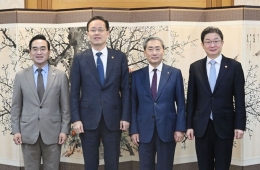
View original imageOn the morning of June 2, at 10 a.m., government-wide delegations from both countries held an inaugural meeting at the Ministry of Foreign Affairs annex in the Seoul Government Complex to discuss follow-up security measures agreed upon at the Korea-U.S. summit. The meeting marked the first face-to-face encounter between the two delegations, headed by First Vice Minister of Foreign Affairs Park Yoonjoo for South Korea and U.S. Department of State Undersecretary of Political Affairs Allison Hooker for the United States.
The government had initially hoped to begin discussions early this year, but economic issues such as U.S.-bound investment and Coupang, as well as the impact of the war in the Middle East, delayed the process by about six months. Given the late start, the government plans to accelerate this two-day meeting so that it immediately addresses the main agenda rather than simply serving as an introductory session. The chief representatives from both sides will attend only the morning session, after which working-level consultations at the National Security Council (NSC) level will take place from the afternoon. Ivan Kanapathy, Senior Director for East Asia at the White House National Security Council (NSC), who is seen as a key participant in these talks, arrived in Korea the previous afternoon with Undersecretary Hooker to participate in the discussions.
The core agenda of this Korea-U.S. security consultation consists of two points: expanding the authority for uranium enrichment and spent nuclear fuel reprocessing, and establishing a separate agreement for securing nuclear submarine fuel. Since the Korea-U.S. Nuclear Energy Agreement was first signed in November 1972, this marks only the second revision, the first having taken place in 2015. The first revision negotiations took four years and six months to complete. It is uncertain how long it will take for the revised agreement to pass the U.S. Congress this time. The government had originally aimed to complete the process before the U.S. midterm elections in November this year, but the delayed start has put them at a time disadvantage. However, Professor Moon Juhyun of Dankook University's Department of Energy Engineering noted, "If a separate annex is signed as a 'protocol' that specifies only detailed aspects such as enrichment and reprocessing methods, without changing the main text of the existing agreement, the process could be significantly shortened," adding, "Negotiations could be concluded in as little as one year if everything proceeds quickly."

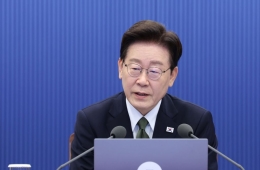
President Lee Jae-myung is listening to Defense Minister Ahn Kyu-baek's basic plan report on the development of a nuclear-powered submarine at the 1st Future Defense Strategy Committee held in Jinhae-gu, Changwon-si, Gyeongnam Province on the 26th of last month. Photo by Yonhap News
View original imageAnother key issue is establishing a legal basis for securing nuclear submarine fuel. The existing Korea-U.S. Nuclear Energy Agreement strictly limits cooperation to "non-military purposes." Even if the enrichment level is below 20%, using the fuel for military nuclear submarines would require a separate agreement for military purposes. On this topic, Professor Moon also advised, "If a separate agreement for military purposes is concluded, then the scope and form of technology transfer for nuclear submarines, dispatching and training of submarine operation personnel, and thorough security measures must be specifically stated," adding, "Because nuclear fuel is an extremely sensitive material, the agreement should clearly define the permissible enrichment level for submarine fuel, as well as security measures for storage methods and facilities."
Hot Picks Today
 "Only 3 Passengers on a 180-Seat Flight"... The Shocking State of the 'Honeymoon Hotspot'
- "Work That Took a Month Now Done in Just 8 Hours"…Samsung and LG Turn to AI to Counter China's Pursuit
- "Returning Excess Fees Collected Under Previous Administration"...$680 Per Person Refund for 950,000 Americans
- "Such chaos for the first time in 140 years"... Even illnesses surge, Tokyo stunned by 'unbelievable' event
- "Nothing Left to Buy, Feeling Indifferent"... 'Rich Daughter' Vibe in Department Stores with 'Hyunbaek Core'
Meanwhile, during her visit to Korea, Undersecretary Hooker—known as a "Korean Peninsula expert" from the second Trump administration—will meet with senior officials in Korea's foreign and security policy circles. She is scheduled to meet with National Security Advisor Wi Seongrak at the Blue House in the afternoon, followed by a breakfast meeting with Foreign Minister Cho Hyun on June 3. In addition, a separate meeting is arranged with Jeong Yeondoo, Director-General for Foreign Strategy and Intelligence, who oversees Korean Peninsula policy. Given Hooker's previous involvement in North Korea negotiations during the first Trump administration, broad discussions on the situation on the Korean Peninsula are naturally expected to take place.
© The Asia Business Daily. All rights reserved. Unauthorized AI training and use prohibited.