Trump Demands MOU Revisions as Iran Prepares Its Own Amendments
Ghalibaf: "No Judgement Until a Clear Outcome Is Reached"
Secretary Bessent Stresses "Nuclear Ban" as a Red Line
Treasury Designates Persian Gulf Strait Authority as Sanctions Target

As U.S. President Donald Trump has demanded revisions to the draft memorandum of understanding (MOU) for ending hostilities with Iran, Iran has also announced that it is preparing its own revised version, leading to last-minute complications in negotiations between the two countries.
On May 31 (local time), Iran's Tasnim News Agency, citing sources, reported, "Both sides are continuing to exchange draft documents, and Iran is naturally reflecting its own amendments in the agreement document." The report added, "Nothing has been finalized yet."
The source emphasized, "Iran's standard is whether the document is something we can directly agree to or not," and clarified, "Just because the Trump administration has applied its own amendments does not mean Iran will accept them." The source further noted, "Iran is thoroughly preparing for a scenario in which no agreement is reached—a so-called 'No Deal' scenario."

On the same day, Iranian Foreign Minister Abbas Araghchi also stated in a state television interview, "Dialogue and message exchanges with the United States are ongoing, but no conclusions can be drawn until a clear outcome is reached."
Trump Demands Specific Timeline for HEU Acquisition and Clearer Language on Strait Reopening in MOU
Previously, U.S. media outlet Axios reported that on May 30, during a White House Situation Room meeting, President Trump reviewed the draft MOU for ending hostilities prepared by the negotiating team and requested revisions to certain clauses.
According to the report, President Trump demanded that the provisions related to Iran's nuclear program, in particular, specify more concretely how and when the United States would secure Iran's highly enriched uranium (HEU). He was also said to have requested that the language regarding the reopening of the Strait of Hormuz be strengthened.
The current draft is known to include Iran's pledge not to pursue nuclear weapons, as well as a plan to negotiate nuclear program measures and sanctions relief over the next 60 days. However, key issues such as the method of handling HEU and additional enrichment restrictions remain to be addressed in follow-up negotiations.
The Trump administration has presented the reopening of the Strait of Hormuz, securing HEU, and prohibiting Iran from possessing nuclear weapons as the core conditions of the negotiation. U.S. Secretary of the Treasury Scott Bessent stated in a Fox News interview that day, "To finish the job means to keep the Strait of Hormuz open, to secure HEU, and to ensure that Iran does not possess nuclear weapons."

Scott Bessent, U.S. Secretary of the Treasury, is arriving through Incheon International Airport. 2026.05.13. Photo by Dongjoo Yoon
View original imageSecretary Bessent said, "This is the first time in 47 years that there has been an attempt to discuss Iran not possessing nuclear weapons," and argued, "It had been a taboo subject until now, but thanks to President Trump, it has been brought to the negotiating table for the first time."
He also remarked, "The economic blockade of funds and the physical blockade of ships entering and leaving Iranian ports have been effective," and stated, "These were the key factors that brought Iran to the negotiating table."
Meanwhile, the U.S. Treasury Department announced on May 29 that it had revised the guidelines of the Office of Foreign Assets Control (OFAC) to prohibit payments of transit fees or the receipt of safe passage guarantees to the Iranian government or the Islamic Revolutionary Guard Corps (IRGC).
Hot Picks Today
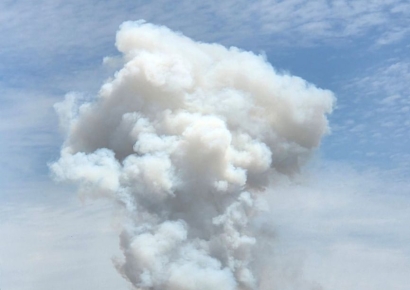 Fire Department: "5 Dead in Hanwha Aerospace Explosion... Victims Not Yet Identified" (Comprehensive Report 2)
- "183 Pyeong with Swimming Pool, Cabanas, and Two Gardens: Three-Story 'Super Penthouse' Tempts Wealthy Investors [Real Estate AtoZ]"
- "Outperforming Its Core Business": Bedding Brand Hits 50 Billion Won Jackpot in Semiconductor Investment After Betting Half Its Operating Profit
- "Told to Undress in Front of Men"... North Korean Defector Reveals Shocking Reality of the Joy Squad
- [Exclusive] Chey Tae-won: "There's Nothing NVIDIA Doesn't Do"... Beaming at Jensen Huang's 'AI CPU Roadmap'
Additionally, the U.S. designated Iran's newly established "Persian Gulf Strait Authority (PGSA)" as a sanctioned entity and warned that transactions with this agency could expose parties to sanctions risk. This move is interpreted as the United States making it clear that it will not accept not only the mere reopening of the strait but also Iran's imposition of transit fees and the exercise of control over passage rights.
© The Asia Business Daily(www.asiae.co.kr). All rights reserved.