Baek Kyunghoon: "Leaping Forward as a Full-Stack AI Supplier Nation... Korea to Take on Frontier Models" (Comprehensive)
Construction Begins on National AI Computing Center, Infrastructure Expansion Underway
Ministry Upgraded to Deputy Prime Minister Level After 17 Years, R&D Ecosystem Restored
Baek Kyunghoon: "Improving Organizational Culture... Expanding the

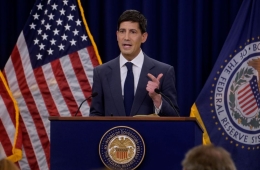
Baek Kyunghoon, Deputy Prime Minister and Minister of Science and ICT, is speaking at the "Ministry of Science and ICT Press Conference" held on the afternoon of the 29th at the Seoul Central Post Office in Jung-gu, Seoul. From left, Koo Hyukchae, First Vice Minister; Baek Kyunghoon, Deputy Prime Minister; and Park Inkyu, Head of the Science and Technology Innovation Headquarters.
View original imageBaek Kyunghoon, Deputy Prime Minister and Minister of Science and ICT, stated, "We will accelerate our leap forward as a full-stack AI supplier nation with bolder and more comprehensive support, and deliver tangible results that the public can truly experience in their daily lives." He also called for Korea to challenge itself to develop AI frontier models on par with the United States and China, just as the country produced eight noteworthy AI models within available resources.
Marking the first anniversary of the Lee Jaemyung administration, Deputy Prime Minister Baek highlighted the establishment of a foundation for Korea to become one of the top three AI powerhouses, the restoration of the research and development (R&D) ecosystem, and alleviating the burden on the public through guaranteed basic communication rights as major achievements. He emphasized, "We will achieve the top three global position in AI through the development of proprietary AI models, securing advanced GPUs, and strengthening AI competency for all citizens."
The Ministry of Science and ICT held a press conference in the main conference room at the Seoul Central Post Office on the 29th and announced its key achievements over the past year. On this day, Deputy Prime Minister Baek said, "Korea is now steadily advancing toward becoming one of the top three AI powerhouses. In the second half of the year, we will release the second proprietary AI model to continue our journey toward AI self-sufficiency, while also commencing construction of the National AI Computing Center to expand the infrastructure needed to lead global technological competition."
260,000 Advanced GPUs to Be Secured Without Delay by 2030
The Ministry of Science and ICT is prioritizing the strengthening of national AI competitiveness. As a result of encouraging proprietary AI development, Korea ranked third in major global assessments, including the Stanford University AI Index and the global AI model performance evaluation platform AAII, operated by the specialized agency Artificial Analysis.
The government is working to secure 260,000 advanced GPUs—the core infrastructure for national AI—by 2030 without setbacks, and is supporting the proliferation of proprietary AI models beyond the development phase to all industries and public sectors, such as semiconductor factories, government administrative networks, and R&D budget reviews.
In particular, Deputy Prime Minister Baek stressed that it is now time for Korea to take on the challenge of AI frontier models. He said, "Just as we produced eight noteworthy AI models within available resources, we can also take on frontier models if we invest more aggressively in GPUs and AI infrastructure. When we reach Artificial General Intelligence (AGI), the speed gap will widen exponentially, so we need to jump into frontier model development to achieve AGI."
While private sector investment in infrastructure and models was lacking in the past, discussions are now underway with the government for even greater investment beyond the 260,000 GPUs, and active measures are being explored to utilize domestically developed Neural Processing Units (NPUs).

The government is also working to enhance AI proficiency among all citizens. The number of AI Digital Learning Centers has nearly doubled from 37 to 69 locations, and the number of people receiving AI training is expanding from 910,000 to 1.3 million. The first-ever National AI Competition, launched this year, is expected to attract participation from over 2 million people by the end of the year.
Deputy Prime Minister Baek announced, "The 'AI for All' project, which will provide AI services based on proprietary AI models to the entire public for free, will be introduced at the end of this year, and will continue to be offered free of charge even after the project concludes in 2028." The AI for All project allows every citizen to own an AI agent, including chatbot functions and specialized models for senior citizens and marginalized groups who may struggle to use AI effectively.
The government is also pursuing the creation of a challenging R&D ecosystem. The R&D budget has been increased by 20% year-on-year to a record-high KRW 35.5 trillion to restore the research ecosystem. The preliminary feasibility study system for R&D was abolished after 18 years, reducing the time from submitting a business plan to budget allocation and adjustment from the previous two years to just five months. In addition, the Project-Based System (PBS), which led to excessive competition for research assignments, has been abolished. However, regarding the development of the aerospace sector, Deputy Prime Minister Baek explained, "With our current level of investment, it is difficult for Korea to become one of the world’s top five aerospace powers. The government is now discussing at what level and by what means investment and development should proceed."
Baek Kyunghoon: "We Will Create AI-Related Development Organizations and Strengthen Staffing"
With the Ministry of Science and ICT being elevated to a deputy prime ministerial ministry for the first time in 17 years, the Science and Technology Ministers’ Meeting, which launched in November last year, is serving as a platform for inter-ministerial coordination and cooperation. The ministry has integrated and reorganized fragmented technology management systems previously operated by individual ministries and is supporting the AI transformation (AX) of each government department. However, some have pointed out the urgent need for substantial authority, enhanced infrastructure, and increased staffing commensurate with its new status as a deputy prime ministerial ministry.
Addressing these concerns, Deputy Prime Minister Baek said, "As someone from the private sector, I was initially concerned about the rigid organization and the sheer volume of work when I was appointed minister. However, by reforming title conventions and promoting flexible communication, the organizational culture is changing rapidly. When it comes to inter-ministerial power, it is important for the Ministry of Science and ICT to focus on the fundamentals and deliver results, which will enable collaboration between ministries."
Deputy Prime Minister Baek stated, "The Ministry of Science and ICT acts as the government’s R&D laboratory. It is important to build a support system so that all ministries can utilize achievements across all areas of science and technology, not just AI. As we continue to deliver clear results, more ministries are now eager to collaborate with us." He added, "We are creating AI-related development organizations and are currently setting up an organization to establish a global AI hub. By demonstrating our capabilities one by one, we are expanding our organization and strengthening our workforce."
Hot Picks Today
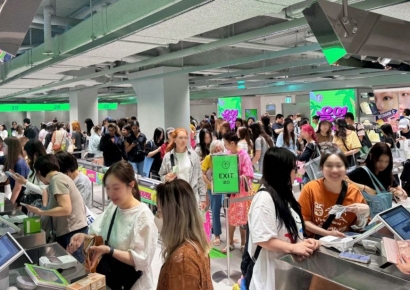 "She Comes Every Three Months to Stock Up"... Surge of Foreign Visitors Entering Korea for Olive Young Sale
- [Exclusive] 3 Billion Won 2045 Future Strategy Report Heads Straight to the Cabinet After Administration Change
- "An Astonishing 84 Million"... China Accelerates Protection for Delivery Riders, the 'Last Line of Defense' for Workers
- "Forced to Pay 500,000 Won for Team Lunches in a Week"... Company Culture Drives New Employee to Quit, Sparks Outcry
- Foods That Make Your Face Look Worse, According to a Plastic Surgeon... What Ranked Above Ham and Ramen?
Finally, Deputy Prime Minister Baek concluded, "If the past year has been about inspiring hope for a better daily life and future with science, technology, and AI, then in the second year, our focus will be on linking the policies we have promoted so far to create synergy and deliver results. In the AI sector, we will invest even more boldly to further solidify our capabilities as one of the top three AI powerhouses."
© The Asia Business Daily(www.asiae.co.kr). All rights reserved.