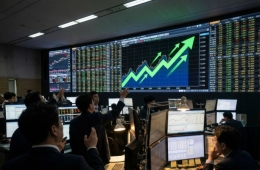
Savings Banks Post 333.8 Billion Won Q1 Net Profit... Delinquency Rate Edges Up
Delinquency Rate Rises, Driven by Corporate Loans
The savings bank industry recorded a profit of over 300 billion won in the first quarter of this year. Profitability improved due to an increase in non-interest income, though the delinquency rate rose slightly, mainly in corporate loans.

According to performance data released by the Korea Federation of Savings Banks on May 29, the combined net profit of 79 savings banks in the first quarter reached 333.8 billion won, a provisional figure that marks a 659% increase (up 289.8 billion won) from 44 billion won in the same period last year.
Non-interest income, including profits from securities, loan receivables, and fees, surged more than tenfold to 294.4 billion won from 26.7 billion won a year earlier. The provision for bad debt was 801.8 billion won, down 11.5% from 905.8 billion won in the same period last year, which also had a positive impact on the results.
As the government strengthened its policy stance on productive finance, savings bank loans to small and medium-sized enterprises increased by 2.9% (1.2 trillion won) to 43.2 trillion won from 42 trillion won in the previous quarter.
However, due to the delay in economic recovery, borrowers’ ability to repay debt weakened, pushing the delinquency rate up by 0.7 percentage points to 6.7% compared to the previous quarter. The delinquency rate for corporate loans stood at 8.9%, nearly double that of household loans (4.8%).
The Bank for International Settlements (BIS) capital adequacy ratio was 16.0%, up 0.1 percentage points from 15.9% in the previous quarter. This was because the growth rate of equity capital (2.3%), driven by profit realization, outpaced the growth rate of risk-weighted assets (1.4%) due to increased lending.
The ratio of substandard and below loans also rose to 8.6%, up 0.2 percentage points from 8.4% in the previous quarter. The liquidity ratio was recorded at 170.8%, and the allowance for bad debts ratio was 108.3%.
The savings bank industry plans to continue expanding the supply of financial products for low-income individuals, in line with the government's policy to promote mid-interest loans for the primary customer base of ordinary people and small business owners.
According to the Federation, the balance of policy-based financial products for low-income individuals—such as Sunshine Loan and Saitdol 2—stood at 24.7 trillion won in the first quarter, up 2.1% (500 billion won) from 24.2 trillion won in the previous quarter.
Hot Picks Today
 Gwanghwamun Falls Silent After Shocking Defeat: "Can't Understand Son Heungmin's Omission from Starting Lineup"
- Another Setback After Hormuz Reopens: The Factor Holding Back 600 Oil Tankers
- "Until 2 a.m. at Karaoke Bars": Female Firefighter Who Died Before Wedding Endured Forced Drinking Parties
- "Doesn't Know How to Sell Shares": Kim Moonsoo, Who Bought SK hynix at 20,000 Won, Draws Attention Over "100-Fold Return" Rumors
- "More Expensive Than King Crab When Dried": The Secret of a Chinese Delicacy Discovered on a Front Lawn
A Federation official stated, "We have achieved a record-high level of capital adequacy and are maintaining stable liquidity management, so the management stability of savings banks is at a sound level." The official also added, "However, as potential risks remain, such as the delay in economic recovery and the weakening debt repayment capacity of customers, we will continue efforts to improve asset soundness."
© The Asia Business Daily. All rights reserved. Unauthorized AI training and use prohibited.
![Under a Bombshell President, a Bombshell Adviser... Rose to Defense Chief Despite Sex Scandals [World Photo]](https://cwcontent.asiae.co.kr/asiaresize/307/2026062512310523344_1782358266.png)