US Defense Secretary: "China Cannot Dominate Asia"... Calls South Korea's Leadership in OPCON Transition "Encouraging" (Comprehensive)
Applause for Korea's Commitment to Raise Defense Spending to 3.5%
"We Do Not Seek Unnecessary Confrontation in the Region"
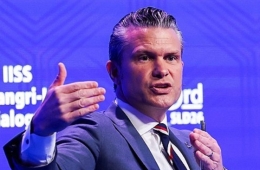
Pete Hegseth, U.S. Secretary of Defense, made clear the United States' intention to block China's quest for Asia-Pacific hegemony during his speech at the Asia Security Conference (Shangri-La Dialogue) held in Singapore on the 30th (local time). He stated, "No country, including China, can undermine the security of the United States and its allies through hegemonic actions."

Pete Hegseus, U.S. Secretary of Defense, is delivering a speech at the Asia Security Conference (Shangri-La Dialogue) held in Singapore on the 30th (local time). Photo by Yonhap News
View original imageHe emphasized, "There is legitimate concern regarding China's historic military buildup and its expanding military activities in the Asia-Pacific region and beyond," adding, "If any hegemonic power comes to dominate the Pacific, the regional balance of power will be broken." He further explained, "What we seek is an advantageous yet sustainable balance of power in which no country, including China, can exercise hegemony to threaten the security or prosperity of the United States and its allies."
However, Secretary Hegseth stated, "We do not seek unnecessary confrontation in this region." He added, "U.S.-China relations are at their best in years under the Trump Administration," and noted, "We are keeping military-to-military communication channels open with China and meeting more frequently."
Secretary Hegseth also stressed, "Regional security has relied excessively on U.S. military strength," and declared, "There is no free ride." He continued, "The era of the United States subsidizing the defense budgets of wealthy countries is over," and added, "We need partners, not protectorates."
The United States reiterated its call for allies and partners to increase their defense spending to 3.5% of their GDP, while promising a military investment of $1.5 trillion (about 2,260 trillion won). He specifically applauded Korea, which has already pledged to raise its defense budget to 3.5% of GDP, stating, "We commend Korea's pragmatism and leadership." Previously, the joint fact sheet from the U.S.-Korea summit in November of last year stipulated plans to increase Korea's defense spending to 3.5% of GDP.
Regarding the transition of wartime operational control for South Korean forces, he commented, "It is a breath of fresh air that allies like Korea are taking more rapid initiative in commanding operational control."
He also mentioned, "The core of the U.S. approach in the Pacific is to deny adversaries access along the First Island Chain (a notional line connecting the Japanese archipelago, Okinawa, Taiwan, the Philippines, and the Strait of Malacca)," reaffirming the need to defend Taiwan. However, he added that any future sale of U.S. weapons to Taiwan would depend on the decision of President Trump.
Hot Picks Today
 "What Will Retail Investors Do With No Ammo Left?... Samsung Electronics and SK Hynix See Another Rosy Outlook"
- "Dividends Plus AI: The Most Attractive Stock for Investment in June [Weekend Money]"
- "Changing Clothes and Diapers in Shared Spaces... Controversy Over Abolishing Gender Separation in Hospital Rooms"
- Sinbanpo 19 and 25 Construction Contractor to Be Selected Today... Promotional Material Review Disputes Continue Until Last Night [Real Estate AtoZ]
- Trump Urged "Buy Quickly"...Stock Soared 39% Overnight
On the subject of war with Iran, he asserted, "If necessary, our ability to resume war goes far beyond what is possible," claiming that the United States maintains more than sufficient weapons stockpiles.
© The Asia Business Daily(www.asiae.co.kr). All rights reserved.