The Paradox of Presidential Support: Visits to Battlegrounds Rarely Lead to Victory
Limited Impact of Presidential Support in Past Elections
"Ultimately, Voter Sentiment Depends on Candidate Competitiveness"
It has been found that visits by incumbent presidents to closely contested regions during election season rarely translate into actual election victories.
While presidents have cited on-site inspections of livelihood issues and attention to regional matters as the reason for these visits, opposition parties have denounced them as government interference in elections. As a result, the anticipated electoral effect often failed to materialize, and in some cases, even led to a backlash.
A representative example is the 18th general election in 2008. At that time, President Lee Myung-bak visited the construction site of Eunpyeong New Town in Seoul just four days before the election. This was a region where Hanara Party candidate Lee Jae-oh was locked in a close race. The opposition immediately criticized the visit as "a government-led election to save a close associate." However, the much-publicized event ended with the victory of Moon Kook-hyun, the candidate from the Creative Korea Party.
Former President Park Geun-hye had a similar experience. Five days before the 2016 general election, she visited the Centers for Creative Economy & Innovation in Cheongju, North Chungcheong Province, and Jeonju, North Jeolla Province, in quick succession. Both regions were anticipated to be extremely close contests at the time.
The controversy intensified as her red attire drew attention, leading to allegations of election interference. The results were mixed: in Cheongju, the Democratic Party candidate won, whereas in Jeonju, the Saenuri Party candidate was elected.
In 2021, before the Busan mayoral by-election, former President Moon Jae-in visited the planned site for the new Gadeokdo Airport, sparking fierce debate in political circles. The People Power Party criticized the move as "blatant election support." However, the election ended with a landslide victory for Park Hyung-joon, the People Power Party’s candidate.
Former President Yoon Suk-yeol also held public forums on livelihood issues and personally addressed regional concerns across the country ahead of the 22nd general election in 2024. He emphasized support for long-awaited local projects and the promotion of national projects, which was interpreted as an effort to boost the ruling party’s candidates. Nevertheless, the People Power Party suffered a devastating defeat in the general election.
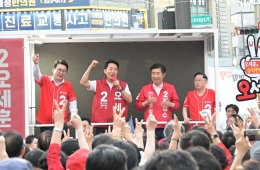
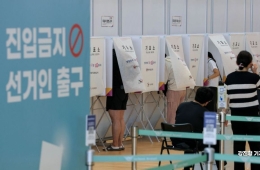
In the upcoming June 3 local elections, Busan has emerged as a closely watched battleground. President Lee Jae-myung visited Busan on the 26th and 27th, stopping by traditional markets and other locations. Former President Park Geun-hye also visited Busan on the 27th, and former President Lee Myung-bak has announced plans to visit on the 31st.
Political analysts note that while presidential visits may garner media attention and mobilize the support base in the short term, their actual impact on voter sentiment is limited. In particular, if a president’s late-stage campaign activities are perceived as government interference in the election, they may trigger a backlash.
Hot Picks Today
!["I Almost Missed Out on Hundreds of Thousands of Won... I Was the Only One Who Didn't Know" How to Find Hidden Government Benefits [The Essentials of Benefits]](https://cwcontent.asiae.co.kr/asiaresize/93/2026052915221681901_1780035736.png) "I Almost Missed Out on Hundreds of Thousands of Won... I Was the Only One Who Didn't Know" How to Find Hidden Government Benefits [The Essentials of Benefits]
"I Almost Missed Out on Hundreds of Thousands of Won... I Was the Only One Who Didn't Know" How to Find Hidden Government Benefits [The Essentials of Benefits]
- Paying $5 a Month to See Ads Unchanged?... Meta’s $12 Billion Experiment [Weekend Money]
- "Big Gains for Holders... Up 566% and Still More to Go" Target Price Raised, But Here’s Why Caution Remains [Weekend Money]
- 'Former Chungju Man' Kim Seontae Gives 10-Year-Old Car to Father with Sick Child... The Reason He Accepted Only 2,500 Won
- "Best Homeroom Teacher"... Hong Kong Education Sector in Shock Over Spread of "Princess Carry" Photos
A local political source commented, "A presidential visit certainly raises the profile of the region and helps rally the support base. However, in many cases, the final election outcome has been determined by local sentiment and the individual competitiveness of the candidates."
![President Lee Jae-myung and First Lady Kim Hye-kyung are seen conversing with merchants at Busan Namhang Market on the 27th. [Image source=Yonhap News Agency]](http://www.asiae.co.kr/news/img_view.htm?img=2026053009390082182_1780101540.jpg)
President Lee Jae-myung and First Lady Kim Hye-kyung are seen conversing with merchants at Busan Namhang Market on the 27th. [Image source=Yonhap News Agency]
View original image© The Asia Business Daily(www.asiae.co.kr). All rights reserved.



!["Land Is Pricier Than the Stock"... Stocks Making a Comeback These Days [Weekend Money]](https://cwcontent.asiae.co.kr/asiaresize/307/2026052816231080420_1779952990.png)