Seosomun Overpass Demolition Completed Three Days After Accident... Gyeongui Line to Resume Tomorrow
The major demolition of the Seosomun Overpass in Seoul, where a collapse accident resulted in six casualties, was completed on May 29. Train service on the Gyeongui Line, which had been suspended due to the accident, is scheduled to resume with the first train on May 30.
The Seoul Metropolitan Government announced, "The emergency demolition work on the upper structure of the Seosomun Overpass, which began at midnight today, was fully completed around 9:40 p.m." This marks the end of the operation approximately 79 hours after the accident occurred at 2:33 p.m. on the 26th.

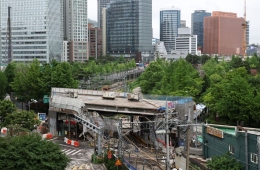
As Seoul prepares to begin a complete demolition of the Seosomun Overpass, where the deck collapsed during bridge dismantling work, a 40-hour demolition operation is scheduled. On the 28th, the area around the collapse site in Seodaemun District, Seoul, is being restricted. Photo by Yonhap News Agency
View original imageThe demolished structures included the upper slab (deck) and the supporting girders and beams. The columns, which pose a relatively lower risk of collapse, will be dismantled within the next 10 days in a way that does not interfere with train operations.
However, not all work has been completed yet. The National Railroad Authority plans to carry out overnight repairs on the overhead lines to enable the operation of Gyeongui Line trains, aiming to finish all necessary measures by around 5 a.m. on May 30 so that service can resume with the first train.
During the demolition on the morning of the 26th, the girder—an essential structure supporting the upper slab—subsided by approximately 2.9 centimeters, prompting a halt to the work at around 2:30 a.m. Later that afternoon, while conducting a safety inspection at the site, a section of the slab collapsed, resulting in the deaths of three people, including construction workers, and injuries to three government officials. The Ministry of Employment and Labor immediately ordered a suspension of demolition work following the accident.
Afterward, the Seoul Metropolitan Government implemented additional safety measures to prevent further accidents and applied to the Ministry of Employment and Labor for permission to resume work. Conditional approval was granted on the afternoon of the 28th, and from midnight that day, equipment was deployed to the site to begin emergency demolition operations.
Prior to the accident, demolition operations were restricted to three hours each day in the early morning to avoid disrupting train service. However, after the accident, efforts focused on a rapid recovery and the quick resumption of rail service, utilizing a "crushing method" to complete the work in a short period. The city first reinforced the tracks that run through the area by laying steel plates and filled the space above the Line 2 subway tunnel, which runs underground at the site, with sand to prevent shock transmission.
Hot Picks Today
 "What Will Retail Investors Do With No Ammo Left?... Samsung Electronics and SK Hynix See Another Rosy Outlook"
- "Switching from Stocks to Savings?"... Up to 19.4% Annual Interest Rate Offered from June 22
- [Exclusive] Bought for 16.6 Billion Won from Kang Hodong, Sold to Noh Hongchul for 15.2 Billion Won: Even Hotspots Become Loss Sales... Gangnam Small Buildings Face 'Tearful Discounts' [Real Estate AtoZ]
- "My Stocks Alone Crashing in a Bull Market? Turns Out... 82% Are in the Same Boat"
- Trump Urged "Buy Quickly"...Stock Soared 39% Overnight
At around 4:43 a.m. on the 29th, demolition was completed for the No. 9 slab, which the railway passes over, along with its supporting structures. All related debris, sand, and steel plates were removed by around 6 p.m. The final remaining No. 8 slab was also dismantled by 9:40 p.m.
© The Asia Business Daily(www.asiae.co.kr). All rights reserved.