"My Stocks Alone Crashing in a Bull Market? Turns Out... 82% Are in the Same Boat"
2,276 out of 2,764 Stocks Decline
Concentration Intensifies in Large-Cap and Semiconductor Sectors
Small and Mid-Cap, Domestic Demand Stocks See Broad Losses
Although the domestic stock market continues to hit new all-time highs day after day, a closer look inside the market reveals a situation that hardly matches the description of a “bull market.” Aside from a handful of stocks driving the index upwards, the majority of stocks are in decline, and there are evaluations that the real economy feels even worse than before.

On the 28th, a dealer is working at the dealing room of the Seoul Hana Bank headquarters. Photo by Yonhap News
View original imageFunds Concentrated in 'Samsung Electronics and SK hynix'... Most Stocks Declining
According to the Korea Exchange, over the past month, 2,276 out of 2,764 stocks listed on the KOSPI and KOSDAQ—equivalent to 82.3%—have fallen. Only 378 stocks rose, and the remainder held steady.
The situation is not much different when viewed by market. More than 80% of all stocks on the KOSPI declined, and the KOSDAQ saw a similar proportion of losing stocks. In other words, the gap between index growth and individual stock performance has widened to an extreme degree.
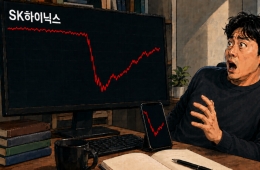
This phenomenon is interpreted as a result of capital being concentrated in a select few large-cap semiconductor stocks. Driven by expectations for increased artificial intelligence (AI) investment, semiconductor shares centered around Samsung Electronics and SK hynix have led the market. Over the past month, the KRX SK hynix Index surged by more than 70%, and the KRX Information Technology (IT) sector overall posted a rise in the 40% range. Samsung Electronics also recorded double-digit growth, contributing to the index’s ascent.
While the semiconductor sector as a whole has been strong, consistently outperforming the KOSPI, the prevailing interpretation is that this reflects a “selective rally” rather than the overall health of the market.

On the 28th, dealers are working in the dealing room of the Hana Bank headquarters in Seoul. Photo by Yonhap News
View original imageSmall and Mid-Cap, Domestic Demand Stocks Suffer... Divergence with Real Economy
In contrast, small and mid-cap stocks and industries related to domestic demand have all declined in unison. The KRX Mid Cap TMI fell by 9.41%, the KRX Small Cap TMI by 11.96%, and the KRX Micro Cap TMI by 11.54%, indicating a broad-based downturn among small and mid-cap indices.
By sector, KRX Utilities fell by 18.65%, KRX Construction by 16.93%, KRX K-Content by 9.86%, KRX Energy & Chemicals by 9.71%, KRX Securities by 9.55%, and KRX Healthcare by 9.44%, all posting significant declines. KRX Banks dropped by 7.71%, and KRX Broadcasting & Telecommunications by 6.18%, also showing weak performance.
This is interpreted as a result of relatively weak expectations for economically sensitive sectors and industries centered on domestic demand, with funds instead flowing into AI-related sectors that have a clear growth narrative.
Securities analysts define the current market as a “rally without breadth,” focusing on the deepening concentration of funds. They also note that as inflows increasingly target large-cap stocks in AI semiconductors, investors who do not hold these stocks are experiencing a growing sense of relative deprivation and a fear of missing out (FOMO).
Hot Picks Today
![[Test Drive] The Sealion 7 Transformed by a 2 Million Won Upgrade: "Base Model Buyers Might Feel Shortchanged"](https://cwcontent.asiae.co.kr/asiaresize/93/2026080417033869589_1785830618.jpg) [Test Drive] The Sealion 7 Transformed by a 2 Million Won Upgrade: "Base Model Buyers Might Feel Shortchanged"
[Test Drive] The Sealion 7 Transformed by a 2 Million Won Upgrade: "Base Model Buyers Might Feel Shortchanged"
- 'Single-Stock Leveraged ETF Blow' Crippled KOSDAQ in July... Hopes Rise for a Turnaround in August with 11.38% Surge [Weekend Money]
- Chinese Buyers Retreat from Seoul’s Real Estate Market? Foreign Purchases Plummet by 2,000 [Real Estate AtoZ]
- "If We Don't Get Married, Let's Live Together"... Gen Z Chooses 'Co-Buying Homes with Friends' Over Romantic Partners [Gen Z Around the World]
- Kim Seontae Appears Gaunt After Leaving 'Don Seontae'... 3,000 Thumbs Up for Chungju Mayor's "Come Back" Offer
Experts believe this concentration may persist for some time. Looking back at past cases, the tendency for funds to cluster intensifies toward the later stages of a bull market. At the same time, some warn to watch for signs when this concentration begins to ease, as it could signal not a healthy rotation that spreads gains across the market, but rather a cooling of an overheated rally.
© The Asia Business Daily. All rights reserved. Unauthorized AI training and use prohibited.





!["Even a 500 Million Won Jump Is Fine, Self-Residence Buyers Flock to Billion-Won Units"...High Winning Bids Continue for Mid- and Low-Priced Reconstruction Complexes [Real Estate AtoZ]](https://cwcontent.asiae.co.kr/asiaresize/307/2026042709001641074_1777248016.jpg)