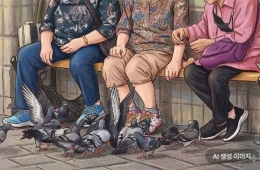
"Fines Up to 1 Million Won Ahead: Do Not Feed Pigeons... Seoul to Significantly Strengthen Enforcement"
Intensive Enforcement and Fines in Ban Zones Throughout June
38 Locations, Including Parks, Designated as No-Feeding Areas
940 On-Site Warnings Issued and Public Awareness Efforts Strengthened
Starting in June, the Seoul Metropolitan Government will significantly strengthen enforcement in no-feeding zones for feral pigeons. Anyone caught feeding feral pigeons in these restricted areas will face a fine of up to 1 million won.

According to the city government on May 29, this intensive crackdown will run throughout June, after which enforcement will shift to a regular inspection system. After approximately three months of on-site guidance and publicity, the city has been imposing fines for feeding pigeons in designated no-feeding zones since July 1 of last year.
Feral pigeons are birds that originally lived in mountainous and natural habitats. However, as they adapted to the urban environment and secured food sources, their habitats have expanded into city areas. The abundant provision of food by people has led to an increase in the urban pigeon population, aggravating problems with droppings and other issues affecting public hygiene and city aesthetics. In response, in April last year, the city designated and announced a total of 38 sites—including major parks and plazas such as Seoul Plaza, Gwanghwamun Square, Seoul Forest, and 11 districts of Hangang Park—as no-feeding zones for feral pigeons.
Until now, enforcement has focused more on raising awareness about the policy rather than imposing fines, with a total of 940 on-site guidance sessions carried out. Starting in June, the city plans to enforce more effective measures during this focused period, actively imposing fines as a means of direct enforcement.

After one year of operating these no-feeding zones, an analysis of civil complaints shows that the total number of complaints increased from 1,481 in 2024 to 1,658 in 2025, but complaints related to hygiene and living conditions have decreased. Notably, requests for stricter enforcement and the designation of additional no-feeding zones soared from 15 to 910, indicating that public awareness of the policy is spreading and that the measure is seen as effective in reducing inconveniences such as droppings and noise.
Feeding pigeons is the main cause of increased pigeon populations and dense gatherings, which result in droppings, foul odors, noise, and the contamination of public facilities, causing inconvenience to citizens. In Seoul’s no-feeding zones, fines of 200,000 won for the first offense, 500,000 won for the second, and up to 1 million won for three or more offenses will be imposed. In addition to the city government, more district offices are independently designating and managing no-feeding zones, especially in children's parks and neighborhood parks.
Besides pigeons, large-billed crows are also appearing more frequently in urban areas due to citizens feeding them and poor management of food waste. From May to July, when young large-billed crows leave their nests, the mother crows become much more aggressive. As such, if you hear the sound of large-billed crows, it is important not to feed them and to avoid contact by taking a detour, as this can help prevent dangerous encounters.
Hot Picks Today
 "What Will Retail Investors Do With No Ammo Left?... Samsung Electronics and SK Hynix See Another Rosy Outlook"
- "Switching from Stocks to Savings?"... Up to 19.4% Annual Interest Rate Offered from June 22
- [Exclusive] Bought for 16.6 Billion Won from Kang Hodong, Sold to Noh Hongchul for 15.2 Billion Won: Even Hotspots Become Loss Sales... Gangnam Small Buildings Face 'Tearful Discounts' [Real Estate AtoZ]
- "My Stocks Alone Crashing in a Bull Market? Turns Out... 82% Are in the Same Boat"
- Trump Urged "Buy Quickly"...Stock Soared 39% Overnight
Lee Changhoon, Director of the Natural Ecology Division of Seoul Metropolitan Government, stated, "The city is a space where people and animals live together. Small actions, such as refraining from feeding wild animals and managing food waste, will help create a pleasant environment for citizens and a healthy ecological environment that reduces excessive dependence on humans among wild animals."
© The Asia Business Daily(www.asiae.co.kr). All rights reserved.