"Calls for Bipartisan Cooperation for the Nation" Early Voting Day Heats Up More Than the Weather
Voting Sites Open in Jongno, Yeongdeungpo, Mapo, and Gangnam
"Supporting My Party" — Will Key Battlegrounds Decide the Outcome?
Voters Over 90 Also Cast Their Ballots "For the Country"
Confusion Over Superintendent Race With No Party
"After the election, I hope that both the ruling and opposition parties will work together and lead the country well."

On the morning of the 29th, citizens who finished voting at Sajik-dong Community Center in Jongno-gu, Seoul, are taking certification photos. Photo by Hosu Park
View original imageOn the first day of early voting for the 9th Nationwide Local Elections, at around 6 a.m. on the 29th, Choi Wonsup (57), who was the first to vote at the Sajik-dong Community Center in Jongno-gu, Seoul—often referred to as the "No.1 Political District"—said, "I hope as many citizens as possible participate so that the will of the people is reflected in politics without distortion." Living in Singapore as an overseas Korean, he added, "I closely follow Korean politics even when I'm abroad," and shared, "I even postponed my schedule just to make sure I could vote."
From early in the morning, citizens eager to cast their valuable votes flocked to early voting stations set up across Seoul. The early voting rate for local elections has reached record highs with each passing election. According to the National Election Commission, the early voting rates for past local elections have steadily increased: 11.5% for the 6th election, 20.1% for the 7th, and 20.6% for the 8th. As of 10 a.m. on this day, the early voting rate was recorded at 2.7%.

On the morning of the 29th, a long line of citizens waiting to cast their early votes stretched outside the Sajik-dong Community Center in Jongno-gu, Seoul. Photo by Hosoo Park
View original imageAt the Daerim 2-dong Community Center in Yeongdeungpo-gu, Kim (58), a tax accountant who was the first to vote, also called for political cooperation for the country’s development. Kim, who has never missed a single vote in his life, said, "There have been national crises, but we have overcome them, and even the KOSPI is now reaching 7,000 to 8,000," adding, "I hope the political community will work to overcome our dark past and help Korea leap into a new future."
Go (46), who cast the first ballot at the Yeoksam 1-dong Community Center in Gangnam-gu, also urged politicians to demonstrate a responsible attitude. Go said, "I came here to express my hope that politicians will not just talk about communication, but actually show a sense of responsibility," and added, "Even if mistakes or accidents happen in the process of doing their best, if they show accountability and provide a clear direction, things will improve."

On the morning of the 29th, a long line of citizens waiting to vote early stretched outside the Yeoksam 1-dong Community Center in Gangnam-gu, Seoul. Photo by Jaehyun Park
View original imageThe active political participation of elderly citizens, transcending generations, was also notable. Lee (94), dressed in a neat suit, visited the Sajik-dong Community Center. Although he had difficulty hearing, he calmly entered the polling station with the guidance of staff. After voting, Lee said emphatically, "I got up at 3 a.m. to prepare. As a citizen, it is only natural to cast my vote." Han (87), who headed to the Daerim 2-dong Community Center with a cane, also said, "I have aches everywhere, but I came to vote for our country," urging, "Politicians should stop fighting and biting each other and instead unite and work together for the nation."
The 2030 generation focused more on policies than ideology. Shin Jeyun (21), a university student who visited the Yeoksam 1-dong Community Center, said, "I came out to vote because my older sister told me that every citizen should vote," and added, "I chose a candidate who can deliver good policies for youth, such as housing and welfare." Kang (34), whom we met at the Daehung-dong Community Center in Mapo-gu, also emphasized, "I believe local elections are very important because they can have a direct impact on my life through policy."

On the morning of the 29th, Mr. Kim (58, center), who participated in early voting for the first time, is entering the polling station at Daerim 2-dong Community Center in Yeongdeungpo-gu, Seoul. Photo by Ji-Ye Lee
View original imageIn some regions, traces of ongoing political conflict since the 12·3 Martial Law period were also apparent. Distrust in early voting due to claims of election fraud and dissatisfaction over foreign voting rights surfaced. Park (59), whom we met in Daerim 2-dong, passionately argued, "Younger people may not know, but I believe there is a lot of fraud in early voting."
A Chinese-Korean resident A (59), who said he has lived in Korea for 25 years, stated, "Even though I have voting rights, the atmosphere is sensitive, so I can't reveal my name," and added, "I cast my vote for a party that pays attention to the concerns of ordinary citizens." Foreigners who have held a permanent residency visa for more than three years are permitted to vote in local elections.
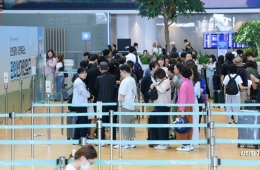
Early voting takes place over two days from this date, running for 12 hours each day from 6 a.m. The lines, which had been manageable earlier, began to grow more crowded as the workday approached. There were also many voters from outside the district. Lee Sunwoo (25), who is originally from Gangwon Province, said, "Even though I am currently in Seoul for my studies, I came to support my favored party."
Hot Picks Today
 "Switching from Stocks to Savings?"... Up to 19.4% Annual Interest Rate Offered from June 22
- "What Will Retail Investors Do With No Ammo Left?... Samsung Electronics and SK Hynix See Another Rosy Outlook"
- "Please Don't Try This at Home": Doctors Alarmed by Controversial Habit and the Reason Behind the Outcry
- "Volunteers Line Up to Serve: 5,000 Apply for Military Service in France, with 20% Women"
- "Adult or Minor?"... UK to Introduce Facial Recognition AI as Abuse Increases
Due to the unique nature of local elections, where there are many candidates to vote for, some confusion occurred. Kim Youngkyun (91) complained, "Why are there no candidate numbers in the superintendent of education election?" expressing confusion over the ballot. Although polling staff repeatedly explained, "Because it's about choosing someone for the children, it is not related to political parties," some complaints continued.
© The Asia Business Daily(www.asiae.co.kr). All rights reserved.