President Lee: "Aerospace, a New Foundation for Economy and Security"... Calls for Fostering Southern Aerospace Belt (Comprehensive)
"Significantly Strengthen Public-Private Cooperation to Foster a 'Korean Version of SpaceX'"
Calls for Advanced Dual-Use Engine and Civil Aircraft Development Based on KF-21 Technology
"Integrate Military Academies Swiftly"…Emphasizes Need for Re-education of Commanders
On May 28, President Lee Jae-myung announced his vision to foster the southern regions—including Gyeongnam and Jeonnam—as a comprehensive aerospace belt, framing the aerospace industry as a new foundation for both the economy and national security. Building on the successful launch of the Nuriho (KSLV-II) No. 4, President Lee presented the goal of elevating technology in launch vehicles, satellites, and ground equipment to the highest global standards and cultivating a private sector-led industrial ecosystem.

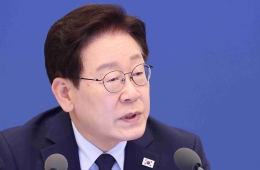
President Lee Jae-myung is presiding over the Senior Presidential Secretaries Meeting at the Blue House on May 28, 2026. Photo by Yonhap News Agency
View original imageDuring his opening remarks at the senior secretaries meeting held at the main building of the Blue House that afternoon, President Lee stated, "Aerospace is a future core strategic industry that encompasses cutting-edge scientific technologies such as artificial intelligence, semiconductors, telecommunications, materials, and precision machinery. Its growth potential is immense, and it is a sector attracting global interest," he said.
President Lee assessed that competition in the global aerospace industry has already shifted to a battle for leadership that involves both nations and private companies. He noted, "Not only major countries but also private companies like SpaceX are fully mobilizing to secure industrial leadership. This is the reality."
He stressed the need for bold investment in research and development. President Lee said, "Despite our late start, we have achieved significant results, such as the successful launch of the Nuriho (KSLV-II) No. 4 last November, which was prepared jointly by the public and private sectors." He added, "However, there is still a long way to go." President Lee continued, "Based on our achievements so far, we must further solidify our path toward becoming a global aerospace powerhouse. Through bold investment in R&D, we must quickly attain world-class technological capabilities across all related fields, including launch vehicles, satellites, and ground equipment."
He identified both the private sector and local regions as key players in the aerospace industry. President Lee said, "Another driving force in aerospace is the private sector and local regions," directing, "We must significantly strengthen public-private cooperation to foster a 'Korean version of SpaceX' and develop the southern regions, such as Gyeongnam and Jeonnam, which possess key infrastructure, into a comprehensive aerospace belt."
In the aviation sector, he also suggested expanding the technology accumulated during the development of the domestically-produced supersonic fighter jet KF-21 into the civil aviation industry. President Lee said, "It would be desirable to accelerate the development of dual-use advanced engines based on the technology acquired from the KF-21 project and to promote the development of civil aircraft. We will actively support aerospace as a new foundation for our economy and national security," he stated.
In the subsequent closed-door meeting, Kim Hyun-jong, First Deputy Director of the National Security Office, reported on strategies to strengthen national defense capabilities, measures for a swift transition to unmanned combat systems, and plans for reserve force innovation to prepare for future warfare scenarios in the context of the Middle East conflict, according to Chief Spokesperson Kang Yoo-jeong.
After receiving the report, President Lee called for the bold and swift integration of the Army, Navy, and Air Force academies. He also emphasized that as the military structure becomes less reliant on human resources, it is time for the weapons systems to evolve as well.
Hot Picks Today
 There Was a Real "Money-Making Machine" Soaring 538%... A Large-Cap Stock Outperformed Samsung and SK hynix
- "No Effect in Young People": Just Two Glasses a Day... The Juice That Controlled Blood Pressure in Older Adults in Two Weeks
- Women Enter Men's Restroom Due to Long Lines for Women's Restroom... "Wouldn't It Be Sexual Harassment If Men Did That?" Sparks Controversy
- "Running Like That Is Dangerous": UK Sees Surge in Injuries Among People in Their 20s Amid SNS-Driven Running Craze
- Busan's Signature Dish Named "World's Most Dangerous" by CNN: The Truth Behind the Korean Cuisine
President Lee stated, "Re-education in advanced weapons systems is essential for military commanders," adding, "While changes to material structures are relatively easy, changes to human structures are more difficult. Therefore, please ensure thorough preparation in line with global shifts in defense posture." He also directed, "Monitor the speed and progress of advanced technology research such as small modular reactors (SMRs), and thoroughly prepare for the transformation of the Korean military’s combat systems and restructuring of the personnel structure."
© The Asia Business Daily(www.asiae.co.kr). All rights reserved.