Rate Hike Seen as Inevitable: "When, By How Much, and How Far?" Governor Shin Hyunsong Responds (Comprehensive 2nd Report)
"We could have raised rates this time,"
"Dot plot median at 3.00%" signals strong likelihood of hikes
Market leans toward "July hike and more than two increases this year"
"Robust growth expected next year... Implications must be considered"
Middle East tensions warrant caution, but additional hikes likely next year
"A freeze that feels like a hike." This was the market's reaction on May 28, after observing the Bank of Korea's Monetary Policy Committee base rate decision and the subsequent press conference. Although the rate was held steady at 2.50% per annum, the fact that there were two dissenting votes for a hike (to 2.75%), and that the majority of dots on the committee’s six-month conditional rate projection (the K dot plot) were at 3.00%, served as strong signals of a future rate increase. Additionally, comments from Bank of Korea Governor Shin Hyun-song—stating that "a rate hike could have happened this time" and that "for the first time, the path forward was clear without conflicting considerations in the rate decision"—further clarified this signal. The market interpreted the meeting as a de facto preview of a rate hike at the next decision in July and assessed that more than two rate hikes could occur within the year.

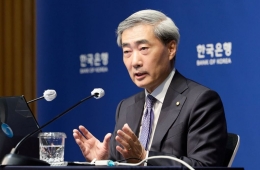
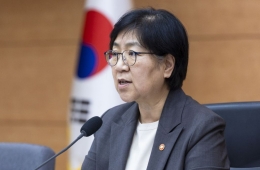
Shin Hyun-sung, Governor of the Bank of Korea, is answering reporters' questions during a press conference after the Monetary Policy Board meeting on the direction of monetary policy at the Bank of Korea in Jung-gu, Seoul, on the 28th. Bank of Korea
View original imageWhen, by how much, and how far will rates rise? "The answer lies in the dot plot"
Governor Shin commented on the timing and frequency of future rate hikes, saying, "We need to consider when to raise, how fast to raise, and how much to raise. I think the answers to these three questions can to some extent be found in this dot plot."
The Monetary Policy Committee judged that, under current conditions, the most likely scenario is that the policy rate will be raised to 3.00% by November, when the final rate decision of the year takes place. There is a high probability that two 0.25 percentage point hikes will occur within the year. According to the K dot plot, where all seven committee members each place three dots indicating their six-month conditional rate outlook (for a total of 21 dots), 10 dots (48%) indicated a policy rate of 3.00% in six months. Seven dots (33.3%) forecasted 2.75% in six months, while two dots projected 3.25%, which would be reached by three 0.25 percentage point hikes. Two dots indicated the rate would remain at the current level in six months.
The market interpreted this as a clear signal that a hike is likely in July. Yonggu Cho, a researcher at Shin Young Securities, said, "I originally expected the median of the dot plot to be 2.75%, but the fact that the majority are at 3.00% can be interpreted as a clear signal for a rate hike in July. I also believe the likelihood of two rate hikes this year has increased."

This year's growth rate at 2.6%: "Next year's growth will remain robust, and implications must be considered"
Governor Shin stated, "We project a fairly robust growth trend next year as well," adding, "When thinking about the level of rate hikes, we also need to consider the implications of this." In its revised economic outlook released on this day, the Bank of Korea raised its forecast for real gross domestic product (GDP) growth this year to 2.6%, up 0.6 percentage points from its previous projection, and its forecast for next year’s growth to 2.1%, an increase of 0.3 percentage points from the prior figure of 1.8%.
Commenting on this, Gongdong Lak, a researcher at Daishin Securities, said, "By forecasting next year’s growth at 2.1%, above the potential growth rate, they have also provided grounds for raising rates. In particular, Governor Shin clarified at the press conference that the upcoming rate hikes may not be a one-off, but could form a significant cycle."
There is analysis that the likelihood of additional hikes next year, not just this year, has also increased. Byunghoon Seok, economics professor at Ewha Womans University, said, "The policy rate needs to be above the neutral rate (2–3% as seen by the market) to rein in inflation. Since they cannot raise too quickly, their plan appears to be to hike twice within this year to reach 3%, the upper bound of the neutral rate, by November." He further projected that at least one more hike would be required next year to fully tame inflation.
Junwoo Park, a researcher at Hana Securities, said, "With growth sustained above the potential rate through next year and with rising oil prices, demand-side inflationary pressures are also expected to increase. I expect the pace of rate hikes to be faster than anticipated and revise my forecast to hikes in July and October this year and January next year."

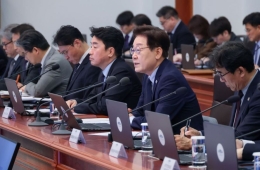
Shin Hyun-song, Governor of the Bank of Korea, attended the Monetary Policy Committee plenary session held at the Bank of Korea in Jung-gu, Seoul, on the morning of the 28th and struck the gavel. Photo by Joint Press Group
View original image"Middle East situation driving won weakness... Will not tolerate excessive FX volatility"
Governor Shin identified the Middle East situation as a key factor behind the recent depreciation of the Korean won. He said, "Exchange rates in countries that import large amounts of oil, such as Japan (yen) and India (rupee), are heavily influenced by oil prices. If the situation in the Middle East stabilizes quickly, I believe there is considerable room for the won to strengthen going forward."
Regarding the high exchange rate, which is fluctuating above 1,500 won, he stressed, "The exchange rate is a very important factor, not only for liquidity or financial stability, but also because it can fuel inflation through import prices, which is a key responsibility of the central bank." He continued, "Let me state clearly here: I will respond firmly to excessive exchange rate movements. I will not tolerate them. We have both the means and the determination to act."

Quarter 2 'positive growth' despite base effect from Q1... Current account surplus at USD 250 billion, double previous record
Meanwhile, the Bank of Korea forecasted that the Korean economy will grow by 0.2% in the second quarter compared to the previous quarter. The robust performance of semiconductor exports is expected to more than offset the base effect from the surprise 1.7% growth in the first quarter. The Bank also expects shocks from the Middle East to be cushioned by the government’s supplementary budget and corporate responses. While third quarter growth may slow to 0% due to production setbacks in certain industries stemming from global energy supply-demand imbalances, recovery is expected to resume in the fourth quarter as energy supply chains normalize (with a forecast of 0.4% growth).
The inflation outlook for this year was revised upward from 2.2% to 2.7%. This reflects not only a sharp rise in oil prices but also the assumption that high oil prices will gradually spill over to other items beyond petroleum, with a time lag. Core inflation is projected to rise by 2.4%, significantly above the previous forecast of 2.1%, as the impact of high oil prices spreads to industrial products and personal services in the second half.
Hot Picks Today
 "Just Two Glasses a Day Dramatically Lowered Blood Pressure... The Juice That Controlled Seniors’ Blood Pressure in Two Weeks"
- Galaxy S26 Now "Free" Just Two Months After Release... Fierce Subsidy Battle Among Three Major Carriers
- There Was a Real "Money-Making Machine" Soaring 538%... A Large-Cap Stock Outperformed Samsung and SK hynix
- Women Enter Men's Restroom Due to Long Lines for Women's Restroom... "Wouldn't It Be Sexual Harassment If Men Did That?" Sparks Controversy
- After 'Needle', Now a 'Blade' Found in Bus Seat... Hong Kong Police Investigate Passenger Safety Threats
This year’s current account surplus is projected at USD 250 billion, a dramatic increase from the previous forecast of USD 170 billion, and nearly double last year’s record surplus of USD 123.1 billion. The Bank of Korea expects a surplus of USD 151.5 billion in the first half alone, surpassing last year’s annual figure, and, with an additional USD 98.5 billion in the second half, forecasts a total surplus of around USD 250 billion. The goods account surplus is projected to reach USD 267.2 billion, driven by stronger-than-expected growth in semiconductor exports.
© The Asia Business Daily(www.asiae.co.kr). All rights reserved.