[Q&A] Hyun-Song Shin: "Timely Rate Hike Needed... Path Is Clear When Considering Inflation, Growth, and Finance"
Bank of Korea's May Monetary Policy Briefing
"The Key Questions: When, How Fast, and How Far to Raise Rates"
"Exchange Rate Is Also Critical... We Will Not Tolerate Excessive Movements"
Hyun-Song Shin, Governor of the Bank of Korea, officially signaled the need for a future interest rate hike on May 28, stating, "When you look at inflation, growth rate, real estate, and the exchange rate, the path forward is relatively clear," adding, "We need to consider 'when to raise the rate,' 'how quickly to raise it,' and 'how far to raise it.'"
Following the Monetary Policy Committee's decision that morning to keep the base rate at 2.50% per annum, Governor Shin held a press conference and said, "The most challenging moments in monetary policy are when multiple objectives conflict, creating a dilemma about which direction to take. However, this time is exceptional," clarifying his remarks.
While the economic growth rate is now expected to exceed initial forecasts due to a semiconductor boom, the prolonged Middle East conflict has pushed up oil prices, leading to second-round effects such as rising inflation expectations and exchange rate volatility. As a result, a rate hike has become inevitable. According to the K-dot plot, a system where each of the seven Monetary Policy Committee members marks three dots indicating their projected interest rate levels six months ahead, 10 out of 21 dots (48%) predict a base rate of 3.00% in six months.
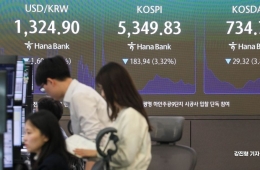
Governor Shin also reiterated a strong stance on the recent concentration of won-dollar exchange rate movement. While cautioning against excessive market interpretation of Policy Chief Yongbeom Kim’s remarks that high exchange rates, high oil prices, and high interest rates are "the inevitable costs of success as the Korean economy advances to a new level," Shin emphasized, "From the central bank’s perspective, the exchange rate is a critical factor, not only in terms of liquidity and financial stability, but also because it stimulates inflation through import prices. We will respond firmly to any pronounced exchange rate movements."
The following is a Q&A session.

Hyun-song Shin, Governor of the Bank of Korea, is attending the Monetary Policy Committee plenary session held at the Bank of Korea in Jung-gu, Seoul on the morning of the 28th and is striking the gavel. Photo by Joint Press Corps/20260528
View original image-Market expectations for two rate hikes within this year have increased. Did the committee discuss the timing or number of rate hikes at this meeting? What is the significance of the highest and median values in this dot plot?
▲Governor Shin = By way of background, we considered inflation and growth. In terms of finance, we looked at the exchange rate, household debt, and housing prices. If you break it down into three streams: inflation has been directly affected by rising oil prices due to the Middle East conflict, impacting consumer prices. There are also indirect effects, as oil is an intermediate good that influences the broader economy through the value chain, affecting prices of manufactured goods and services. The most important is the second-round effect: it stimulates inflation expectations and core inflation, impacting price formation, wages, and demand through multiple channels. For example, although core inflation in April was 2.2%, other indicators suggest there is significant inflationary pressure. Especially, the cost of living index, which comprises 140 frequently purchased items that most strongly affect perceived inflation, was 2.9% in April. The cost of living index can directly impact inflation expectations, and under such circumstances, I see upward pressure on inflation given the current economic situation and price trends. Second is growth. In the first quarter, growth was 1.7%—a very strong indicator. We forecast a growth rate of 2.6% for this year, assuming this trend will continue. If the Middle East conflict is resolved quickly, growth could exceed 2.6% this year. Growth remains robust. Third, in terms of finance, the exchange rate remains weak, and household debt is rising again. Usually, the most challenging part of policymaking is when objectives conflict, such as when you must pursue multiple goals that may move in different directions, creating a dilemma. This time, however, the path is relatively clear when considering inflation, growth, exchange rate, and real estate. The upcoming base rate hike will allow for consistent policy management. The key questions are when to raise, how quickly, and how far. Looking at the dot plot, you can see some answers to these questions. As you know, each committee member marks three dots, for a total of 21 dots from seven members. The flexibility of the K-dot plot system allows each member to express both their personal projections and their subjective uncertainty. The wide range in the plot reflects the high level of uncertainty in the current economic situation, which translates into significant individual uncertainty among committee members. Even within that range, the concrete approaches to implementation may differ, even if members share a similar understanding. The variation in the plot reflects the subjective uncertainty of each member.
--There were two dissenting opinions in today’s rate decision. Can you explain them in detail?
▲Governor Shin = As outlined by the three main streams previously mentioned, there was broad consensus among the committee. In fact, it was relatively easy to reach agreement. However, there were technical differences in how to implement policy. A persuasive case could have been made for raising the rate at this meeting as well. However, given the uncertainty, with the latest core inflation statistic being 2.2% in April and no more recent data available, the majority opinion was to place greater weight on uncertainty and observe further. Is there a risk? Of course, there is a chance that the Bank of Korea could miss the window to raise the base rate at the right time. However, in the current situation, we believe that waiting is still acceptable. The minority opinions were strategic differences within the overall consensus.
-The market currently sees the terminal rate at about 3.5%. What is your view on this consensus?
▲Governor Shin = It's still unclear. We do not know if the rate will reach 3.5%, remain below, or go higher. We will continue to review data and communicate accordingly.
-There are concerns about inflation in the monetary policy statement. When do you expect inflation to peak, and what is the biggest variable?
▲Governor Shin = Let me address the peak first. I expect inflation to reach its peak in the second half of this year, provided that policy is properly implemented. This is a judgment that incorporates our policy outlook. The biggest variable is the Middle East situation, which is crucial for inflation. For growth, the semiconductor cycle is a key factor.
-When will the GDP gap turn positive?
▲Governor Shin = We expect the GDP gap to turn positive next year.

-You projected a 2.6% growth rate for this year. Do you view this as a temporary or structural increase? Could you comment on the growth and inflation impacts under different scenarios, and your thoughts on the argument that Samsung Electronics' semiconductor bonuses are boosting inflation and leading to higher interest rates?
▲Governor Shin = The first quarter statistics are highly informative. For example, in the first quarter, GDP grew by 3.6%, while gross domestic income (GDI) grew by 12.3%. These typically move together. The high GDI means that international prices were high, even for the same level of output. The question of whether this is a temporary or lasting phenomenon essentially asks how long the current semiconductor cycle will continue. Given price trends, high prices could be sustained. The upward adjustment to the economic growth rate reflects the view that this will last for a considerable period, rather than being a temporary phenomenon. In terms of growth and inflation impacts under different scenarios, the key variables are how quickly the Middle East conflict is resolved and how soon oil prices come down, both of which remain uncertain. Even if the war were to end today, oil production cannot be resumed instantly, so oil prices are likely to remain high for some time. We are considering a range of possibilities, but our baseline assumption is that by year-end, shipments through the Strait of Hormuz will reach 60% of last year’s level. However, uncertainty remains high. Regarding bonuses, the most important thing is labor-management agreement. As I said earlier, wages are crucial for sustainable growth. Looking at the components of GDP, consumption, facility investment, and construction investment are all robust, as are exports. If wages increase and boost purchasing power, this could also raise inflationary pressure. We will monitor this very closely. While labor-management agreement is important, it is also desirable to ensure that such agreements do not further exacerbate inequality, which remains a major issue in Korea.
-The bond market had priced in four rate hikes, and yields rose by 0.05 percentage points after the dot plot was released. What is your assessment? Are stabilization measures off the table during a rate hike cycle?
▲Governor Shin = International conditions are crucial for bond market yields. Although Korean government bond yields have risen slightly, this is a global phenomenon. The most important factor is the Middle East conflict. Inflation concerns are rising in major countries, and there are significant worries about fiscal conditions in some. Korean government bonds are moving in tandem. When constructing portfolios, investors include U.S., U.K., and Eurozone government bonds, and Korea can be included as well, which increases yields. The market’s minute-by-minute reactions reflect collective participant expectations, so major responses are not necessary. Market equilibrium should be maintained through agreements between buyers and sellers. Occasionally, the market becomes one-sided before a shock, which can cause damage. Intervention is needed only when the market mechanism fails, but that is not currently the case.
-The exchange rate not only exceeds 1,500 won but is also highly volatile. While foreign investors are selling in the stock market, what are the fundamental causes?
▲Governor Shin = The weak won can be attributed to Middle East developments. As you can feel day to day, risk aversion and market dynamics have a direct impact, especially in countries that import a lot of oil. This is also seen with the Japanese yen and Indian rupee. Countries that import oil are strongly affected by oil prices. Encouragingly, if the Middle East situation stabilizes, the won could strengthen.
-You mentioned that offshore non-deliverable forward (NDF) trading is shaking the spot market. How will you address this?
▲Governor Shin = NDF trading involves settling in dollars for contracts made offshore without direct access to dollars. NDF markets often involve anonymous trading, rather than the transparent transactions seen onshore within regulatory and governance frameworks. Sometimes the tail wags the dog—when NDF trades occur in offshore markets during Korean nighttime hours, they can influence the domestic market. When NDF positions are taken, hedging is needed, which affects the onshore market. In times of major financial market volatility, the small NDF market can impact the larger domestic DF market. The best solution is to promote internationalization of the won, bringing such transactions into the formal sector. This means that when trading in the won swap market, actual won should be secured and returned, increasing the scope and transparency of won usage. Rather than full market opening, the idea is to bring activity into areas where we can shine a light on it. Further development of the onshore DF market is needed.
-Policy Chief Yongbeom Kim said high exchange rates, high prices, and high interest rates are the costs of success during Korea’s economic leap. What is your view?
▲Governor Shin = I read Mr. Kim's Facebook post, and he made several important points. Some interpret this as condoning a weak won, but I did not read it that way. One factor behind the weak won is temporary liquidity trades as foreign investors rebalance and exit the stock market. While exchange rates are affected by liquidity, there is always an underlying value, so the effect is temporary. I interpret Mr. Kim’s remarks as reflecting the degree of foreign confidence in Korea through investment. External financial assets and debts represent foreign ownership stakes in Korea, not obligations for Korea to repay. Korea’s national wealth has grown, as has the value of foreign ownership. From the central bank’s perspective, however, the exchange rate is important not only for liquidity and financial stability, but also because it stimulates inflation via import prices. I want to make clear that we will respond firmly to pronounced exchange rate movements; we will not tolerate them. We have the tools, willingness, and various methods at our disposal, and we will act decisively if necessary.
-The KOSPI has surged from 4,000 at the start of the year to over 8,000, and real estate prices in central Seoul are rising. What is your view on asset price increases?
▲Governor Shin = It is true that stock prices have risen steeply, reflecting improved corporate performance. However, when prices rise rapidly in a short period, it can trigger behavioral changes in the market, such as an increase in leveraged investing ("debt-fueled investment"). Debt-financed investment can distort the normal demand curve, which typically slopes downward. With excessive leverage, falling prices do not prompt more buying, but rather trigger mechanical selling. This leads to forced liquidation and capital withdrawal, reversing the normal demand curve. When prices surge suddenly, the appeal of leveraged investment increases, making such phenomena more likely. While there are concerns about systemic risk in the market, it is important to consider the effect on other investors. If leveraged investment becomes widespread, even a small shock can lead to a large market correction, impacting those not engaged in leveraged investing. For now, I do not believe we are facing systemic risk, as further interlinkages would be needed. So far, the equity market can be viewed as a discrete market, with limited spillover effects.
Hot Picks Today
 He Left It in the Car and Forgot... "I Nearly Collapsed with Joy": Man Wins $1.48 Million Lottery
- Goldman Sachs Cuts KOSPI Target by 25%... "Excessive Pessimism, Still Attractive"
- "'Nodding Off' on the Subway? Here's Why Koreans Are Getting Even Less Sleep"
- "Please Pay Me at Least 3 Million Won a Month": More Than Half of Young People Today Prioritize "Working Conditions" Over Company Size
- Beachgoer Finds 'Plastic' That Turns Out to Be Perfume Ingredient Worth More Than Twice as Much as Gold
-What are the potential spillover effects on domestic demand and vulnerable borrowers if rates are raised preemptively?
▲Governor Shin = Monetary policy does not differentiate between economic agents. Issues related to vulnerable borrowers, income distribution, and financial inclusion are more effectively addressed with other policies. Additional measures and optimized policies are needed in fiscal policy, and the central bank will cooperate with other policy authorities.
© The Asia Business Daily. All rights reserved. Unauthorized AI training and use prohibited.