Minister Choi Hwee-young: "Redefining K-Culture... 400 Trillion Won Market Target for 2030"
Press Conference Marking the First Anniversary of the Sovereign Government Launch
"K-Culture Export Target Raised to 110 Billion Dollars"
"We will redefine the concept of K-Culture, and accordingly, we will raise the 2030 market size target for K-Culture from the previous 300 trillion won to 400 trillion won."
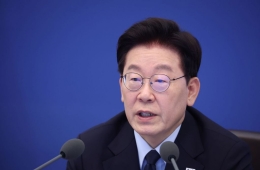
On May 28, Minister of Culture, Sports and Tourism Choi Huieong held a press conference at the National Museum of Modern and Contemporary Art Seoul in Jongno-gu, Seoul, to mark the first anniversary of the launch of the People's Sovereignty Government, emphasizing, "We will usher in the 400 trillion won era of K-Culture by 2030." This represents an increase of 100 trillion won from the 300 trillion won target he announced immediately after taking office in July last year.
Minister Choi explained that the reason for raising the target is "the result of newly defining the concept of K-Culture." He stated, "The newly defined scale of the K-Culture industry is much larger than we previously thought," and added, "Accordingly, we raised the target to 400 trillion won."

Minister of Culture, Sports and Tourism Choi Huieong explained the vision of "400 trillion won K-Culture by 2030" at a press conference marking the 1st anniversary of the launch of the People's Sovereignty Government held on the 28th at the National Museum of Modern and Contemporary Art in Jongno-gu, Seoul. Ministry of Culture, Sports and Tourism
View original imageAccording to the Ministry of Culture, Sports and Tourism, the conventional K-Culture industry was measured based on the content and arts industry sectors. Minister Choi emphasized that it is also necessary to include inbound tourism, K-Food, K-Beauty, and K-Fashion exports. He classified the existing content and arts industry sector as the "Cultural Creative Industry," and the newly included inbound tourism, K-Food, and others as the "Lifestyle Industry."
Minister Choi explained, "Recently, a significant portion of foreign tourists visiting Korea are attracted by K-Culture. Therefore, the foreign currency they spend in Korea should be seen as value added by K-Culture and should naturally be included as part of the K-Culture industry. However, this was previously left out of the statistics."
Minister Choi stated, "The same logic applies to K-Food, K-Beauty, and K-Fashion. While it may be an exaggeration to call the entire food, fashion, or beauty industries K-Culture, the export value of K-Food, K-Beauty, and K-Fashion should be considered a result of demand from foreigners attracted by K-Culture."
As a result of this redefinition of K-Culture, the industry scale has expanded significantly. Minister Choi said, "After redefining and recalculating, the provisional scale of the K-Culture industry last year stands at 274 trillion won. Under the previous 'Cultural Creative Industry' criteria, it was around 206 trillion won in 2023." The newly calculated 274 trillion won exceeds 90% of the previous 2030 target of 300 trillion won. In response, the Ministry of Culture, Sports and Tourism set the new 2030 target at 400 trillion won.
The export scale has also expanded dramatically. Based on the Cultural Creative Industry, last year’s K-Culture exports amounted to 14.9 billion dollars, but when including the Lifestyle Industry, this increases to 71.8 billion dollars. This is comparable to automobiles (72.0 billion dollars), which ranked second after semiconductors (173.4 billion dollars) among Korea’s export items last year. Accordingly, the Ministry has raised the 2030 K-Culture export target from 35 billion dollars to 110 billion dollars.
Minister Choi emphasized, "K-Culture is already one of Korea's core export industries," and added, "K-Culture is a much larger industry than we had previously imagined."

On the 28th, Choi Hwi-young, Minister of Culture, Sports and Tourism, stated at the press conference marking the first anniversary of the People's Sovereignty Government held at the National Museum of Modern and Contemporary Art Seoul in Jongno-gu, Seoul, "We will realize the 400 trillion won era of K-Culture by 2030." Ministry of Culture, Sports and Tourism
View original imageHowever, he noted that further discussion is needed on how to reflect the newly defined K-Culture in official government statistics. Minister Choi said, "Whether to include it in official industrial statistics or manage it as a separate statistic requires coordination with relevant ministries. The figures reflected this time are also being verified by the Korea Culture and Tourism Institute for accuracy." He continued, "As the very concept of K-Culture is being newly refined and expanded, we will continue to supplement and develop it going forward."
Minister Choi reiterated that becoming a cultural powerhouse is the vision of the People’s Sovereignty Government, and stressed his commitment to realizing attractive economic growth led by culture.
Hot Picks Today
 "A Shortcut to Ruining Your Health? I Never Buy These": 3 Foods a Doctor Warns Against
- "Female Teachers Must Wear Skirts in Class"... Outrage Erupts Over Principal's Demand: What's Happening in North Korea?
- "What Were You Doing When Investors Piled Into Samsung and SK hynix?" ... Renowned Foreign Anchor Slams Authorities Amid KOSPI Plunge
- "Meals are expensive, so give 150,000 won" "Are wedding gifts turning into meal payments?" In the era of 80,000-won wedding meals, guests feel pressured
- "The leggings are all see-through. It's so embarrassing to look at," complaints prompt Lululemon to fire development staff.
To this end, he stated, "We will thoroughly implement detailed policies to ensure the practical protection of artists' rights, and strengthen safety nets so that artists, who create social public goods, can focus on their creative work." He added, "We will spare no investment and support for basic arts, which are the foundation of our culture, and establish new talent training programs for young artists." Regarding tourism, Minister Choi said, "We will work to achieve the national goal of attracting 30 million inbound tourists by 2030 as early as possible." He also emphasized plans to bridge regional gaps, expand local cultural welfare, and lay the foundation so that all citizens can enjoy culture.
© The Asia Business Daily. All rights reserved. Unauthorized AI training and use prohibited.