Monetary Policy Committee Signals Possible Rate Hike: "Timing to Be Determined by Inflationary Pressures and Economic Improvement"
Full Statement from the May Monetary Policy Committee Meeting
After the Monetary Policy Committee of the Bank of Korea decided on May 28 to keep the base interest rate unchanged at 2.50% per annum, the committee stated, "Going forward, the direction of monetary policy will be determined by reviewing the extent of inflationary pressures, the trend of economic recovery, and the situation in financial stability, in order to decide on the timing of a rate hike."

Shin Hyun Song, Governor of the Bank of Korea, is attending the Monetary Policy Committee plenary meeting held at the Bank of Korea in Jung-gu, Seoul on the morning of the 28th, knocking the gavel. Photo by Joint Press Corps/20260528
View original imageThrough the statement released during the Monetary Policy Direction Meeting on the morning of the same day, the Monetary Policy Committee explained, "While inflationary pressures have increased due to the Middle East conflict, the growth rate is expanding more than expected thanks to strong exports, and risks to financial stability continue to persist." The committee added, "The phrase 'base rate hike' was included in this statement."
Regarding the background for freezing the rate, the committee explained, "Since uncertainties remain high with respect to the development and spillover effects of the Middle East situation, we determined it is appropriate to maintain the current base rate and further assess the trends and their impact on growth and inflation."
The committee assessed that the domestic economy is expected to see significant growth, driven by robust exports and increased investment led by the semiconductor sector, as well as continued solid consumption. The committee stated, "Although the effects of rising raw material prices and supply disruptions will somewhat expand going forward, the domestic economy will continue to improve thanks to a strong semiconductor cycle and supplementary budgets."
Regarding domestic prices, the committee noted that consumer price inflation rose sharply to 2.6% in April due to a significant increase in petroleum prices, and assessed that there is a high likelihood of further inflation going forward. The committee stated, "The upward trend in prices is expected to expand further as the spillover effect of rising international oil prices grows and demand-side pressures from income growth also increase." The committee also noted that "the path of inflation ahead is subject to considerable uncertainty, including movements in international oil prices and exchange rates, the degree of cost-push effects, and the effectiveness of government price stabilization measures."
On the financial and foreign exchange markets, the committee noted, "Yields on government bonds rose sharply due to concerns over domestic and global inflation and changing expectations regarding monetary policy." The committee added, "Stock prices have shown sharp fluctuations in response to developments in the Middle East, but continue to rise rapidly on expectations of improved corporate earnings." Housing prices in the Seoul metropolitan area have seen the upward trend accelerate, with expectations of further increases, and household loans have also seen a somewhat greater increase in housing-related lending, which warrants continued caution.
Accordingly, the committee stated, "Going forward, we will monitor the growth trend to ensure that inflation can stabilize at the target level in the medium term, while conducting monetary policy with continued attention to financial stability."
Meanwhile, of the committee members, five voted in favor of keeping the base rate unchanged, while Jang Yongseong and Yoo Sangdae (Vice Governor) expressed minority opinions, arguing for a rate hike to 2.75%.

Below is the full text of the Monetary Policy Direction Statement.
The Monetary Policy Committee has decided to maintain the Bank of Korea base rate at the current level of 2.50% until the next decision on the direction of monetary policy. While inflationary pressures have increased due to the Middle East conflict, the pace of growth is expanding more than expected thanks to robust exports, and risks to financial stability persist. However, as uncertainties regarding the development and spillover effects of the Middle East situation remain high, the committee judged that it is appropriate to maintain the current base rate and further assess the trends and their impact on growth and inflation.
Globally, despite increased investment in AI, growth is expected to slow due to higher energy and raw material prices and supply disruptions from the Middle East conflict. However, inflationary pressures are expected to expand significantly. In international financial markets, government bond yields rose sharply due to delays in negotiations between the U.S. and Iran and the potential shift in monetary policy stances of major economies, while the U.S. dollar strengthened. Stock prices rose sharply, reflecting expectations of increased demand for AI-related investment and strong corporate earnings. Going forward, global economic and financial market conditions are expected to be affected by developments in the Middle East, trends in AI investment, changes in the monetary and fiscal policies of major economies, and shifts in the global trade environment.
Domestically, the economy has seen significant growth driven by strong exports and increased investment centered on semiconductors, as well as solid consumption. Employment continued to rise, but the pace of job gains slowed, particularly in the service sector. Looking ahead, although the effects of rising raw material prices and supply disruptions are expected to somewhat increase, the domestic economy is likely to maintain its improving trend due to the favorable semiconductor cycle and supplementary budgets. As a result, this year's growth rate is expected to reach 2.6%, substantially exceeding the February projection of 2.0%. This growth trajectory is subject to substantial upside and downside risks related to the expansion of the semiconductor cycle, spillover effects on domestic demand, developments in the Middle East, and changes in the global trade environment.
Regarding domestic prices, consumer price inflation rose sharply to 2.6% in April due to a significant increase in petroleum prices, while core inflation (excluding food and energy) remained at 2.2%. Short-term inflation expectations among the general public were in the upper 2% range. The upward trend in prices is expected to expand further as the spillover effect of rising international oil prices grows and demand-side pressures from income growth also increase. Accordingly, this year’s consumer price and core inflation rates are projected to reach 2.7% and 2.4%, respectively—significantly exceeding the February projections of 2.2% and 2.1%. Going forward, the inflation path is subject to considerable uncertainty, including movements in international oil prices and exchange rates, the degree of cost-push effects, and the effectiveness of government price stabilization measures.
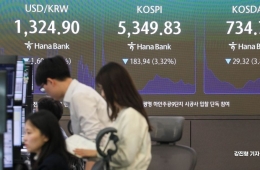
In the financial and foreign exchange markets, high volatility in major price variables has continued. Yields on government bonds rose sharply due to concerns over inflation at home and abroad and changing expectations regarding monetary policy. The won/dollar exchange rate, which had declined somewhat, rebounded to around 1,500 won due to the strong U.S. dollar and continued net selling of Korean stocks by foreign investors. Stock prices have shown sharp fluctuations in response to developments in the Middle East, but have continued to rise rapidly on expectations of improved corporate earnings. Housing prices in the Seoul metropolitan area have seen the upward trend accelerate, with expectations of further increases, while household loans have continued to grow moderately, with a somewhat greater increase in housing-related lending.
The Monetary Policy Committee will continue to monitor the growth trend to ensure that inflation can stabilize at the target level in the medium term, while conducting monetary policy with continued attention to financial stability. Inflation is expected to remain above the target level for a considerable period, and economic growth is likely to maintain a solid recovery thanks to the strong semiconductor cycle, despite the effects of the Middle East conflict. From the perspective of financial stability, continued attention is needed for the high volatility in the exchange rate, the housing market in the Seoul metropolitan area, and the household debt situation. Therefore, future monetary policy will be determined by reviewing the extent of inflationary pressures, the trend of economic recovery, and the situation in financial stability, in order to decide on the timing of a rate hike.
Hot Picks Today
 He Left It in the Car and Forgot... "I Nearly Collapsed with Joy": Man Wins $1.48 Million Lottery
- Goldman Sachs Cuts KOSPI Target by 25%... "Excessive Pessimism, Still Attractive"
- "'Nodding Off' on the Subway? Here's Why Koreans Are Getting Even Less Sleep"
- "Please Pay Me at Least 3 Million Won a Month": More Than Half of Young People Today Prioritize "Working Conditions" Over Company Size
- Beachgoer Finds 'Plastic' That Turns Out to Be Perfume Ingredient Worth More Than Twice as Much as Gold
Regarding this base rate decision, five members of the Monetary Policy Committee voted in favor of keeping the rate unchanged, while Jang Yongseong and Yoo Sangdae expressed the view that it would be desirable to raise the rate to 2.75%.
© The Asia Business Daily. All rights reserved. Unauthorized AI training and use prohibited.