Minister Kim Sung-hwan Emphasizes Combined Use of Renewables and Nuclear, Warns of Electricity Rate Pressure if Middle East Conflict Prolongs
"KEPCO Not in Deficit Yet, But Situation Under Close Watch"
Nationwide Expansion of 'Solar Income Villages' Planned
"All 38,000 Ri-Level Villages Under Review"
"Domestic Solar Modules Are Costlier, But Industry Must Be Sustained"

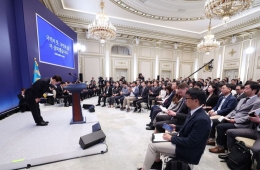
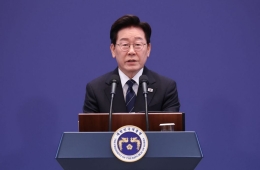
Kim Sung-hwan, Minister of Climate, Energy and Environment, is announcing the energy transition plan on April 6 at the Seoul Government Complex Annex in Jongno-gu, Seoul. 2026.4.6 Photo by Cho Yongjun
View original imageKim Sung-hwan, Minister of Climate Energy and Environment, stated that the government will confront both the Middle East-driven energy crisis and the climate crisis by adopting an "energy mix" strategy that combines renewable energy with nuclear power. Amid growing pressure to raise electricity rates due to the recent war in the Middle East, the plan is to prevent Korea Electric Power Corporation (KEPCO) from returning to a deficit and to avoid a steep hike in electricity bills by expanding renewables and utilizing nuclear power.
Appearing on the YouTube broadcast "Jang Yoon-seon's News Convenience Store" on May 28, Minister Kim said, "During the five years of the Moon Jae-in administration and the three years of the Yoon Suk-yeol administration, renewable energy and nuclear power have been at odds in a sort of zero-sum game, but such a confrontation makes it difficult to reduce coal and gas quickly." He emphasized, "The key is to use both renewables and nuclear power to reduce coal consumption and lay the groundwork for expanding renewable energy."
He also addressed the possibility of rising electricity rates due to the prolonged conflict in the Middle East. Minister Kim explained, "The system marginal price (SMP) for power generation used to be around 100 to 110 won before the Middle East war, but it has recently climbed to the mid-120 won range. If the average annual SMP exceeds 146 won, KEPCO could shift to a deficit." He continued, "For now, there are no signs of a deficit, but if high gas prices persist for a prolonged period, the risk cannot be ruled out. Our task is to minimize the use of coal and gas, and to expand nuclear and renewable energy so that electricity rates do not surge."
The government also plans to accelerate the transition to electric vehicles in the public sector. Minister Kim said, "Most new vehicle purchases by public institutions are now mandated to be electric vehicles. We are also preparing to convert special-purpose vehicles, such as police patrol cars and postal vehicles, to electric." He added, "We are discussing with the Ministry of Economy and Finance measures to encourage electric vehicle purchases by applying differentiated corporate tax benefits."
The 'Solar Income Village' project, a key energy policy of the Lee Jae-myung administration, will also be expanded. Minister Kim stated, "Initially, we considered creating 2,500 villages during the term, but the President has asked us to review the possibility of including all 38,000 ri-level villages nationwide. This year, we plan to conduct pilot projects in 700 to 1,000 villages."
Referring to the example of Guyang-ri in Yeoju, Gyeonggi Province, he said, "A 1MW-scale solar power facility provided monthly revenue of around 10 million won for the village. Residents are using this income for meals, transportation, and community activities." He emphasized, "This can become a new rural basic income model that links solar energy to residents' incomes."
Regarding the cost of renewables, Minister Kim noted, "The generation cost for solar and wind power has dropped significantly compared to the past. The settlement price for solar power is now around 120 won, and for wind power, it is down to 108 won." However, he pointed out that domestic industry has been weakened by low-priced imports from China. He said, "During the three years of the Yoon Suk-yeol administration, the solar industry has nearly come to a halt, shrinking the domestic sector. Although Korean-made modules are about 20% more expensive, they account for only about 20% of total generation costs, so we must foster the domestic industry in parallel."
Minister Kim also revealed plans to expand urban renewable energy. He said, "The latest supplementary budget includes the 'veranda solar' project. Installing a 200 to 250W solar facility can reduce daytime electricity costs for air conditioners and refrigerators."
Hot Picks Today
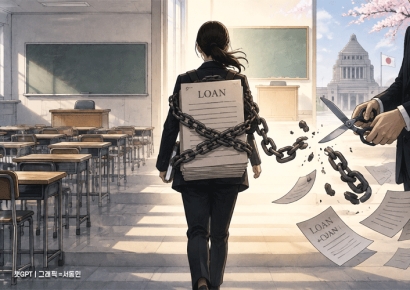 "If You Become a Teacher, You Don't Have to Repay Student Loans"... Japan Pulls Out 'Repayment Exemption' After 30 Years
- "How Little Do Koreans Read? Who Will Acquire Munhakdongne Now on the Market [Weekend Money]"
- "I'll Pay Cash for This Home"... Cash Purchases Rise and Loan Share Falls as Sub-1 Billion Won Listings Increase in China
- "If You Go Late, There Are No Seats; Crowds Gather Before Sunset"... The 'Yajang' Hotspots Drawing 20-Somethings These Days
- "Raised a Stray Kitten, but..." Scientific Community Stunned: First New Wild Cat Species Discovered in 100 Years
On environmental issues, he announced, "To address algal blooms in the Nakdong River, we will partially open the weirs as needed through a seasonal management system to ensure water flow." Regarding the lovebug problem, he said, "We are conducting a pilot test using biological agents at the larval stage, and we will evaluate the results this year to decide whether to expand the program starting next year."
© The Asia Business Daily. All rights reserved. Unauthorized AI training and use prohibited.