Bank of Korea Holds Rate Steady... Growth Forecast Sharply Raised to 2.6%, Inflation to 2.7% (Update)
Base Rate Held at 2.50% for Eighth Consecutive Time Since July Last Year
Growth Forecast Raised to 2.6% and Inflation to 2.7% for This Year
Stronger Signals of a Rate Hike: Rising Threats to Price Stability, Easing Economic Concerns
On May 28, the Monetary Policy Committee of the Bank of Korea decided to keep the base interest rate unchanged at 2.50% per annum. The committee stated that it needs to continue monitoring the prolonged impact of high oil prices resulting from the Middle East war. The economic growth forecast for this year was significantly raised to 2.6%. This adjustment reflects the expectation that the semiconductor supercycle will outweigh downward pressure factors and drive Korea's economic growth this year. The consumer price inflation forecast was also revised upward to 2.7%, taking into account the shock of persistently high oil prices due to the prolonged Middle East war and concerns about secondary ripple effects. Most experts believe that the base rate will be raised at the next interest rate decision in July.

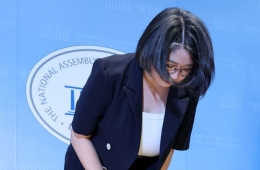
Shin Hyun-song, Governor of the Bank of Korea, is attending the Monetary Policy Committee plenary meeting held at the Bank of Korea in Jung-gu, Seoul on the morning of the 28th, striking the gavel. Photo by the Joint Press Corps
View original imageThe Monetary Policy Committee announced that it would maintain the base rate at 2.50% per annum at the monetary policy direction meeting held at the Bank of Korea's main building in Jung-gu, Seoul, on this day. This rate freeze marks the eighth consecutive decision, following those in July, August, October, and November last year, as well as January, February, and April this year. The result is in line with market expectations. In a previous survey conducted by The Asia Business Daily, all 13 respondents predicted a rate freeze this month. The committee concluded that, given the persistent uncertainty surrounding the Middle East war, and the depth of concerns about prolonged high oil prices varying depending on the war situation, it would be appropriate to maintain the rate and continue monitoring the situation.
However, the likelihood of a rate hike in the near future has increased. This is because threats to price stability—which is the Bank of Korea's top priority—have grown, while concerns about the economy that might have deterred a rate hike have been significantly alleviated. In its revised economic outlook released on this day, the Bank of Korea raised its forecast for consumer price inflation this year to 2.7%. The growth forecast for this year (2.6%) was also revised upward significantly from the previous forecast (2.0%), reflecting the 'semiconductor effect.' The committee is expected to send a strong signal of a future hike through the soon-to-be-released K-dot plot—conditional interest rate forecasts by committee members for the next six months—and Governor Shin Hyun-song's press briefing following the meeting.
The situation remains unstable in terms of financial stability as well. The continued weakness of the won and the overheating of the real estate market in the Seoul metropolitan area are key factors. Earlier this month, the won-dollar exchange rate, which had hovered around the 1,450-won level, surpassed 1,500 won again on May 15, based on the weekly closing price. On May 22, just before the weekly close, a surge in dollar-buying by foreign investors selling securities pushed the rate as high as 1,517.2 won. Housing prices are also acting as a source of instability. According to the Korea Real Estate Board, in the third week of May, apartment sale prices in Seoul rose by an average of 0.31% compared to the previous week, marking the third consecutive week of expanding increases.
Hot Picks Today
!["Don't Use Chinese-Made Products": One U.S. Warning Triggers a 5 Trillion Won Jackpot for Korean Batteries [Weekend Money]](https://cwcontent.asiae.co.kr/asiaresize/93/2025121709393659037_1765931975.jpg) "Don't Use Chinese-Made Products": One U.S. Warning Triggers a 5 Trillion Won Jackpot for Korean Batteries [Weekend Money]
"Don't Use Chinese-Made Products": One U.S. Warning Triggers a 5 Trillion Won Jackpot for Korean Batteries [Weekend Money]
- "Dividend Payouts of 40 Million Won Before Their First Birthday"...'Baby Shareholders' Put Ordinary Workers at a Disadvantage
- "Planning a Trip to Japan?"... Accelerating Yen Strength [Weekend Money]
- Men in Their 20s and 30s Who Struggled with Dating Are Heading to Japan: "Virtual Matchmaking First, Then Start Dating"
- Foreign Tourists Leave in Tears Praising Seoul: "Wi-Fi So Fast, My Fingers Can't Keep Up" [K-holic]
The prevailing view in the market is that the base rate will be raised in July. There is growing support for the forecast that the rate will be raised twice this year, each time by 0.25 percentage points, reaching 3.00%. The main reasons are the heightened inflation concerns stemming from the Middle East war and the fact that expectations for a rate increase within the year have already been largely priced in by the market. Therefore, there is little reason to wait until after August to begin raising rates. Yoonmin Baek, a researcher at Kyobo Securities, pointed out, "If the goal is to curb expected inflation, an earlier rate hike would likely be more effective."
© The Asia Business Daily. All rights reserved. Unauthorized AI training and use prohibited.


![[Breaking] Party and Government Consider Renaming 'Judiciary Control Division' to 'Non-Indictment Case Review Division'](https://cwcontent.asiae.co.kr/asiaresize/307/2026091316513726167_1789285898.jpg)